
Strategy decks describe the country we wish we lived in.
Operations describe the one we actually do.
The gap between the two has a name. Carl von Clausewitz called it Reibung — friction — and he was the first European theorist to insist that this gap was not a defect to be apologised for, but the defining feature of the world the strategist actually operates in. Two centuries later, most strategy reviews still treat it as an embarrassment. It is not. It is the job.
“Everything is very simple in War, but the simplest thing is difficult.”
— Carl von Clausewitz, On War, Bk. I, Ch. VII, trans. Col. J. J. Graham (1873)
Clausewitz drafted Vom Kriege between 1816 and his death in 1831 (with partial revisions through 1830), and the book was published posthumously in 1832 by his widow Marie. Two centuries later, the part of his argument that has been least absorbed is also the part the modern strategist most needs.
That sentence is the most under-quoted line in the entire strategic canon. It is also the one most quarterly reviews would benefit from printing on the cover of every plan they wave at it.
A note on translation. All Clausewitz quotations in this post are from the 1873 English translation by Colonel J. J. Graham, available in the public domain via Project Gutenberg #1946. Howard & Paret’s 1976 Princeton translation is more polished, but it is copyrighted; Graham’s wording is what is open and verifiable to a primary URL. Citations follow the form Bk. I, Ch. VII (Book One, Chapter Seven).
What Clausewitz Means by Friction (Reibung)
The temptation, when you read Clausewitz on friction, is to assume he is talking about competence. People who do their jobs poorly. Plans that are too detailed. Bureaucracies that move slowly. Get the right people, build the right org chart, hold the right meetings, and friction goes away.
This is the opposite of what he is saying. Friction, in Clausewitz’s frame, is structural. It does not come from the people in the room. It comes from the world the room sits inside.
“Friction is the only conception which in a general way corresponds to that which distinguishes real War from War on paper.”
— On War, Bk. I, Ch. VII (Graham 1873)
Read that sentence with the modern translation in mind: friction is what makes the real thing different from the document. It is the residue between what was written down and what is happening. The plan does not care that the road is muddy. The slide does not care that the integration partner just renegotiated a clause. The PowerPoint is not the territory, and the gap between the two is what Clausewitz named.
His most famous illustration is a traveller — written in the era of post-horses, but the geometry is timeless:
“Suppose now a traveller, who towards evening expects to accomplish the two stages at the end of his day’s journey, four or five leagues, with post-horses, on the high road—it is nothing. He arrives now at the last station but one, finds no horses, or very bad ones; then a hilly country, bad roads; it is a dark night, and he is glad when, after a great deal of trouble, he reaches the next station, and finds there some miserable accommodation. So in War, through the influence of an infinity of petty circumstances, which cannot properly be described on paper, things disappoint us, and we fall short of the mark.”
— On War, Bk. I, Ch. VII (Graham 1873)
The phrase that does the work is “an infinity of petty circumstances, which cannot properly be described on paper.” Each circumstance, taken alone, is trivial. The horses are tired. The road is bad. The accommodation is poor. None of these would justify scrapping the journey if you had only had to deal with one. The damage is in the aggregate. The damage is in the fact that they all happen on the same day, to the same traveller, with the same finite reserves.
This is the core insight, and most modern strategy teaching misses it. Friction is not the failure of any single component. It is the cost of being one finite system trying to do many imperfect things in sequence. The remedy is not better individual components. The remedy is a strategy that already assumes it will not get clean inputs.
Compare this to the kind of reasoning that produces a five-year plan. The plan begins by assuming clean roads, fresh horses, and visible terrain. Each step is “simple” — Clausewitz’s word — and so the plan, on paper, is also simple. But “the simplest thing is difficult” is not a complaint about subordinates. It is a description of physics. Once you stack enough simple things, the difficulty does not just appear. It compounds.
That is what the next section is about.
The Compound Effect: Why Small Failures Cascade
There is a piece of arithmetic that should appear in every operations classroom and almost never does.
Take a process — a strategy execution, a launch, a campaign — that has fifteen sequential steps. Each step has a 95% chance of going right. By any single-step standard, that is a very reliable process. Five percent failure is the kind of number a programme manager would proudly report.
Now ask the more honest question: what is the chance the whole sequence succeeds?
The answer is 0.95 to the fifteenth power — about 46%.
Below 50%. A coin flip.
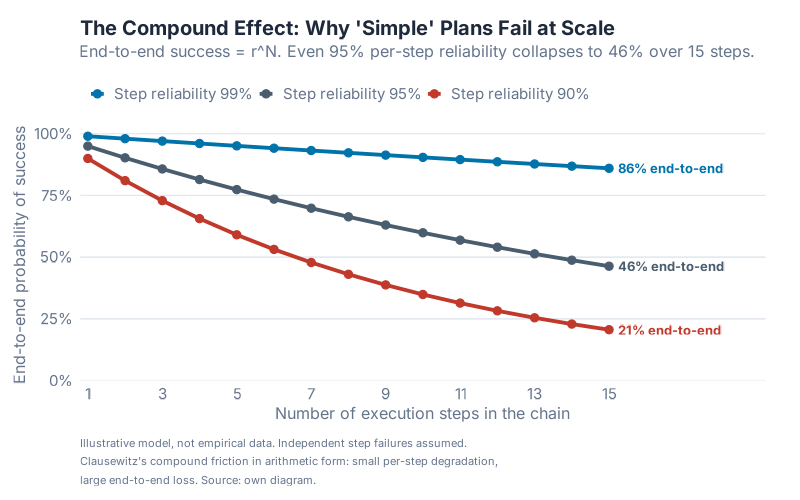
The chart above is illustrative, not empirical, but the arithmetic is hard. At per-step reliability of 99% — extraordinary by any standard — fifteen sequential steps still drop end-to-end success to 86%. At 95% you land at 46%. At 90% — still a passing grade on any individual review — you finish at 21%. Each curve bends because friction does not add. It multiplies.
This is what Clausewitz was describing two centuries before the math was formalised. An infinity of petty circumstances. Each step degrades the capacity of the next. The traveller who arrives at the last post-station already tired, in the dark, on a bad road, with worse horses, is precisely the system whose failure modes compound. That is the geometry the chart shows.
The case against optimism, in operations, is not pessimism. It is multiplication.
Market Garden: A Plan That Did Not Survive the Road Network
The canonical historical case is Operation Market Garden, 17–25 September 1944. Field Marshal Bernard Montgomery’s plan to seize a sequence of bridges and drive XXX Corps to Arnhem was technically elegant. Each individual step was simple — by Clausewitz’s exact definition. The compound failure came from the sort of “infinity of petty circumstances” the On War chapter could have been written to describe:
- Radios with a 3- to 5-mile effective range deployed across a 15-mile geography.
- Aircrews unwilling to overfly known flak corridors, scattering the airborne drops.
- Intelligence about two SS Panzer divisions in the Arnhem area that was discounted in the planning phase.
- A single causeway road — Hell’s Highway — as the only ground route.
- Weather that closed in over the resupply window.
No one of those, in isolation, would have sunk the operation. Their compound effect did. The British 1st Airborne Division began the operation with roughly 10,000 men. About 8,000 of them were killed, captured, or missing by the time it ended. Market Garden was a perfectly engineered plan that did not survive contact with weather, radios, and a Dutch road network.
The Clausewitzian read of that disaster is not that the planners were stupid. They were not. The plan was admired in the abstract for years afterwards. The Clausewitzian read is that the plan refused to budget for friction — and friction does not honour the planner’s refusal.
His warning to the strategist who responds to compound friction with sheer stubbornness is unsparing:
“A powerful iron will overcomes this friction; it crushes the obstacles, but certainly the machine along with them.”
— On War, Bk. I, Ch. VII (Graham 1873)
Iron will, in his view, is not a substitute for designing for friction. It is the cost of not having designed for it. The obstacles get crushed; the machine breaks. The shareholder version of the same sentence is a leadership team that hits the quarter at the price of an organisation it spends the next two years rebuilding.
Friction in Organisations
The widely cited “seventy percent of strategies fail” figure is folklore.
The line traces back to John Kotter’s Leading Change (1996). It has been quoted into every consulting deck since. Kotter never published the dataset behind it. Mark Hughes’ 2011 paper in the Journal of Change Management — “Do 70 Per Cent of All Organizational Change Initiatives Really Fail?” — is the most thorough audit of the claim, and concluded that the figure has no peer-reviewed empirical foundation. It is a number that travelled because it sounded right, not because it was measured.
The most rigorous attempt to actually put a number on strategy-implementation failure is Bridges Business Consultancy’s Strategy Implementation Survey, first run in 2002 and repeated in 2016. The 2016 wave surveyed 144 senior leaders (92% C-suite) across 38 organisations in 18 countries. It found that 67% of strategies failed to be successfully implemented — down from 90% in the 2002 baseline. The top three causes named by the 2016 leaders: poor communication, lack of leadership, and using the wrong measures.
Three observations follow.
First, the real number is bad enough that the folklore version is unnecessary. Two-thirds of strategies failing in implementation is, by any honest reading, the dominant outcome. You do not need to inflate it.
Second, the improvement from 90% to 67% in fourteen years is worth pausing on. It says strategy execution is not an unsolvable problem — organisations actually got better at it — but that the residue is structural. There is a friction floor below which organisational execution does not seem to drop, and we are still some distance above it.
Third, and most important: every one of the 2016 leaders’ top three failure causes — communication, leadership, measurement — is a friction problem in Clausewitz’s exact sense. None of them is a defect of any single component. They are all gap problems between layers of the organisation.
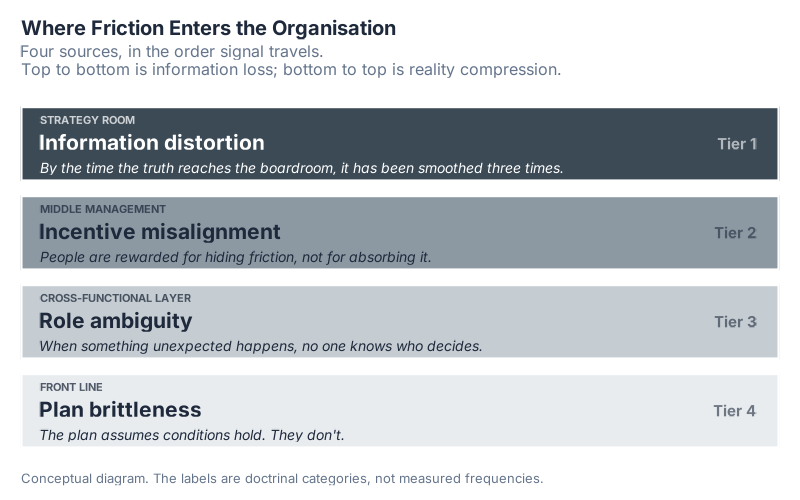
The diagram above maps friction to the place it lives. The strategy room produces a clean plan. Middle management translates that plan into projects. The cross-functional layer reconciles those projects against budget, headcount, and dependencies. The front line executes against whatever finally arrives.
At each gap, a different friction source operates:
- Strategy room → middle management: information distortion. What gets said in the boardroom is not what gets heard one layer down. Acronyms drop their context. Conditional language (“we’d like to explore”) gets recoded as commitment (“we are launching”). Trade-offs that were obvious in the strategy room arrive at the next layer as a fait accompli.
- Middle management → cross-functional: incentive misalignment. Two managers each carry a clear and reasonable target. The targets do not, between them, add up to the strategy. The cross-functional layer is the first place where this becomes visible — and the last place that has the authority to fix it.
- Cross-functional → front line: role ambiguity. Whose decision is this? The integration of three product owners’ priorities into one front-line workflow is rarely done explicitly. Front-line staff resolve the ambiguity locally, by instinct, in the way that minimises personal risk. Aggregate that across a thousand decisions and the strategy has been quietly rewritten.
- Front line → reality: plan brittleness. The plan made assumptions about customers, suppliers, and timelines that the world declines to honour. The front line absorbs the difference. The plan does not get updated; the people do.
Every one of these is structural. None of them is solved by hiring better people. All of them are what Clausewitz meant by friction.
A Contemporary Reading: The 737 MAX as Organisational Friction
If a modern case is needed to make the architecture visible, the Boeing 737 MAX programme between roughly 2011 and 2019 is a textbook example of compound organisational friction rather than of engineering incompetence. Each individual decision was defensible inside the silo that owned it: re-engine an existing airframe to compete with the Airbus A320neo, position the larger engines further forward and higher on the wing, add MCAS to compensate for the resulting pitch tendency, depend on a single angle-of-attack sensor without redundancy, omit MCAS from pilot training material to preserve the common type rating.
The compound effect was Lion Air Flight 610 (29 October 2018, 189 fatalities) and Ethiopian Airlines Flight 302 (10 March 2019, 157 fatalities) — 346 deaths in total, and a 20-month worldwide grounding of the type.
The FAA’s 2022 Summary of the FAA’s Review of the Boeing 737 MAX reads, in its specifics, like a Clausewitzian account of an organisation that had become structurally incapable of letting friction signals reach the room where they could be acted on. The individuals were competent. The system had stopped absorbing friction; it had started suppressing it.
That is the friction problem in its sharpest modern form, and no amount of personal “iron will” inside the programme would have fixed it. The machine would have been crushed first.
Designing for Friction: Auftragstaktik and Mission Command
If friction is structural, the strategic question changes.
It is no longer “how do we eliminate friction?” — that question has no answer. It becomes “how do we design an organisation that absorbs friction without breaking?” That is a different problem. It has been answered.
The answer’s name is Auftragstaktik — mission-type tactics. It emerged from the Prussian military reforms after the catastrophe of Jena-Auerstedt (1806), when Napoleon tore the centralised Prussian command apart in a single morning. The reformers — Scharnhorst, Gneisenau, and the young Clausewitz himself — concluded what the next century would confirm: centralised command cannot react fast enough to the friction it encounters. The nervous system is too slow. The information is too stale. By the time the order arrives, the situation it was issued for no longer exists.
Auftragstaktik’s reply is an inversion. Commanders specify intent — what is to be achieved and why — and grant subordinates the authority to choose method. Subordinates know more about the local terrain than headquarters does. Centralised orders make worse decisions than decentralised execution against a clear intent.
Helmuth von Moltke the Elder, Chief of the Prussian (later German) General Staff from 1857 to 1888, institutionalised the doctrine. Daniel Hughes’ 1993 anthology of Moltke’s writings argues that Moltke translated Clausewitz’s philosophical insight about friction into a concrete operational doctrine: friction is constant, central command is slow, therefore subordinates must be empowered to act on intent.
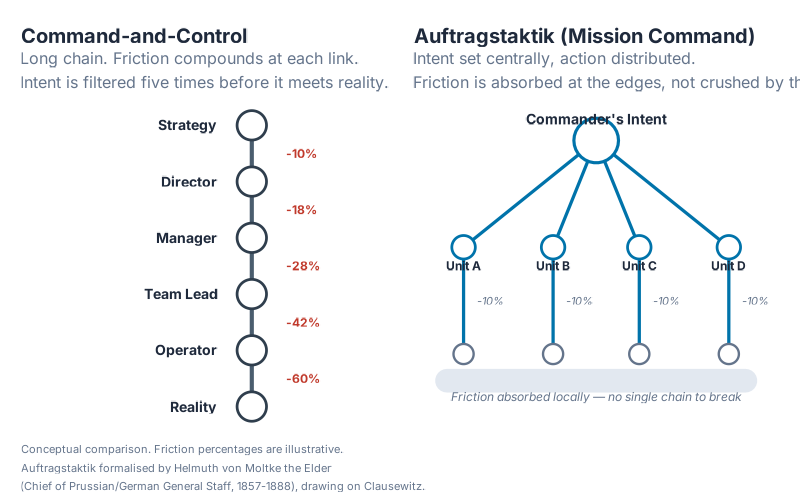
In a command-and-control chain, friction accumulates link by link as orders pass down — by the time the front line receives the directive, a substantial fraction of the original intent has been ground away. In an Auftragstaktik fan-out, intent is set once at the top and parallel units act against it directly, absorbing friction at the edges where it actually occurs. The first geometry compounds friction. The second distributes it.
Apollo 13: Iron Will With the Machine Intact
The civilian counterpart of Auftragstaktik most readers will recognise is the Apollo 13 mission, 11–17 April 1970. The lunar landing was scrapped on day two when an oxygen tank ruptured mid-flight; three astronauts in a Lunar Module rated for two had to survive the return to Earth. They did. The CO₂-scrubber improvisation — duct tape, sock fabric, an FDF binder cover, plastic bags from the Lunar Module, suit hoses — has become the canonical image of the rescue.
It is tempting, watching the Apollo 13 film, to ascribe the survival to individual heroism — Gene Kranz’s resolve, Jim Lovell’s calm, the engineers’ brilliance with a duct-taped CO₂ scrubber. Those things were real. They were not, however, where the survival came from.
The survival came from the system. Years before the flight, Mission Control had run simulator exercises that injected cascading anomalies an instructor could later defend as physically possible. The “lifeboat” procedure for using the Lunar Module as a refuge had been explicitly written. Decentralised problem-solving authority was the norm in the back rooms. Engineers built the improvised CO₂ scrubber adapter from materials that were already on the spacecraft because the culture expected them to improvise from what was on hand.
Apollo 13 is what Clausewitz’s iron will looks like with the machine intact. Friction was absorbed by design, not crushed by personality. That is the difference between a system that has trained for friction and one that has only steeled itself against it.
The modern military descendant of Auftragstaktik is mission command (US Army Doctrine Publication 6-0; British Army equivalent). The civilian-business descendant is the intent-based school of management. Stephen Bungay’s The Art of Action (2011) traces it back to Moltke explicitly: leaders set intent and the conditions for action; subordinates choose method.
A note for the OKR enthusiasts: OKRs are not Auftragstaktik. Andy Grove was reading Drucker, not Moltke. OKRs can serve as a vehicle for intent-based execution, but only if the “O” is genuinely an outcome the team is trusted to achieve in its own way. An OKR that arrives at the team alongside a prescribed method is not Auftragstaktik. It is a directive in disguise.
The Friction Audit
The remainder of this article is a tool. Five questions. Apply them to whatever strategy is currently sitting in front of you — the one your team is supposed to execute next quarter, or the one whose post-mortem is being written this week.
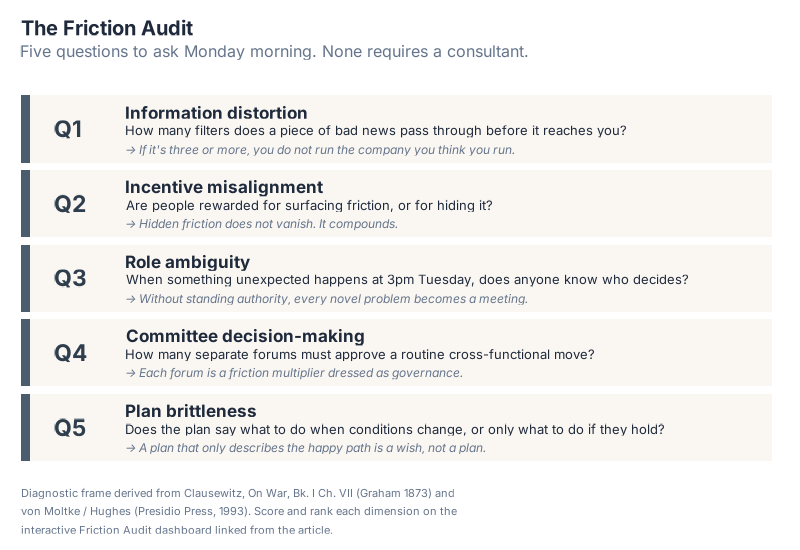
1. What does this plan assume about the world that the world has not yet agreed to?
Every plan rests on assumptions about customer behaviour, supplier reliability, competitor pace, regulatory windows, internal capacity. List them. Each one is a friction surface. Plans that cannot list their assumptions explicitly are not plans — they are wishes wearing a project plan’s clothes.
2. Where in the plan does success multiply, and where does it compound?
Map the sequence. Where are steps independent (a failure does not impair the next step)? Where are they sequential (a failure degrades the next step’s chance)? The compound segments are where 95% reliability collapses to 46% over fifteen steps. Engineering effort belongs there, not on the parallel parts of the plan.
3. What is the gap between the room where this is being decided and the place where it will be done?
Count the layers. Each layer is a translation step. Each translation step costs information. If the strategy room is four layers from the front line, no amount of internal communication discipline will close the gap; only structure will. Auftragstaktik is the structural answer. “Better cascading” is not.
4. If this plan fails, will the failure be visible — or absorbed?
Friction, absorbed silently by the front line, does not show up in the variance report until very late. Plans without explicit early-warning signals will accumulate failure quietly until the budget review, by which point the explanation is already too expensive to give. The 737 MAX programme is the cautionary case: the friction signals existed; the system was structurally incapable of routing them upward.
5. Where is the iron will in this plan — and what machine is it about to crush?
This is the Clausewitzian question almost no plan asks of itself. Where will the organisation be ground down to deliver the result? People, supplier relationships, technical debt, customer trust — name the cost. If the answer is “no machine will be crushed,” the plan is either uncommonly elegant or uncommonly dishonest, and the second is more common than the first.
A strategy that survives the five questions is not friction-proof — nothing is — but it is a strategy that has at least thought about what it will encounter on the road. That is, in Clausewitz’s sense, the only kind of strategy that distinguishes itself from a wish.
Friction is the permanent operating condition of all complex action. Any strategy that does not budget for it is not a strategy; it is a wish.
Monday we keep going with Clausewitz: from friction to fog. If friction is what the strategist cannot eliminate, fog is what the strategist cannot see. Article 6 — Fog of War, Fog of Market: Decision-Making Under Uncertainty, Monday May 11.
Interactive Dashboard
The Friction Audit works on paper. It works better when you can see your scores plotted against the four-tier organisational map — and against the two archetypes (centralised command-and-control vs. Auftragstaktik fan-out) that define the design space. The interactive version lets you do that in five minutes.
Interactive Dashboard
Explore the data yourself — adjust parameters and see the results update in real time.
Show R Code
# =============================================================================
# generate_friction_images.R
# Charts for "Friction Is the Strategy: What Clausewitz Knew About Execution"
# Article 5 of 15 — Strategy That Lasts series (May 2026)
# =============================================================================
#
# This article is HUMANITIES-FIRST. The four figures are conceptual diagrams,
# not data charts. Where any chart shows numbers (the cascade in Chart 1),
# the chart itself is labelled "illustrative — not empirical".
#
# Output files (all bg='white', dpi=100):
#   https://inphronesys.com/wp-content/uploads/2026/05/friction_compound_cascade-1.png         (800x500 — cascade math)
#   https://inphronesys.com/wp-content/uploads/2026/05/friction_levels_diagram-1.png           (800x500 — 4-source stack)
#   https://inphronesys.com/wp-content/uploads/2026/05/friction_auftragstaktik_vs_command-1.png (800x500 — 2-panel compare)
#   https://inphronesys.com/wp-content/uploads/2026/05/friction_audit_questions-1.png          (800x550 — five audit Qs)
#
# Translation locked: GRAHAM (1873), public-domain. Project Gutenberg #1946.
#   https://www.gutenberg.org/ebooks/1946
# Clausewitz series accent (May 2026): #4A5D6E iron-blue / #2F3E4D deep iron.
# Brand primary remains #0073aa.
# =============================================================================

suppressPackageStartupMessages({
  library(ggplot2)
  library(dplyr)
  library(tidyr)
  library(scales)
  library(patchwork)
})

source("Scripts/theme_inphronesys.R")

# Clausewitz series accents (May 2026 series tag — distinct from Sun Tzu teal)
clausewitz_iron      <- "#4A5D6E"
clausewitz_iron_dark <- "#2F3E4D"
clausewitz_iron_lite <- "#6B7B8A"

# Defensive: ensure Images/ exists
dir.create("Images", showWarnings = FALSE)

# =============================================================================
# CHART 1 — The Compound Effect of Friction
# =============================================================================
# A chain of N execution steps. Each step has independent reliability r.
# End-to-end success probability = r^N. We show three reliability levels
# (r = 0.99, 0.95, 0.90) across N = 1..15 steps.
#
# This chart is ILLUSTRATIVE. The point is geometric, not empirical:
# even high per-step reliability collapses end-to-end performance when N is
# large. That is Clausewitz's compound friction in mathematical form.
# =============================================================================

cascade <- expand.grid(
  steps    = 1:15,
  per_step = c(0.99, 0.95, 0.90)
) |>
  mutate(
    success = per_step ^ steps,
    label   = paste0("Step reliability ", scales::percent(per_step, accuracy = 1))
  )

# Order legend high-to-low reliability
cascade$label <- factor(cascade$label,
                         levels = c("Step reliability 99%",
                                    "Step reliability 95%",
                                    "Step reliability 90%"))

# End-of-line annotations at N = 15
endpoints <- cascade |>
  filter(steps == 15) |>
  mutate(
    end_label = paste0(scales::percent(success, accuracy = 1),
                       " end-to-end")
  )

p1 <- ggplot(cascade, aes(x = steps, y = success, color = label, group = label)) +
  geom_hline(yintercept = c(0.25, 0.5, 0.75), color = iph_colors$lightgrey,
             linewidth = 0.4) +
  geom_line(linewidth = 1.3) +
  geom_point(size = 2.4) +
  geom_text(
    data = endpoints,
    aes(x = steps + 0.25, y = success, label = end_label),
    hjust = 0, vjust = 0.5, fontface = "bold", size = 3.5,
    family = "Inter", show.legend = FALSE
  ) +
  scale_color_manual(values = c(
    "Step reliability 99%" = iph_colors$blue,
    "Step reliability 95%" = clausewitz_iron,
    "Step reliability 90%" = iph_colors$red
  )) +
  scale_x_continuous(breaks = seq(1, 15, 2),
                     limits = c(1, 19),
                     expand = c(0, 0.2)) +
  scale_y_continuous(labels = scales::percent_format(accuracy = 1),
                     limits = c(0, 1.02),
                     breaks = seq(0, 1, 0.25),
                     expand = c(0, 0)) +
  labs(
    title = "The Compound Effect: Why 'Simple' Plans Fail at Scale",
    subtitle = paste0(
      "End-to-end success = r^N. Even 95% per-step reliability collapses to ",
      "46% over 15 steps."
    ),
    x = "Number of execution steps in the chain",
    y = "End-to-end probability of success",
    color = NULL,
    caption = paste(
      "Illustrative model, not empirical data. Independent step failures assumed.",
      "Clausewitz's compound friction in arithmetic form: small per-step degradation,",
      "large end-to-end loss. Source: own diagram.",
      sep = "\n"
    )
  ) +
  theme_inphronesys(grid = "y") +
  theme(
    legend.position = "top",
    legend.justification = "left",
    plot.caption = element_text(lineheight = 1.3, hjust = 0,
                                color = iph_colors$grey, size = 8.5,
                                margin = margin(t = 12)),
    plot.margin = margin(15, 25, 10, 10)
  )

ggsave("https://inphronesys.com/wp-content/uploads/2026/05/friction_compound_cascade-1.png", p1,
       width = 8, height = 5, dpi = 100, bg = "white")

# =============================================================================
# CHART 2 — Where Friction Enters the Organisation
# =============================================================================
# A four-tier stacked diagram. NO inline SVG. Pure ggplot tiles + labels.
# Tier 1 (top, lightest tint) = boardroom; Tier 4 (bottom, darkest) = front line.
# Each tier names a friction source and gives a one-line manifestation.
# =============================================================================

friction_levels <- tibble::tribble(
  ~y, ~tier,                    ~label,                         ~manifestation,
  4L, "Strategy room",          "Information distortion",       "By the time the truth reaches the boardroom, it has been smoothed three times.",
  3L, "Middle management",      "Incentive misalignment",       "People are rewarded for hiding friction, not for absorbing it.",
  2L, "Cross-functional layer", "Role ambiguity",               "When something unexpected happens, no one knows who decides.",
  1L, "Front line",             "Plan brittleness",             "The plan assumes conditions hold. They don't."
)

# Vertical gradient: deeper iron at top (boardroom = densest filter), lighter
# tints at bottom (front line = closest to reality, lightest signal compression).
# y = 4 (top) -> darkest, y = 1 (bottom) -> lightest.
fill_palette <- c("#E8ECEF", "#C5CCD2", "#8C99A3", clausewitz_iron)
friction_levels$fill <- fill_palette[friction_levels$y]

# Text colour: white on the dark top tile, dark on the lighter tiles below.
friction_levels$text_color <- ifelse(friction_levels$y == 4, "white", iph_colors$dark)

p2 <- ggplot(friction_levels) +
  geom_rect(aes(xmin = 0, xmax = 10, ymin = y - 0.42, ymax = y + 0.42,
                fill = fill),
            color = "white", linewidth = 1.2) +
  scale_fill_identity() +
  # Tier label (small, top-left of tile)
  geom_text(aes(x = 0.25, y = y + 0.27, label = toupper(tier),
                color = text_color),
            hjust = 0, fontface = "bold", size = 3,
            family = "Inter", alpha = 0.75) +
  scale_color_identity() +
  # Friction label (large, bold, centre-left)
  geom_text(aes(x = 0.25, y = y + 0.02, label = label,
                color = text_color),
            hjust = 0, fontface = "bold", size = 5.6,
            family = "Inter") +
  # Manifestation (italic, below label)
  geom_text(aes(x = 0.25, y = y - 0.27, label = manifestation,
                color = text_color),
            hjust = 0, fontface = "italic", size = 3.6,
            family = "Inter", alpha = 0.85) +
  # Right-edge tier number indicator
  geom_text(aes(x = 9.7, y = y, label = paste0("Tier ", 5 - y),
                color = text_color),
            hjust = 1, fontface = "bold", size = 4,
            family = "Inter", alpha = 0.6) +
  scale_x_continuous(limits = c(0, 10), expand = c(0, 0)) +
  scale_y_continuous(limits = c(0.45, 4.55), expand = c(0, 0)) +
  labs(
    title = "Where Friction Enters the Organisation",
    subtitle = "Four sources, in the order signal travels — top to bottom is information loss; bottom to top is reality compression.",
    caption = "Conceptual diagram. The labels are doctrinal categories, not measured frequencies."
  ) +
  theme_inphronesys(grid = "none") +
  theme(
    axis.title = element_blank(),
    axis.text = element_blank(),
    panel.grid = element_blank(),
    plot.margin = margin(15, 15, 10, 15)
  )

ggsave("https://inphronesys.com/wp-content/uploads/2026/05/friction_levels_diagram-1.png", p2,
       width = 8, height = 5, dpi = 100, bg = "white")

# =============================================================================
# CHART 3 — Command-and-Control vs Auftragstaktik
# =============================================================================
# Two side-by-side panels (patchwork). Each panel is a network-style picture
# made entirely of ggplot points and segments — NO inline SVG.
#
# Panel A: long thin chain. Strategy at top, friction accumulates at each
# downstream link. Edges thin out further from the top.
# Panel B: distributed pattern. Intent at top, parallel action nodes, friction
# absorbed at the edges (smaller arrows, no single chain to break).
# =============================================================================

# --- Panel A: Command-and-Control ---
ccnodes <- tibble::tibble(
  x = rep(0.5, 6),
  y = 5:0,
  label = c("Strategy",
            "Director",
            "Manager",
            "Team Lead",
            "Operator",
            "Reality")
)

ccedges <- tibble::tibble(
  x = 0.5, xend = 0.5,
  y    = 5:1,
  yend = 4:0,
  # Friction grows the further you are from intent
  friction = c(0.10, 0.18, 0.28, 0.42, 0.60)
)

panel_a <- ggplot() +
  # Edges (chain) — colour and thickness encode accumulating friction
  geom_segment(data = ccedges,
               aes(x = x, xend = xend, y = y, yend = yend),
               color = clausewitz_iron, linewidth = 1.4,
               arrow = arrow(length = unit(0.18, "cm"), type = "closed")) +
  # Friction "drag" markers along each edge
  geom_text(data = ccedges,
            aes(x = x + 0.18,
                y = (y + yend) / 2,
                label = paste0("-", scales::percent(friction, accuracy = 1))),
            hjust = 0, size = 3.2,
            color = iph_colors$red, fontface = "bold",
            family = "Inter") +
  # Nodes
  geom_point(data = ccnodes,
             aes(x = x, y = y),
             size = 9, color = clausewitz_iron_dark, fill = "white",
             shape = 21, stroke = 1.4) +
  geom_text(data = ccnodes,
            aes(x = x - 0.18, y = y, label = label),
            hjust = 1, fontface = "bold", size = 3.6,
            color = iph_colors$dark, family = "Inter") +
  scale_x_continuous(limits = c(-0.7, 1.2), expand = c(0, 0)) +
  scale_y_continuous(limits = c(-0.3, 5.3), expand = c(0, 0)) +
  labs(
    title = "Command-and-Control",
    subtitle = "Long chain. Friction compounds at each link.\nIntent is filtered five times before it meets reality."
  ) +
  theme_inphronesys(grid = "none") +
  theme(
    axis.title = element_blank(),
    axis.text = element_blank(),
    panel.grid = element_blank(),
    plot.margin = margin(15, 10, 10, 10),
    plot.title = element_text(color = iph_colors$dark, face = "bold"),
    plot.subtitle = element_text(color = iph_colors$grey, lineheight = 1.2)
  )

# --- Panel B: Auftragstaktik ---
# Single intent at top, fanned out to four distributed action nodes,
# each touching its own slice of reality.
atnodes <- tibble::tibble(
  x = c(0.5, 0.1, 0.37, 0.63, 0.9),
  y = c(5,   3,   3,    3,    3),
  label = c("Commander's Intent",
            "Unit A", "Unit B", "Unit C", "Unit D"),
  type = c("intent", "action", "action", "action", "action")
)

# Reality nodes at the bottom, one per unit
realnodes <- tibble::tibble(
  x = c(0.1, 0.37, 0.63, 0.9),
  y = rep(1, 4),
  label = rep("Local reality", 4)
)

# Edges: intent -> each unit (fan-out), then each unit -> its reality
atedges_top <- tibble::tibble(
  x = rep(0.5, 4),    y = rep(5, 4),
  xend = c(0.1, 0.37, 0.63, 0.9), yend = rep(3, 4),
  friction = rep(0.05, 4)
)
atedges_bot <- tibble::tibble(
  x = c(0.1, 0.37, 0.63, 0.9),    y = rep(3, 4),
  xend = c(0.1, 0.37, 0.63, 0.9), yend = rep(1, 4),
  friction = rep(0.10, 4)
)
atedges <- bind_rows(atedges_top, atedges_bot)

panel_b <- ggplot() +
  # Edges
  geom_segment(data = atedges,
               aes(x = x, xend = xend, y = y, yend = yend),
               color = iph_colors$blue, linewidth = 1.1,
               arrow = arrow(length = unit(0.16, "cm"), type = "closed")) +
  # Small friction markers (low — friction is absorbed locally)
  geom_text(data = atedges_bot,
            aes(x = xend + 0.04,
                y = (y + yend) / 2,
                label = paste0("-", scales::percent(friction, accuracy = 1))),
            hjust = 0, size = 2.8,
            color = iph_colors$grey, fontface = "italic",
            family = "Inter") +
  # Reality strip across the bottom
  geom_segment(aes(x = 0.05, xend = 0.95, y = 0.5, yend = 0.5),
               color = iph_colors$lightgrey, linewidth = 8,
               lineend = "round") +
  # Reality nodes
  geom_point(data = realnodes,
             aes(x = x, y = y),
             size = 6, color = iph_colors$grey, fill = "white",
             shape = 21, stroke = 1.2) +
  geom_text(aes(x = 0.5, y = 0.2,
                label = "Friction absorbed locally — no single chain to break"),
            hjust = 0.5, fontface = "italic", size = 3.2,
            color = iph_colors$grey, family = "Inter") +
  # Intent node (top, large)
  geom_point(data = filter(atnodes, type == "intent"),
             aes(x = x, y = y),
             size = 14, color = iph_colors$blue, fill = "white",
             shape = 21, stroke = 1.6) +
  geom_text(data = filter(atnodes, type == "intent"),
            aes(x = x, y = y + 0.4, label = label),
            hjust = 0.5, fontface = "bold", size = 3.8,
            color = iph_colors$dark, family = "Inter") +
  # Action nodes (mid)
  geom_point(data = filter(atnodes, type == "action"),
             aes(x = x, y = y),
             size = 7, color = iph_colors$blue, fill = "white",
             shape = 21, stroke = 1.4) +
  geom_text(data = filter(atnodes, type == "action"),
            aes(x = x, y = y - 0.35, label = label),
            hjust = 0.5, fontface = "bold", size = 3.2,
            color = iph_colors$dark, family = "Inter") +
  scale_x_continuous(limits = c(-0.05, 1.05), expand = c(0, 0)) +
  scale_y_continuous(limits = c(-0.3, 5.6), expand = c(0, 0)) +
  labs(
    title = "Auftragstaktik (Mission Command)",
    subtitle = "Intent set centrally, action distributed.\nFriction is absorbed at the edges, not crushed by the centre."
  ) +
  theme_inphronesys(grid = "none") +
  theme(
    axis.title = element_blank(),
    axis.text = element_blank(),
    panel.grid = element_blank(),
    plot.margin = margin(15, 10, 10, 10),
    plot.title = element_text(color = iph_colors$dark, face = "bold"),
    plot.subtitle = element_text(color = iph_colors$grey, lineheight = 1.2)
  )

p3 <- panel_a + panel_b +
  plot_annotation(
    caption = paste(
      "Conceptual comparison. Friction percentages are illustrative.",
      "Auftragstaktik formalised by Helmuth von Moltke the Elder",
      "(Chief of Prussian/German General Staff, 1857-1887), drawing on Clausewitz.",
      sep = "\n"
    ),
    theme = theme(
      plot.caption = element_text(family = "Inter", size = 8.5,
                                   color = iph_colors$grey,
                                   hjust = 0, lineheight = 1.3)
    )
  )

ggsave("https://inphronesys.com/wp-content/uploads/2026/05/friction_auftragstaktik_vs_command-1.png", p3,
       width = 8, height = 5, dpi = 100, bg = "white")

# =============================================================================
# CHART 4 — The Friction Audit: Five Diagnostic Questions
# =============================================================================
# Visual list of the 5 audit dimensions with one-line diagnostic question and
# Clausewitzian implication. Mirrors the dashboard scoring schema.
# =============================================================================

audit <- tibble::tribble(
  ~order, ~dimension,                    ~question,                                                                        ~implication,
  1L,    "Information distortion",       "How many filters does a piece of bad news pass through before it reaches you?",  "If it's three or more, you do not run the company you think you run.",
  2L,    "Incentive misalignment",       "Are people rewarded for surfacing friction, or for hiding it?",                  "Hidden friction does not vanish. It compounds.",
  3L,    "Role ambiguity",               "When something unexpected happens at 3pm Tuesday, does anyone know who decides?", "Without standing authority, every novel problem becomes a meeting.",
  4L,    "Committee decision-making",    "How many separate forums must approve a routine cross-functional move?",         "Each forum is a friction multiplier dressed as governance.",
  5L,    "Plan brittleness",             "Does the plan say what to do when conditions change, or only what to do if they hold?", "A plan that only describes the happy path is a wish, not a plan."
)

audit <- audit |> mutate(y = rev(seq_along(order)))

p4 <- ggplot(audit) +
  # Alternating row backgrounds
  geom_rect(aes(xmin = 0, xmax = 10, ymin = y - 0.45, ymax = y + 0.45),
            fill = "#FAF7F2", color = NA) +
  # Left iron-blue accent bar
  geom_rect(aes(xmin = 0, xmax = 0.12, ymin = y - 0.45, ymax = y + 0.45),
            fill = clausewitz_iron, color = NA) +
  # Question number (large, bold, in iron-blue)
  geom_text(aes(x = 0.45, y = y, label = paste0("Q", order)),
            hjust = 0, fontface = "bold", size = 6,
            color = clausewitz_iron_dark, family = "Inter") +
  # Dimension name (bold, top of cell)
  geom_text(aes(x = 1.4, y = y + 0.22, label = dimension),
            hjust = 0, fontface = "bold", size = 4.4,
            color = iph_colors$dark, family = "Inter") +
  # Question text (regular, middle)
  geom_text(aes(x = 1.4, y = y - 0.02, label = question),
            hjust = 0, size = 3.5,
            color = iph_colors$dark, family = "Inter") +
  # Implication (italic, bottom, grey)
  geom_text(aes(x = 1.4, y = y - 0.27, label = paste0("→ ", implication)),
            hjust = 0, fontface = "italic", size = 3.2,
            color = iph_colors$grey, family = "Inter") +
  scale_x_continuous(limits = c(0, 10), expand = c(0, 0)) +
  scale_y_continuous(limits = c(0.4, 5.7), expand = c(0, 0)) +
  labs(
    title = "The Friction Audit",
    subtitle = "Five questions to ask Monday morning. None requires a consultant.",
    caption = paste(
      "Diagnostic frame derived from Clausewitz, On War, Bk. I Ch. VII (Graham 1873) and",
      "von Moltke / Hughes (Presidio Press, 1993). Score and rank each dimension on the",
      "interactive Friction Audit dashboard linked from the article.",
      sep = "\n"
    )
  ) +
  theme_inphronesys(grid = "none") +
  theme(
    axis.title = element_blank(),
    axis.text = element_blank(),
    panel.grid = element_blank(),
    plot.caption = element_text(lineheight = 1.3, hjust = 0,
                                color = iph_colors$grey, size = 8.5,
                                margin = margin(t = 12)),
    plot.margin = margin(15, 20, 10, 15)
  )

ggsave("https://inphronesys.com/wp-content/uploads/2026/05/friction_audit_questions-1.png", p4,
       width = 8, height = 5.5, dpi = 100, bg = "white")

# =============================================================================
# Confirmation output
# =============================================================================
message("\n=== Friction (Clausewitz) images generated ===")
message("https://inphronesys.com/wp-content/uploads/2026/05/friction_compound_cascade-1.png         (800x500)")
message("https://inphronesys.com/wp-content/uploads/2026/05/friction_levels_diagram-1.png           (800x500)")
message("https://inphronesys.com/wp-content/uploads/2026/05/friction_auftragstaktik_vs_command-1.png (800x500)")
message("https://inphronesys.com/wp-content/uploads/2026/05/friction_audit_questions-1.png          (800x550)")
References
- Clausewitz, Carl von. On War (Vom Kriege), Book I, Chapter VII “Friction in War”, and Book I, Chapter I §24. Translated by Col. J. J. Graham (London: N. Trübner & Co., 1873). Public domain. Project Gutenberg #1946. https://www.gutenberg.org/ebooks/1946. Clean reading text of Bk. I Ch. VII at https://clausewitzstudies.org/readings/OnWar1873/BK1ch07.html.
- Bridges Business Consultancy. Strategy Implementation Survey 2016 (n = 144 senior leaders, 38 organisations, 18 countries). Baseline survey 2002. http://bridgesconsultancy.com/research-and-white-papers/
- Hughes, Mark. “Do 70 Per Cent of All Organizational Change Initiatives Really Fail?” Journal of Change Management 11(4), 2011. https://www.researchgate.net/publication/233202794_Do_70_Per_Cent_of_All_Organizational_Change_Initiatives_Really_Fail
- Kotter, John P. Leading Change. Boston: Harvard Business School Press, 1996; 2nd edition, Boston: Harvard Business Review Press, 2012. ISBN 978-1-4221-8643-5 (2nd ed.). [Cited as the popular origin of the “70% fail” claim; the figure is anecdotal.]
- Moltke, Helmuth Graf von. Moltke on the Art of War: Selected Writings. Edited and translated by Daniel J. Hughes with Harry Bell. Novato, CA: Presidio Press, 1993; reprinted Ballantine 1995. ISBN 978-0-89141-575-6. https://www.penguinrandomhouse.com/books/83978/moltke-on-the-art-of-war-by-daniel-hughes/
- van Creveld, Martin. Command in War. Cambridge, MA: Harvard University Press, 1985. ISBN 978-0-674-14441-5. https://www.hup.harvard.edu/books/9780674144415
- Bungay, Stephen. The Art of Action: How Leaders Close the Gaps between Plans, Actions, and Results. London: Nicholas Brealey, 2011. ISBN 978-1-85788-559-0.
- Kaplan, Robert S. & David P. Norton. The Execution Premium: Linking Strategy to Operations for Competitive Advantage. Boston: Harvard Business School Press, 2008. ISBN 978-1-4221-2116-0.
- US Department of the Army. Army Doctrine Publication 6-0: Mission Command. Washington, DC: Headquarters, Department of the Army.
- UK National Army Museum. “Operation Market Garden.” https://www.nam.ac.uk/explore/market-garden
- Imperial War Museums. “What Went Wrong at the Battle of Arnhem.” https://www.iwm.org.uk/history/what-went-wrong-at-the-battle-of-arnhem
- “Battle of Arnhem.” Wikipedia. https://en.wikipedia.org/wiki/Battle_of_Arnhem
- Apollo 13 Flight Journal, Day 4 part 4 — “Building the CO₂ Adapter.” https://apollojournals.org/ap13fj/15day4-mailbox.html
- Smithsonian National Air and Space Museum. “Lithium Hydroxide Canister, Mock-up, Apollo 13 Emergency.” https://airandspace.si.edu/collection-objects/lithium-hydroxide-canister-mock-apollo-13-emergency/nasm_A19760747000
- Federal Aviation Administration. Summary of the FAA’s Review of the Boeing 737 MAX, 2022. https://www.faa.gov/sites/faa.gov/files/2022-08/737_RTS_Summary.pdf
- Articles 1–4 in this series — Strategy That Lasts: The Classics, May 2026, on inphronesys.com.
Leave a Reply