
Musashi’s last scroll is the shortest in his book. The Book of the Void runs only a few pages in any of the standard translations — Harris, Wilson, Cleary — and a careful reader can finish it in fifteen minutes. After four scrolls on foundations, response, combat, and the critique of rival schools, Musashi ends his manual with a section that, by design, refuses to hand the reader anything solid to hold.
That refusal is the point of the scroll. Friday’s piece on the Fire scroll covered hyōshi — the discipline of controlling the rhythm of an engagement, of choosing when to act inside an opponent’s beat. The Void scroll teaches the opposite skill. It is the strategist’s response to a world in which the engagement does not yet have a rhythm at all — where the move that wins is the move a competitor cannot back-solve from your last three.
That is the practical claim of the Void Book. Mastery is not technique so internalised that you stop using technique. It is the state of having no fixed form left for an adversary to read. And, like every other claim in Musashi, it has a corporate translation that most of the books written about him miss.
What Is Ku? (空)
The character 空 — ku — translates badly into English. The dictionary glosses are "empty," "void," "sky." None of them is wrong; all of them are misleading. Each one carries an associative weight that Musashi is not invoking.
Harris’s 1974 Overlook translation captures the practical sense more cleanly than the better-known Cleary or Wilson editions:
By knowing things that exist, you can know that which does not exist. That is the void.
— Musashi, The Book of the Void, trans. Victor Harris (Overlook Press, 1974)
Read sideways, this is a statement about negative space. The void is what the master sees once she has fully internalised the structure: the moves that are not there, the positions a competitor is structurally unable to take, the gap that closes the moment the situation changes. It is the discipline of acting into the unfilled, not from a memorised pattern of past actions.
Ku is earned, not chosen. The structure of the Gorin no Sho makes that explicit. Earth lays the foundations. Water teaches fluid response. Fire teaches engagement. Wind teaches the limits of rival schools. Only after those four does Musashi feel entitled to write down what the master does once the technique has been so deeply absorbed that it stops being technique at all.
For the strategist, this looks like the operating state of a leader who has been around her business so long that her judgements no longer require the apparatus — the frameworks, the templates, the consultants. She does not run SWOT against the decision; she sees, in the same five minutes, what SWOT would have shown three weeks later. Not because the framework is wrong. Because it has been displaced by the deeper internalisation that dō, the way, produces. (Article 8 spent its second half on this same distinction between dō and jutsu.)
Musashi vs. Zen: Similar Vocabulary, Different Intent
Western readers reach for the Book of the Void expecting Zen. The vocabulary is borrowed from Zen. The intent is not.
Zen ku is a metaphysical posture. It is the recognition that all phenomena lack inherent self-existence — a religious endpoint reached through meditation, satori, decades inside a monastic discipline. Musashi was a Buddhist of his time, and the cultural osmosis is real. But the Gorin no Sho is a practical manual, not a religious text. He wrote it on a deathbed at the Reigandō cave with explicit instructions to his student Terao Magonojō about how to apply it.
What Musashi calls ku is a pragmatic capacity. It is the ability of a trained operator to respond accurately to a situation she has never seen before, without falling back on a scripted pattern that the opponent has already mapped. It is the difference between the chess prodigy who plays from memorised openings and the grandmaster who plays into the position in front of her.
I read the Void Book as the closer of a working manual, not the opening of a cosmology. Musashi had four decades of duels behind him and weeks of life ahead. He was not in the mood for mysticism.
No-Form Strategy: The Unpredictable Organisation
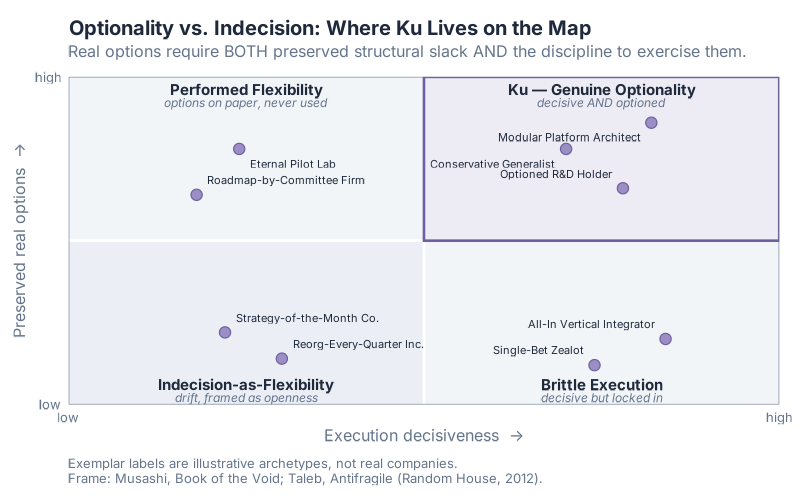
The corporate translation of ku is narrow. It is the top-right of the 2×2 above: a firm that can both execute decisively and preserve real, exercisable optionality at the same time. Most of what gets called "flexibility" in business writing lives in one of three failure modes. Each of them looks like ku from the outside, and none of them is.
Performed flexibility (top-left) is the most common. It is the firm with a portfolio of pilots, a scenario-planning function, an exploration committee, and a slide deck full of strategic options — none of which ever get exercised. The optionality is on paper. The decision authority to convert any of it into a real bet has been quietly diluted across enough committees that nothing ever actually happens. The performance is convincing because, at any moment, the firm can show its work. Six years later, the work is the same.
Brittle execution (bottom-right) is the opposite failure. The firm moves with conviction down a single corridor — one product, one geography, one customer segment — and one wrong assumption brings the whole edifice down. This is the firm that mistakes Schwerpunkt (Article 7) for ku. Concentration without optionality is not the Void; it is the all-in bet that survives only as long as the environment stays inside the bet’s modelling assumptions.
Indecision-as-flexibility (bottom-left) is the worst of the three because it is the easiest to defend. The firm makes no commitments, holds no real options, and presents the resulting drift as a deliberate choice. Quarterly strategy reviews are reorganisations. Reorganisations are strategy. Nothing compounds, but nothing visibly fails either, because failure requires having taken a position.
A major platform company exhibits ku — to the extent any large firm exhibits it at all — when its competitors cannot reverse-engineer its next category from its last three launches. The product schedule reads, from the outside, like a list of disconnected experiments. The internal logic is coherent. The external observability is not. That asymmetry between what is legible from outside and what is structured inside is the entire point.
Optionality in Practice: What Ku Looks Like Corporately
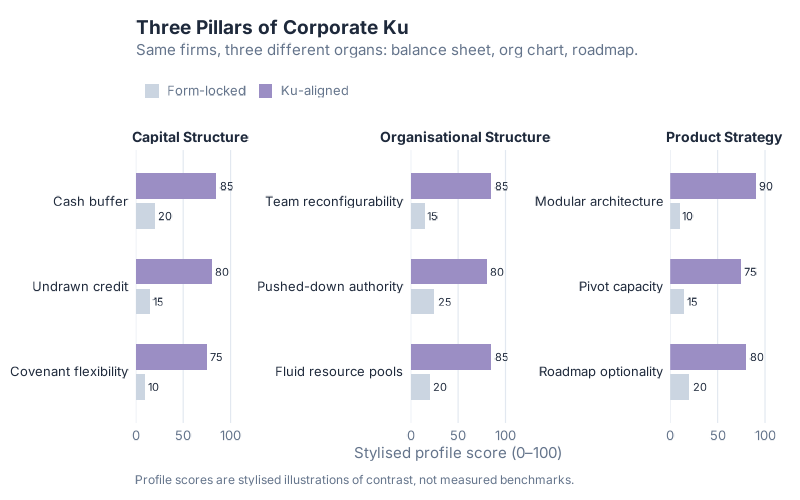
If ku is a corporate state, it expresses itself in three organs: the balance sheet, the org chart, and the roadmap. The chart above sketches the contrast on each.
Balance sheet — capital structure with real dry powder. Cash on hand. Undrawn credit lines. Loan covenants that do not force the firm’s hand at the wrong moment. This is the unfashionable side of optionality because it costs visible yield. The CFO who runs a leveraged balance sheet looks more efficient on a one-year horizon. The CFO who runs a slack balance sheet looks lazy until the moment a market dislocation puts a precision asset on sale at a 70% discount and only a handful of bidders can move. Taleb’s framing is exact:
Optionality is the property of asymmetric upside (preferably unlimited) with correspondingly limited downside (preferably tiny).
— Nassim Taleb, Antifragile (Random House, 2012)
A balance sheet without slack is a balance sheet that cannot say yes when the asymmetric trade arrives. Slack is not waste. Slack is the price you pay for being one of the few firms that can move when most cannot.
Move to the org chart. Structure that reconfigures, on demand, without a six-month consultancy engagement. Teams form around the work, not the other way around. Authority over a decision sits with the level closest to the work, not with the level closest to the executive committee. Resource pools — engineers, finance partners, legal hours — are held centrally and assigned as the work requires, rather than pre-allocated to permanent silos that defend their headcount. The contrast is sharp: in a form-locked organisation, doing a new thing requires a reorganisation. In a ku-aligned organisation, doing a new thing requires forming a team. The first takes nine months and a deck of slides. The second takes a fortnight and an email.
Roadmap — product strategy that does not foreclose its own pivots. Architecture that is modular at the seams that matter, not at the seams that are convenient. Internal interfaces stable enough that components can be replaced without disturbing the system around them. Product commitments that pre-pay the option to change direction — pricing structures that can absorb a model change, contracts that do not lock the firm into a single delivery shape, integrations that are pluggable rather than welded. The form-locked alternative is the firm whose three-year roadmap is a monolith: every line item assumes every other line item is delivered on schedule, and the first slip cascades through the whole document. Ku roadmaps decompose more cleanly because they were designed to be decomposed.
None of this is hoarding. My read of the more common corporate failure is not insufficient optionality but options nobody ever exercises — performed flexibility, the top-left of the earlier 2×2, where pilots never graduate and dry powder stays dry because the same committee that holds the powder also has to authorise its use. Ku requires both halves: the option, and the institutional permission to spend it.
The Limit of the Void: When Structure Is the Advantage
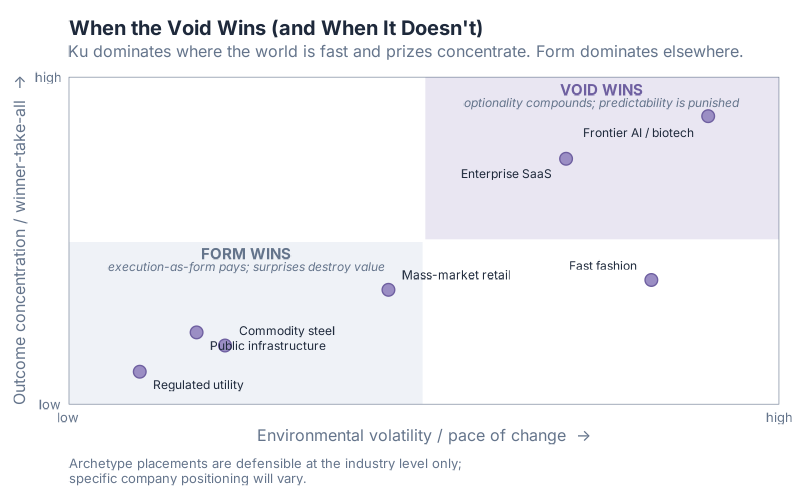
The honest counterpoint, without which the rest of the article is naive: ku is not universally superior. It dominates a specific kind of environment and loses everywhere else.
It dominates where two conditions hold at once. First, the environment moves fast enough that yesterday’s optimal form is today’s encumbrance. Second, outcomes concentrate — the top firm captures multiples of what the second-place firm captures. Frontier AI and biotech, enterprise SaaS, and anything that resembles a winner-take-all tournament all sit in this top-right quadrant of the chart above. The shape of the prize rewards the firm that can move into a category the day after the category becomes legible, before the second mover has even noticed the opening.
Some markets reward form because form is precisely what they reward. A regulated utility is rewarded for predictability — its regulators require predictability as a precondition for the rate of return on capital they will permit. A commodity steel mill competes on unit cost, and the firm that has wrung the variance out of its operating form to three significant figures wins on cents per ton. Public infrastructure depends on form so completely that removing the form is the operating risk; nobody wants an experimental water utility.
Courtney, Kirkland, and Viguerie made the same point in a different vocabulary thirty years ago. Their Harvard Business Review essay "Strategy Under Uncertainty" (November–December 1997) argued that posture must match the level of uncertainty in the environment, not the leadership team’s preferences about the world they wish they lived in. Form pays in their Level 1 (a clear-enough future) and Level 2 (a small set of alternate futures). The Void posture pays in Level 3 (a range of futures with no clear discrete outcomes) and Level 4 (true ambiguity, where even the variables are unstable).
The interesting cases are the diagonal — mass-market retail, fast fashion, mid-cap manufacturing — where neither posture dominates and the firm has to choose which axis it is willing to be wrong about. There is no clean answer for those cases. The honest article does not pretend otherwise.
Where the Series Goes Next
Musashi’s text closes here. Earth, Water, Fire, Wind, Void — five scrolls, one accumulating argument about what mastery costs and what it permits. The reader who has stayed across all three Musashi articles in this series now has the architecture and, with luck, a slightly different ear for the word master.
Tomorrow the series turns to Italy.
Tuesday — Article 11: Machiavelli on the half of strategy you cannot control.
Interactive Dashboard
Two interactives. An Optionality vs. Indecision quadrant tool — drop your organisation on the 2×2 against five honest prompts. And a Ku-vs-Form environment matcher — describe your industry’s volatility and concentration, and see where the evidence pushes you.
Interactive Dashboard
Explore the data yourself — adjust parameters and see the results update in real time.
Show R Code
# =============================================================================
# generate_void_images.R
# Charts for "The Void: Strategic Emptiness as Competitive Advantage"
# Article 10 of 15 — Strategy That Lasts series (May 2026) — Musashi
# =============================================================================
#
# Output files (all 800px wide, dpi=100, bg='white'):
#   https://inphronesys.com/wp-content/uploads/2026/05/void_optionality_vs_indecision-2.png   (Section 3 — no-form strategy)
#   https://inphronesys.com/wp-content/uploads/2026/05/void_three_pillars_of_corporate_ku-2.png (Section 4 — corporate ku)
#   https://inphronesys.com/wp-content/uploads/2026/05/void_when_void_wins-2.png              (Section 5 — honest limits)
#
# Translation locked: Victor Harris (1974), Overlook Press.
# Musashi accent color: #9B8EC4 (May 2026 series tag for the Void article)
#
# Source values: Scripts/void_data.json (canonical contract for Alpha+Charlie)
# =============================================================================

suppressPackageStartupMessages({
  library(ggplot2)
  library(dplyr)
  library(tidyr)
  library(scales)
  library(patchwork)
})

source("Scripts/theme_inphronesys.R")

# Musashi accent (May 2026 series tag — locked across all three images)
void_violet      <- "#9B8EC4"
void_violet_dark <- "#6E5FA0"
deemph_grey      <- "#e2e8f0"
form_grey        <- "#cbd5e1"
text_dark        <- iph_colors$dark
text_muted       <- iph_colors$grey

# =============================================================================
# CHART 1 — Optionality vs Indecision (2x2 with exemplar archetypes)
# =============================================================================

quadrant_fill <- tibble::tribble(
  ~xmin, ~xmax, ~ymin, ~ymax, ~fill,         ~alpha, ~quadrant,
  0.50,  1.00,  0.50,  1.00,  void_violet,   0.18,   "Ku — Genuine Optionality",
  0.00,  0.50,  0.50,  1.00,  deemph_grey,   0.45,   "Performed Flexibility",
  0.50,  1.00,  0.00,  0.50,  deemph_grey,   0.45,   "Brittle Execution",
  0.00,  0.50,  0.00,  0.50,  deemph_grey,   0.70,   "Indecision-as-Flexibility"
)

quadrant_labels <- tibble::tribble(
  ~x,    ~y,    ~label,                          ~face,
  0.75,  0.96,  "Ku — Genuine Optionality",      "bold",
  0.75,  0.92,  "decisive AND optioned",         "italic",
  0.25,  0.96,  "Performed Flexibility",          "bold",
  0.25,  0.92,  "options on paper, never used",  "italic",
  0.75,  0.06,  "Brittle Execution",              "bold",
  0.75,  0.02,  "decisive but locked in",        "italic",
  0.25,  0.06,  "Indecision-as-Flexibility",     "bold",
  0.25,  0.02,  "drift, framed as openness",     "italic"
)

exemplars <- tibble::tribble(
  ~label,                         ~x,    ~y,    ~quadrant,
  "Modular Platform Architect",   0.82,  0.86,  "Ku",
  "Conservative Generalist",      0.70,  0.78,  "Ku",
  "Optioned R&D Holder",          0.78,  0.66,  "Ku",
  "Eternal Pilot Lab",            0.24,  0.78,  "Performed Flexibility",
  "Roadmap-by-Committee Firm",    0.18,  0.64,  "Performed Flexibility",
  "All-In Vertical Integrator",   0.84,  0.20,  "Brittle Execution",
  "Single-Bet Zealot",            0.74,  0.12,  "Brittle Execution",
  "Strategy-of-the-Month Co.",    0.22,  0.22,  "Indecision-as-Flexibility",
  "Reorg-Every-Quarter Inc.",     0.30,  0.14,  "Indecision-as-Flexibility"
)

# Nudge labels so they don't overlap their points
exemplars$nudge_y <- ifelse(exemplars$y > 0.7, -0.045, 0.045)
exemplars$hjust   <- ifelse(exemplars$x > 0.5, 1, 0)
exemplars$nudge_x <- ifelse(exemplars$x > 0.5, -0.015, 0.015)

p1 <- ggplot() +
  geom_rect(data = quadrant_fill,
            aes(xmin = xmin, xmax = xmax, ymin = ymin, ymax = ymax,
                fill = fill, alpha = alpha)) +
  scale_fill_identity() +
  scale_alpha_identity() +
  geom_hline(yintercept = 0.5, color = "white", linewidth = 0.9) +
  geom_vline(xintercept = 0.5, color = "white", linewidth = 0.9) +
  geom_text(data = filter(quadrant_labels, face == "bold"),
            aes(x = x, y = y, label = label),
            family = "Inter", fontface = "bold",
            size = 4.0, color = text_dark) +
  geom_text(data = filter(quadrant_labels, face == "italic"),
            aes(x = x, y = y, label = label),
            family = "Inter", fontface = "italic",
            size = 3.2, color = text_muted) +
  annotate("rect", xmin = 0.50, xmax = 1.00, ymin = 0.50, ymax = 1.00,
           fill = NA, color = void_violet_dark, linewidth = 0.9) +
  geom_point(data = exemplars,
             aes(x = x, y = y),
             color = void_violet_dark, fill = void_violet,
             shape = 21, size = 3.4, stroke = 0.6) +
  geom_text(data = exemplars,
            aes(x = x + nudge_x, y = y + nudge_y,
                label = label, hjust = hjust),
            family = "Inter", size = 2.9, color = text_dark) +
  scale_x_continuous(limits = c(0, 1), expand = c(0, 0),
                     breaks = c(0, 0.5, 1), labels = c("low", "", "high")) +
  scale_y_continuous(limits = c(0, 1), expand = c(0, 0),
                     breaks = c(0, 0.5, 1), labels = c("low", "", "high")) +
  labs(
    title = "Optionality vs. Indecision: Where Ku Lives on the Map",
    subtitle = "Real options require BOTH preserved structural slack AND the discipline to exercise them.",
    x = "Execution decisiveness  →",
    y = "Preserved real options  →",
    caption = paste(
      "Exemplar labels are illustrative archetypes, not real companies.",
      "Frame: Musashi, Book of the Void; Taleb, Antifragile (Random House, 2012).",
      sep = "\n"
    )
  ) +
  theme_inphronesys(base_size = 13, grid = "none") +
  theme(
    panel.background = element_rect(fill = "white", color = NA),
    panel.border = element_rect(color = text_muted, fill = NA, linewidth = 0.4),
    axis.text = element_text(color = text_muted, size = 10),
    plot.caption = element_text(hjust = 0)
  )

ggsave("https://inphronesys.com/wp-content/uploads/2026/05/void_optionality_vs_indecision-2.png",
       plot = p1, width = 8, height = 5, dpi = 100, bg = "white")

# =============================================================================
# CHART 2 — Three Pillars of Corporate Ku (faceted bullet bars)
# =============================================================================

pillars <- tibble::tribble(
  ~panel,                    ~panel_order, ~attribute,                ~ku, ~form,
  "Capital Structure",        1,           "Cash buffer",              85,  20,
  "Capital Structure",        1,           "Undrawn credit",           80,  15,
  "Capital Structure",        1,           "Covenant flexibility",     75,  10,
  "Organisational Structure", 2,           "Team reconfigurability",   85,  15,
  "Organisational Structure", 2,           "Pushed-down authority",    80,  25,
  "Organisational Structure", 2,           "Fluid resource pools",     85,  20,
  "Product Strategy",         3,           "Modular architecture",     90,  10,
  "Product Strategy",         3,           "Pivot capacity",           75,  15,
  "Product Strategy",         3,           "Roadmap optionality",      80,  20
)

pillars_long <- pillars |>
  pivot_longer(c(ku, form), names_to = "profile", values_to = "score") |>
  mutate(
    profile = factor(profile,
                     levels = c("form", "ku"),
                     labels = c("Form-locked", "Ku-aligned")),
    panel = factor(panel,
                   levels = c("Capital Structure",
                              "Organisational Structure",
                              "Product Strategy")),
    attribute = factor(attribute, levels = rev(unique(pillars$attribute)))
  )

p2 <- ggplot(pillars_long,
             aes(x = score, y = attribute, fill = profile)) +
  geom_col(position = position_dodge(width = 0.7),
           width = 0.6) +
  geom_text(aes(label = score),
            position = position_dodge(width = 0.7),
            hjust = -0.25, family = "Inter", size = 3.0,
            color = text_dark) +
  facet_wrap(~ panel, ncol = 3, scales = "free_y") +
  scale_fill_manual(values = c("Form-locked" = form_grey,
                               "Ku-aligned"  = void_violet),
                    name = NULL) +
  scale_x_continuous(limits = c(0, 115), expand = c(0, 0),
                     breaks = c(0, 50, 100),
                     labels = c("0", "50", "100")) +
  scale_y_discrete(expand = expansion(add = c(0.6, 0.6))) +
  labs(
    title = "Three Pillars of Corporate Ku",
    subtitle = "Same firms, three different organs: balance sheet, org chart, roadmap.",
    x = "Stylised profile score (0–100)",
    y = NULL,
    caption = "Profile scores are stylised illustrations of contrast, not measured benchmarks."
  ) +
  theme_inphronesys(base_size = 12, grid = "x") +
  theme(
    panel.spacing.x = unit(0.9, "lines"),
    strip.text = element_text(face = "bold", size = 10.5, color = text_dark),
    strip.clip = "off",
    legend.position = "top",
    legend.justification = "left",
    axis.text.y = element_text(color = text_dark, size = 9.5),
    plot.caption = element_text(hjust = 0)
  )

ggsave("https://inphronesys.com/wp-content/uploads/2026/05/void_three_pillars_of_corporate_ku-2.png",
       plot = p2, width = 8, height = 5, dpi = 100, bg = "white")

# =============================================================================
# CHART 3 — When the Void Wins (industry archetypes scatter)
# =============================================================================

archetypes <- tibble::tribble(
  ~archetype,                ~x,    ~y,    ~zone,
  "Regulated utility",       0.10,  0.10,  "Form wins",
  "Public infrastructure",   0.18,  0.22,  "Form wins",
  "Commodity steel",         0.22,  0.18,  "Form wins",
  "Mass-market retail",      0.45,  0.35,  "Mixed",
  "Fast fashion",            0.82,  0.38,  "Mixed",
  "Enterprise SaaS",         0.70,  0.75,  "Void wins",
  "Frontier AI / biotech",   0.90,  0.88,  "Void wins"
)

archetypes$hjust   <- ifelse(archetypes$x > 0.5, 1, 0)
archetypes$nudge_x <- ifelse(archetypes$x > 0.5, -0.02, 0.02)
archetypes$nudge_y <- c(-0.04, -0.04, 0.045, 0.045, 0.045, -0.045, -0.05)

zone_fills <- tibble::tribble(
  ~xmin, ~xmax, ~ymin, ~ymax, ~fill,        ~alpha, ~zone,
  0.50,  1.00,  0.50,  1.00,  void_violet,  0.22,   "Void wins",
  0.00,  0.50,  0.00,  0.50,  deemph_grey,  0.55,   "Form wins"
)

zone_labels <- tibble::tribble(
  ~x,    ~y,    ~label,                                            ~color,
  0.75,  0.96,  "VOID WINS",                                       void_violet_dark,
  0.75,  0.92,  "optionality compounds; predictability is punished",  text_muted,
  0.25,  0.46,  "FORM WINS",                                       text_muted,
  0.25,  0.42,  "execution-as-form pays; surprises destroy value", text_muted
)

p3 <- ggplot() +
  geom_rect(data = zone_fills,
            aes(xmin = xmin, xmax = xmax, ymin = ymin, ymax = ymax,
                fill = fill, alpha = alpha)) +
  scale_fill_identity() +
  scale_alpha_identity() +
  geom_hline(yintercept = 0.5, color = "white", linewidth = 0.9) +
  geom_vline(xintercept = 0.5, color = "white", linewidth = 0.9) +
  geom_text(data = filter(zone_labels, label %in% c("VOID WINS", "FORM WINS")),
            aes(x = x, y = y, label = label, color = color),
            family = "Inter", fontface = "bold", size = 4.0) +
  geom_text(data = filter(zone_labels, !label %in% c("VOID WINS", "FORM WINS")),
            aes(x = x, y = y, label = label),
            family = "Inter", fontface = "italic", size = 3.1,
            color = text_muted) +
  scale_color_identity() +
  geom_point(data = archetypes,
             aes(x = x, y = y),
             color = void_violet_dark, fill = void_violet,
             shape = 21, size = 3.8, stroke = 0.7) +
  geom_text(data = archetypes,
            aes(x = x + nudge_x, y = y + nudge_y,
                label = archetype, hjust = hjust),
            family = "Inter", size = 3.2, color = text_dark) +
  scale_x_continuous(limits = c(0, 1), expand = c(0, 0),
                     breaks = c(0, 0.5, 1), labels = c("low", "", "high")) +
  scale_y_continuous(limits = c(0, 1), expand = c(0, 0),
                     breaks = c(0, 0.5, 1), labels = c("low", "", "high")) +
  labs(
    title = "When the Void Wins (and When It Doesn't)",
    subtitle = "Ku dominates where the world is fast and prizes concentrate. Form dominates elsewhere.",
    x = "Environmental volatility / pace of change  →",
    y = "Outcome concentration / winner-take-all  →",
    caption = paste(
      "Archetype placements are defensible at the industry level only;",
      "specific company positioning will vary.",
      sep = "\n"
    )
  ) +
  theme_inphronesys(base_size = 13, grid = "none") +
  theme(
    panel.background = element_rect(fill = "white", color = NA),
    panel.border = element_rect(color = text_muted, fill = NA, linewidth = 0.4),
    axis.text = element_text(color = text_muted, size = 10),
    plot.caption = element_text(hjust = 0)
  )

ggsave("https://inphronesys.com/wp-content/uploads/2026/05/void_when_void_wins-2.png",
       plot = p3, width = 8, height = 5, dpi = 100, bg = "white")

message("Void images written:")
message("  https://inphronesys.com/wp-content/uploads/2026/05/void_optionality_vs_indecision-2.png")
message("  https://inphronesys.com/wp-content/uploads/2026/05/void_three_pillars_of_corporate_ku-2.png")
message("  https://inphronesys.com/wp-content/uploads/2026/05/void_when_void_wins-2.png")
References
- Miyamoto Musashi. A Book of Five Rings, trans. Victor Harris. Woodstock, NY: Overlook Press, 1974. The Book of the Void; The Book of the Wind. Full-text scan of the Harris translation: https://archive.org/stream/MiyamotoMusashi-BookOfFiveRingsgoRinNoSho/Book_of_Five_Rings_djvu.txt. Wikipedia entry: https://en.wikipedia.org/wiki/The_Book_of_Five_Rings.
- Taleb, Nassim Nicholas. Antifragile: Things That Gain from Disorder. New York: Random House, 2012. ISBN 978-1-4000-6782-4. https://www.penguinrandomhouse.com/books/176227/antifragile-by-nassim-nicholas-taleb/. Source for the optionality / convexity framing used in the corporate ku section.
- Courtney, Hugh, Jane Kirkland, and Patrick Viguerie. "Strategy Under Uncertainty." Harvard Business Review, November–December 1997. https://hbr.org/1997/11/strategy-under-uncertainty. Source for the posture-must-match-uncertainty argument cited in the limits section.
- Article 8 in this series — The Way of Strategy: What a 17th-Century Swordsman Knew About Mastery, inphronesys.com, May 14, 2026. Introduces Musashi, the five scrolls, and the dō / jutsu distinction.
- Article 9 in this series — Hyōshi: Musashi’s Discipline of Tempo, inphronesys.com, May 15, 2026. The Fire scroll, three modes of initiative, and the void moment between intention and action.
- Articles 1–7 in this series — Strategy That Lasts: The Classics, May 2026, on inphronesys.com.
Leave a Reply