
The Fire scroll is the most quoted and most misread of Musashi’s five scrolls. Western readers reach for it because it sounds like tactics — combat, timing, the moment of decision. What they find, if they read it patiently, is a treatise on tempo. The argument is uncomfortable for modern planners: the strategist who controls the rhythm of an engagement has already won it, regardless of which moves either side plays.
Yesterday’s article introduced Musashi the man and the five scrolls. Today we go inside one — 火, Ka, the Fire scroll.
Hyōshi: The Rhythm of All Things
Hyōshi (拍子) — rhythm, timing, beat — is the concept that organises the Fire scroll. Every encounter has a tempo, and there is a right moment inside that tempo when an action will work and a wrong moment when the same action will fail.
Musashi insists that timing pervades everything — swordplay, music, mounted combat, business, the cycles of nature. The line readers love to quote — about timing being something that “cannot be mastered without a great deal of practice” — actually sits in the Earth scroll (Chi no Maki), where Musashi lays the philosophical foundation, not in Fire. Earth tells you that timing is universal; Fire tells you how to operate inside it once you have accepted that.
The claim is one most modern strategy refuses to admit: the same move is correct or wrong depending only on when it is played. Two competitors can ship the same product on the same day, and the one who moves on the right beat wins — the other looks like an imitator regardless of who planned it first.
Three Modes of Initiative
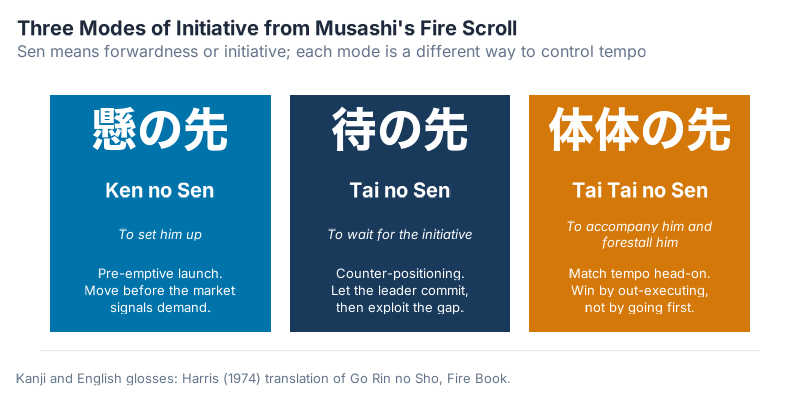
The most-quoted section of the Fire scroll catalogues three — and only three — ways to take the lead in an engagement. Victor Harris’s 1974 translation supplies the canonical English, and Musashi himself closes the section: “There are no methods of taking the lead other than these three.”
| Mode | Kanji | Harris’s gloss | Operating logic |
|---|---|---|---|
| Ken no Sen | 懸の先 | “to set him up” | Forestall by attacking — you move first, on your own tempo |
| Tai no Sen | 待の先 | “to wait for the initiative” | Forestall as he attacks — let him commit, then strike inside his motion |
| Tai Tai no Sen | 体体の先 | “to accompany him and forestall him” | Forestall when both move together — match the motion and seize the beat |
These are not the same as the sen-sen-no-sen / sen-no-sen / go-no-sen triad familiar from modern aikido and kendo pedagogy — that framework is a later codification. Musashi’s three sen are framed not by when you move, but by whose tempo the engagement runs on.
The first seizes tempo. The second redirects an opponent’s. The third forces tempo to be shared, then claimed inside the meeting.
A market operator can read the table directly. Ken no Sen is the unprovoked launch. Tai no Sen is the trap — let the competitor commit publicly, then move inside the announcement window before the commitment is operational. Tai Tai no Sen is the mutual play — both sides move together, and the side that commits more cleanly in the shared beat wins.
The Void Moment
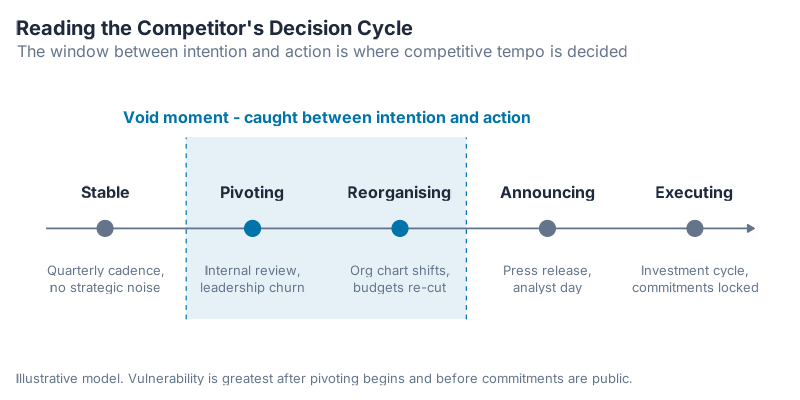
Every competitor’s decision cycle moves through the same stages: stable, pivoting, reorganising, announcing, executing. The Fire scroll is interested in the gap between pivoting and announcing — when intention has formed but commitment is not yet public. This is the void moment: the window during which an opponent is no longer where they were, but not yet where they are going.
Musashi’s instruction is direct: strike inside the void. Once a commitment is public, the cost of breaking it is institutional; pre-commitment, the cost is merely intellectual. A competitor mid-restructuring, mid-CEO-transition, or mid-strategic-review is, in Musashi’s vocabulary, between beats.
A caveat: the Fire scroll was written for an opponent who would, given the chance, kill the reader — recognise the void, but treat the legality and reputational consequences of acting on it as a separate decision.
Market Applications: Launch, Response, M&A
Launch (Ken no Sen). A challenger times an announcement to land before a known incumbent’s annual planning cycle closes. Pattern reference: Spotify built streaming category dominance years before Apple Music arrived. The agenda was set by the company that moved first; the larger incumbent then had to answer on a tempo it did not choose.
Response (Tai no Sen). A second mover lets the first mover commit publicly to a price, a partnership, or a positioning, then moves inside the announcement window before the commitment is operational. Pattern reference: T-Mobile’s Un-carrier era — letting the majors commit to contract-and-subsidy positioning, then striking inside that commitment. The win is not from being faster, but from being better timed.
M&A (Tai Tai no Sen). Two acquirers contend for the same target during the same diligence window. Both have moved; both are public. Pattern reference: the Disney / Comcast contest for the 21st Century Fox assets. The acquirer who closes faster — whose approvals, financing, and integration plan are pre-warmed — wins the mutual beat.
The Anti-Pattern: Reactive Strategy
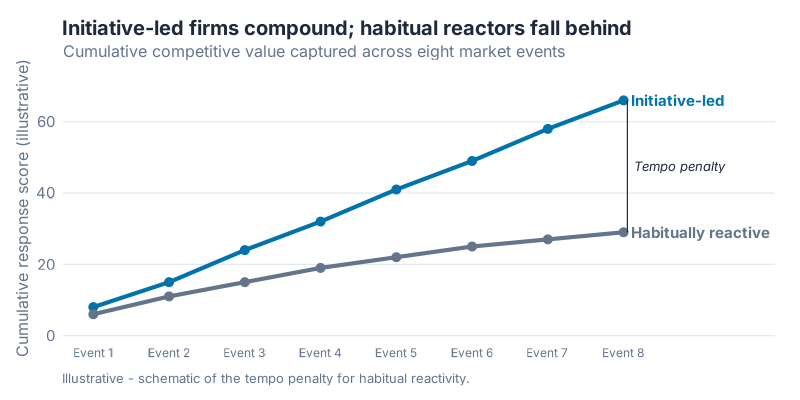
The Wind scroll (Kaze no Maki) is Musashi’s critique of other schools. The failure mode he returns to is reactive practice: traditions that train students only to respond. A reactive practitioner depends on the opponent to move first, which means the opponent owns the tempo of every engagement — and across many engagements, the reactive side accumulates a permanent lag.
Modern strategy has rediscovered this. Richard D’Aveni’s Hypercompetition (Free Press, 1994) argues that sustained advantage is no longer defended; it is restarted, repeatedly, by the firm willing to disrupt its own position. George Stalk and Thomas Hout’s Competing Against Time (Free Press, 1990), written from inside the Boston Consulting Group, makes the related claim that time — not cost, quality, or capability — is the next competitive battleground. Both are reformulations of the Fire scroll’s central point. Hyōshi is the dimension on which the war is decided.
The Fire scroll is not about combat. It is about temporal dominance — who owns the rhythm owns the outcome.
Monday — Article 10 in the series: the Void scroll. Mastery beyond technique.
Interactive Dashboard
Two interactives. A Three Sen explorer — pick a competitive scenario and see which of Ken / Tai / Tai Tai applies. And a Void-Moment scenario tool — adjust a competitor’s decision-cycle stages and watch the optimal strike window open and close.
Interactive Dashboard
Explore the data yourself — adjust parameters and see the results update in real time.
Show R Code
# =============================================================================
# generate_musashi_fire_images.R
# Article 9 of "Strategy That Lasts" — May 15, 2026
# "Timing and Rhythm: Musashi's Fire Scroll for Fast-Moving Markets"
#
# Builds three 800x400 images for the Fire Scroll blog post:
#   1. fire_three_sen.png            — Ken no Sen / Tai no Sen / Tai Tai no Sen
#   2. fire_void_moment.png          — Competitor decision cycle with void window
#   3. fire_reactive_vs_initiative.png — Initiative-led vs reactive tempo
#
# Run from project root:
#   Rscript Scripts/generate_musashi_fire_images.R
# =============================================================================

suppressPackageStartupMessages({
  library(ggplot2)
  library(dplyr)
  library(tidyr)
  library(scales)
  library(patchwork)
  library(showtext)
  library(sysfonts)
})

source("Scripts/theme_inphronesys.R")

# --- CJK font for kanji ----------------------------------------------------
# Hiragino Sans is installed by default on macOS and renders the kanji we
# need (Ken no Sen, Tai no Sen, Tai Tai no Sen, hyoshi, kaze no maki).
if (!"HiraginoSans" %in% sysfonts::font_families()) {
  tryCatch(
    sysfonts::font_add(
      family = "HiraginoSans",
      regular = "/System/Library/Fonts/ヒラギノ角ゴシック W3.ttc",
      bold    = "/System/Library/Fonts/ヒラギノ角ゴシック W7.ttc"
    ),
    error = function(e) message("Hiragino font not found; kanji may fall back.")
  )
}

# Kanji used in this script, as literal Unicode strings (no escapes).
KANJI <- list(
  ken_no_sen      = "懸の先",
  tai_no_sen      = "待の先",
  tai_tai_no_sen  = "体体の先",
  hyoshi          = "拍子",
  kaze_no_maki    = "風の巻",
  hi_no_maki      = "火の巻"
)

# ============================================================================
# 1. fire_three_sen.png — Three modes of initiative
# ============================================================================

three_sen <- tibble(
  order   = c(1, 2, 3),
  romaji  = c("Ken no Sen", "Tai no Sen", "Tai Tai no Sen"),
  kanji   = c(KANJI$ken_no_sen, KANJI$tai_no_sen, KANJI$tai_tai_no_sen),
  gloss   = c("Forestall by attacking",
              "Forestall as the enemy attacks",
              "Forestall by attacking together"),
  business = c("Pre-emptive launch.\nMove before the market\nsignals demand.",
               "Counter-positioning.\nLet the leader commit,\nthen exploit the gap.",
               "Match tempo head-on.\nWin by out-executing,\nnot by going first."),
  fill_col = c(iph_colors$blue, iph_colors$navy, iph_colors$orange)
)

p1 <- ggplot(three_sen, aes(x = order, y = 0.85)) +
  geom_tile(aes(fill = I(fill_col)), width = 0.92, height = 1.30) +
  geom_text(aes(label = kanji, y = 1.32),
            family = "HiraginoSans", fontface = "bold",
            size = 12, colour = "white") +
  geom_text(aes(label = romaji, y = 0.98),
            family = "Inter", fontface = "bold",
            size = 5.4, colour = "white") +
  geom_text(aes(label = gloss, y = 0.74),
            family = "Inter", fontface = "italic",
            size = 3.7, colour = "white") +
  geom_text(aes(label = business, y = 0.46),
            family = "Inter", size = 3.4,
            colour = "white", lineheight = 1.05) +
  scale_x_continuous(limits = c(0.4, 3.6), expand = c(0, 0)) +
  scale_y_continuous(limits = c(0.05, 1.60), expand = c(0, 0)) +
  labs(
    title = "Three Modes of Initiative from Musashi's Fire Scroll",
    subtitle = "Sen means forwardness or initiative; each mode is a different way to control tempo",
    caption  = "Kanji and English glosses: Harris (1974) translation of Go Rin no Sho, Fire Book."
  ) +
  theme_inphronesys(grid = "none") +
  theme(axis.title = element_blank(),
        axis.text  = element_blank(),
        panel.grid = element_blank(),
        plot.margin = margin(15, 12, 10, 12))

ggsave("https://inphronesys.com/wp-content/uploads/2026/05/fire_three_sen.png", p1,
       width = 8, height = 4, dpi = 100, bg = "white")

# ============================================================================
# 2. fire_void_moment.png — Competitor decision cycle with void window
# ============================================================================

stages <- tibble(
  order = 1:5,
  stage = c("Stable", "Pivoting", "Reorganising", "Announcing", "Executing"),
  signal = c("Quarterly cadence,\nno strategic noise",
             "Internal review,\nleadership churn",
             "Org chart shifts,\nbudgets re-cut",
             "Press release,\nanalyst day",
             "Investment cycle,\ncommitments locked"),
  vulnerable = c(FALSE, TRUE, TRUE, FALSE, FALSE)
)

p2 <- ggplot(stages, aes(x = order, y = 1)) +
  annotate("rect", xmin = 1.55, xmax = 3.45, ymin = 0.55, ymax = 1.45,
           fill = iph_colors$blue, alpha = 0.10) +
  annotate("segment", x = 1.55, xend = 1.55, y = 0.55, yend = 1.45,
           colour = iph_colors$blue, linewidth = 0.4, linetype = "dashed") +
  annotate("segment", x = 3.45, xend = 3.45, y = 0.55, yend = 1.45,
           colour = iph_colors$blue, linewidth = 0.4, linetype = "dashed") +
  annotate("text", x = 2.5, y = 1.55,
           label = "Void moment - caught between intention and action",
           family = "Inter", fontface = "bold",
           size = 4.2, colour = iph_colors$blue) +
  annotate("segment", x = 0.6, xend = 5.4, y = 1.0, yend = 1.0,
           colour = iph_colors$grey, linewidth = 0.6,
           arrow = arrow(length = unit(0.18, "cm"), type = "closed")) +
  geom_point(aes(colour = vulnerable), size = 5) +
  scale_colour_manual(values = c(`FALSE` = iph_colors$grey,
                                  `TRUE`  = iph_colors$blue),
                       guide = "none") +
  geom_text(aes(label = stage, y = 1.18),
            family = "Inter", fontface = "bold",
            size = 4.2, colour = iph_colors$dark) +
  geom_text(aes(label = signal, y = 0.75),
            family = "Inter", size = 3.4,
            colour = iph_colors$grey, lineheight = 1.05) +
  scale_x_continuous(limits = c(0.4, 5.6), expand = c(0, 0)) +
  scale_y_continuous(limits = c(0.35, 1.75), expand = c(0, 0)) +
  labs(
    title = "Reading the Competitor's Decision Cycle",
    subtitle = "Musashi's 'moment between intention and action' is where tempo is decided",
    caption = "Illustrative model. Vulnerability is greatest after pivoting begins and before commitments are public."
  ) +
  theme_inphronesys(grid = "none") +
  theme(axis.title = element_blank(),
        axis.text  = element_blank(),
        panel.grid = element_blank(),
        plot.margin = margin(15, 12, 10, 12))

ggsave("https://inphronesys.com/wp-content/uploads/2026/05/fire_void_moment.png", p2,
       width = 8, height = 4, dpi = 100, bg = "white")

# ============================================================================
# 3. fire_reactive_vs_initiative.png — Initiative-led vs habitually reactive
# ============================================================================

set.seed(42)
events <- tibble(
  event = 1:8,
  initiative_led = cumsum(c(8, 7, 9, 8, 9, 8, 9, 8)),
  reactive       = cumsum(c(6, 5, 4, 4, 3, 3, 2, 2))
)

events_long <- events |>
  pivot_longer(cols = c(initiative_led, reactive),
               names_to = "mode", values_to = "score") |>
  mutate(mode = factor(mode, levels = c("initiative_led", "reactive"),
                       labels = c("Initiative-led",
                                  "Habitually reactive")))

endpts <- events_long |> filter(event == max(event))

p3 <- ggplot(events_long, aes(x = event, y = score, colour = mode)) +
  geom_line(linewidth = 1.4) +
  geom_point(size = 2.6) +
  geom_text(data = endpts,
            aes(label = mode, x = event + 0.1),
            family = "Inter", fontface = "bold", size = 4,
            hjust = 0, vjust = 0.5, show.legend = FALSE) +
  annotate("segment",
           x = 8.05, xend = 8.05,
           y = events$reactive[8], yend = events$initiative_led[8],
           colour = iph_colors$dark, linewidth = 0.4) +
  annotate("text", x = 8.15,
           y = mean(c(events$reactive[8], events$initiative_led[8])),
           label = "Tempo penalty",
           family = "Inter", fontface = "italic", size = 3.5,
           hjust = 0, colour = iph_colors$dark) +
  scale_colour_manual(values = c("Initiative-led"      = iph_colors$blue,
                                  "Habitually reactive" = iph_colors$grey),
                       guide = "none") +
  scale_x_continuous(breaks = 1:8,
                      limits = c(0.6, 10.0),
                      expand = c(0, 0),
                      labels = paste("Event", 1:8)) +
  scale_y_continuous(labels = scales::comma_format(),
                      limits = c(0, NA),
                      expand = expansion(mult = c(0.02, 0.10))) +
  labs(
    title    = "Initiative-led firms compound; habitual reactors fall behind",
    subtitle = "Cumulative competitive value captured across eight market events",
    x = NULL,
    y = "Cumulative response score (illustrative)",
    caption  = "Illustrative - schematic of the tempo penalty for habitual reactivity."
  ) +
  theme_inphronesys(grid = "y") +
  theme(axis.text.x = element_text(size = 9),
        plot.margin = margin(15, 18, 10, 12))

ggsave("https://inphronesys.com/wp-content/uploads/2026/05/fire_reactive_vs_initiative.png", p3,
       width = 8, height = 4, dpi = 100, bg = "white")
References
- Miyamoto Musashi. Gorin no Sho (The Book of Five Rings), written 1643–1645 at the Reigandō cave on Kyushu. English translation cited in this article: Victor Harris, A Book of Five Rings (Woodstock, NY: Overlook Press, 1974). Three sen, hyōshi, and Wind-scroll quotations verified against the archive.org full-text scan of the Harris translation: https://archive.org/stream/MiyamotoMusashi-BookOfFiveRingsgoRinNoSho/Book_of_Five_Rings_djvu.txt.
- “The Book of Five Rings.” Wikipedia. https://en.wikipedia.org/wiki/The_Book_of_Five_Rings. Source for the canonical scroll order, kanji, and Wind-scroll purpose (critique of other schools).
- D’Aveni, Richard A., with Robert Gunther. Hypercompetition: Managing the Dynamics of Strategic Maneuvering. New York: Free Press (Simon & Schuster), 1994. ISBN 978-0-02-906938-7. https://www.simonandschuster.com/books/Hypercompetition/Richard-A-Daveni/9780029069387.
- Stalk, George, and Thomas M. Hout. Competing Against Time: How Time-Based Competition Is Reshaping Global Markets. New York: Free Press, 1990. ISBN 978-0-02-915291-1. Boston Consulting Group’s articulation of time as the next competitive battleground.
- Article 8 in this series — The Way of Strategy: What a 17th-Century Swordsman Knew About Mastery, inphronesys.com, May 14, 2026. Background on Musashi, the five scrolls, and the dō / jutsu distinction.
- Articles 1–7 in this series — Strategy That Lasts: The Classics, May 2026, on inphronesys.com.
Leave a Reply