
Carl von Clausewitz was a staff officer who wrote about war. Sun Tzu may not have been one person at all. Miyamoto Musashi fought more than sixty opponents in single combat, won every one, and then walked into a cave to write about why that is not what strategy actually is.
The first two strategists are folded into MBA curricula. The third is not. Clausewitz hands you a system. Sun Tzu hands you a doctrine. Musashi refuses to hand you anything you can put on a slide. This is the May series’ pivot — from organisational strategy to individual mastery, from boardroom to dojo.
Who Was Miyamoto Musashi?

Musashi lived from 1584 to 1645 — some sources give 1582 — across the violent transition from the Sengoku wars into the early Edo peace. Tradition holds that his first duel came at thirteen, in 1596, against a wandering samurai named Arima Kihei. By traditional accounts he also fought at Sekigahara in 1600, aged sixteen, on the losing Toyotomi side. By the time he sat down to write, he had spent four decades inside the most literal performance regime ever applied to a discipline: lose and you die.
Musashi claimed to have fought in more than sixty individual sword fights, many of which were to the death and all of which he won.
— Gorin no Sho, Earth scroll (Musashi’s own count, c. 1643–45); paraphrased in Britannica
That claim is his own. He is not theorising about combat the way Clausewitz theorised about war — he is reporting from inside the work. Sun Tzu is generally read as a composite text, traditionally dated to the 5th century BC, speaking with the calm of a doctrine that has already survived its battles. Musashi is the only one whose authority rests on having personally, repeatedly, and without exception survived the consequences.
He wrote the Gorin no Sho — the Book of Five Rings — during a retreat to the Reigandō cave on Kyushu beginning in 1643, and completed it weeks before his death in June 1645. A deathbed manual: a master writing down what he wishes someone had told him forty years earlier.
The Ichi School and Niten Ichi-ryū
Musashi’s school — Niten Ichi-ryū, founded during the early Edo period — is known for one technical signature: the two-sword method, long blade in the right hand, short blade in the left, both alive at once. Other schools taught the long sword as a two-handed instrument and treated the short sword as a backup. Musashi treated both as primary.
The point is not the martial-arts trivia; it is what the choice reveals. Most schools optimised one tool for one situation. Musashi refused to commit to a default. The two-sword method is a physical argument that the strategist who depends on a single technique has already lost to the one who can switch without thinking. The operator who knows only SWOT looks for situations that fit SWOT. The two-sworded operator carries more than one frame and lets the situation choose.
The Five Scrolls: A Map of the Text

The book is not a single argument. It is five — gorin, five rings — and each scroll is a different level of strategic understanding. The canonical order is fixed:
- Earth (地, Chi) — foundations and overview. What strategy is, and the ground the strategist stands on.
- Water (水, Sui) — fluidity and adaptability. The form of action follows the form of the situation, the way water takes the shape of its vessel.
- Fire (火, Ka) — combat itself. Timing, rhythm, intensity, the moment of decision.
- Wind (風, Fū) — knowing other schools and their limits. Musashi names rival traditions explicitly and dismantles them.
- Void (空, Kū) — the ultimate principle. Acting without dependence on form. Mastery so complete that technique disappears.
The architecture does real work. Earth, Water, and Fire are the operating doctrine — ground, response, contact. Wind is critique of the alternatives. Void is the destination: a strategist who no longer requires the scaffolding. The reader who skips to Fire because it sounds the most operational has misunderstood the book in exactly the way Musashi predicts the impatient student will.
Dō vs. Jutsu: The Way vs. the Technique
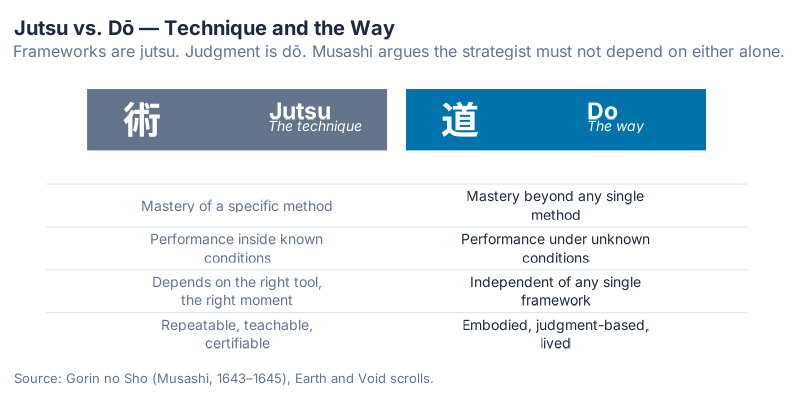
The most consequential distinction in Japanese martial philosophy is the one Musashi never lets the reader forget. Jutsu (術) is the technique — the named method, the executable procedure, the thing taught in a course and tested. Dō (道) is the way — the practice through which technique stops being a sequence of moves and becomes an embodied response to whatever the situation presents. Karate-jutsu becomes karate-dō. Ken-jutsu becomes ken-dō. Jutsu is what you do inside known conditions. Dō is what you become so that you can act outside them.
The operator who knows DCF, SWOT, Porter, OKRs, and a half-dozen consultancy frameworks is a jutsu practitioner. The mastery is real — but the frameworks decide what the operator sees, and the conditions they were built for are the conditions in which they work. Last week’s Schwerpunkt (Article 7) is itself a jutsu — a specific discipline of concentration, deeply teachable. Dō is what tells the operator that the chosen Schwerpunkt is on the wrong front before the math has been run.
The dō practitioner has used the same frameworks long enough that they have stopped being instruments and started being intuition. They no longer reach for SWOT; they notice the asymmetry SWOT is meant to surface, without naming it. They hear, in the first ten minutes of a competitor briefing, which of Porter’s five forces is doing the work this time. That is dō — the thing the McKinsey playbook cannot, by its own structure, teach.
Consider the head of procurement who walks into a supplier-review meeting and, within ten minutes, knows the renegotiation will fail — not because the spreadsheet says so, but because the supplier’s lead engineer is sitting on the wrong side of the table, the founder hasn’t been mentioned once, and the CFO is talking about quarter when she should be talking about programme. The Five Forces analysis would have arrived at the same conclusion three weeks later. Dō is what arrives in ten minutes.
Musashi’s claim, uncomfortable for any institution that sells frameworks: there is no dō without first mastering the jutsu, and no mastery without going past the jutsu into the dō.
Why Japanese Business Adopted Musashi
In the postwar decades, Japanese executives reached for the Gorin no Sho with the seriousness an American MBA cohort reaches for Drucker. The cultural fit was structural. Western strategy of the period was framework-led — Drucker, Ansoff, the rising consultancies. Japanese strategy, embedded in the keiretsu and its long horizons, was situation-led. Decisions emerged from context, not from a model. Gorin no Sho described, in pre-industrial vocabulary, exactly how that mind operates.
Kenichi Ohmae’s The Mind of the Strategist — published in Japanese in 1975, in English by McGraw-Hill in 1982 — sits in the same tradition: oblique, situation-driven, judgment-first. The strategist Ohmae describes is not the one who builds the cleanest matrix. It is the one who, after years of contact with the market, has earned the right to ignore the matrix when the matrix is wrong. Ohmae’s central argument is that good strategy does not come from analysis — that the seasoned strategist sees the shape of the problem before the analysis has had time to be run.
That is the bridge from Musashi to the modern boardroom. Not the sword. The training.
What the Western Reader Should Bring
Three rules for the Western reader.
Read it slowly. Gorin no Sho is roughly a hundred pages. A determined reader can finish it in an evening, most do, and most retain almost nothing. The book rewards being read across a year — a scroll a season — with the reader’s own situations as the laboratory.
Expect obliquity. Musashi does not argue the way a Western strategist argues. He sets down a principle, gives an example from combat, and moves on. The reader who keeps demanding "but what is the framework?" will close the book frustrated. The framework is the reader’s life. The book is the lens.
Use a serious translation. William Scott Wilson (1974) and Victor Harris (1974) are both defensible starts. Avoid the pop-business editions that retitle the scrolls and sprinkle in case studies — they translate Musashi into the exact framework-thinking the original was written to escape.
The reader who emerges with a list of bullet points has misread it. The one who starts to notice their own decisions differently has read it correctly.
Frameworks are jutsu. Judgment is dō. Strategy is not the matrix on the slide; it is the operator who knows when the matrix is wrong.
Friday — Article 9 in the series: the Fire scroll. Timing, rhythm, and when not to react.
Interactive Dashboard
Two short interactives. A Five Scrolls explorer — click through Earth, Water, Fire, Wind, and Void with a one-line prompt to apply each to a current situation. And a Dō / Jutsu self-assessment — eight forced-choice items that surface, honestly, which side of the distinction your habits sit on today.
Interactive Dashboard
Explore the data yourself — adjust parameters and see the results update in real time.
Show R Code
# =============================================================================
# generate_musashi_images.R
# -----------------------------------------------------------------------------
# Builds the three static images for Article 8 of the May 2026
# "Strategy That Lasts" series:
#   "The Way of Strategy: What a 17th-Century Swordsman Knew About Mastery"
#
# Outputs (in Images/):
#   1. musashi_strategist_timeline.png    (800x400)
#   2. musashi_five_scrolls_map.png       (800x500)
#   3. musashi_do_vs_jutsu.png            (800x400)
#
# Every fact below was verified against primary / encyclopedic sources before
# being committed to the chart. URLs are inline. Where authorship or dates are
# disputed (Sun Tzu, Musashi's birth year), the chart shows the most widely
# cited value and the dataset comments flag the uncertainty.
#
# RUN:  Rscript Scripts/generate_musashi_images.R
# =============================================================================

suppressPackageStartupMessages({
  library(ggplot2)
  library(dplyr)
  library(tibble)
  library(scales)
  library(sysfonts)
  library(showtext)
  library(stringr)
})

source("Scripts/theme_inphronesys.R")

# Load a CJK font so the Japanese kanji (地 水 火 風 空 術 道) render
# instead of "NO GLYPH" tofu. Inter has no CJK coverage.
font_add_google("Noto Sans JP", "NotoJP")
showtext_auto()

# -----------------------------------------------------------------------------
# 0. VERIFIED FACTS TABLE — printed to stdout so reviewers can cross-check
# -----------------------------------------------------------------------------
verified_facts <- tribble(
  ~fact,                                                          ~value,                                        ~source,
  "Sun Tzu (Sun Wu) — traditional period",                        "~5th century BC",                             "https://www.britannica.com/biography/Sunzi",
  "Sun Tzu authorship — note",                                    "contested; composite text 5th-4th c. BCE",    "https://en.wikipedia.org/wiki/The_Art_of_War",
  "Clausewitz birth",                                             "1 June 1780",                                 "https://www.britannica.com/biography/Carl-von-Clausewitz",
  "Clausewitz death",                                             "16 Nov 1831",                                 "https://www.britannica.com/biography/Carl-von-Clausewitz",
  "Vom Kriege first published",                                   "1832 (posthumous, ed. Marie von Bruehl)",     "https://en.wikipedia.org/wiki/On_War",
  "Musashi birth",                                                "1584 (some sources 1582; Britannica: 1584)",  "https://www.britannica.com/biography/Miyamoto-Musashi-Japanese-soldier-artist",
  "Musashi death",                                                "13 June 1645, Higo",                          "https://www.britannica.com/biography/Miyamoto-Musashi-Japanese-soldier-artist",
  "Musashi duels (self-reported, Earth scroll opening)",          "more than 60, all won",                       "https://www.britannica.com/biography/Miyamoto-Musashi-Japanese-soldier-artist",
  "Gorin no Sho writing period",                                  "1643-1645 (Reigando cave retreat)",           "https://en.wikipedia.org/wiki/The_Book_of_Five_Rings",
  "Niten Ichi-ryu founding",                                      "early 17th c.; exact year disputed",          "https://en.wikipedia.org/wiki/Niten_Ichi-ry%C5%AB",
  "Five Scrolls — Earth",                                         "Chi (地) — foundations and overview",          "https://en.wikipedia.org/wiki/The_Book_of_Five_Rings",
  "Five Scrolls — Water",                                         "Sui (水) — fluidity and adaptability",         "https://en.wikipedia.org/wiki/The_Book_of_Five_Rings",
  "Five Scrolls — Fire",                                          "Ka (火) — combat, timing, intensity",          "https://en.wikipedia.org/wiki/The_Book_of_Five_Rings",
  "Five Scrolls — Wind",                                          "Fu (風) — critique of other schools",          "https://en.wikipedia.org/wiki/The_Book_of_Five_Rings",
  "Five Scrolls — Void",                                          "Ku (空) — the ultimate principle, emptiness",  "https://en.wikipedia.org/wiki/The_Book_of_Five_Rings",
  "Ohmae 'Mind of the Strategist' — Japanese ed.",                "1975",                                        "https://thinkers50.com/blog/the-mind-of-the-strategist/",
  "Ohmae 'Mind of the Strategist' — English ed.",                 "1982 (McGraw-Hill)",                          "https://thinkers50.com/blog/the-mind-of-the-strategist/",
  "Ohmae explicit Musashi reference",                             "UNVERIFIED in secondary sources",              "see dataset notes"
)

cat("\n========================================================================\n")
cat("VERIFIED FACTS TABLE  (Musashi profile, Article 8 of May 2026 series)\n")
cat("========================================================================\n")
print(verified_facts, n = Inf, width = Inf)
cat("\n")

# -----------------------------------------------------------------------------
# IMAGE 1 — Strategist Timeline
# Three strategists on one horizontal timeline; Musashi in focus (iph blue),
# others in light grey. We extend the axis far enough left to include Sun Tzu
# but visually compress the gap with a break annotation rather than literal
# scale break (axis break geoms render via inline SVG primitives).
# -----------------------------------------------------------------------------

# We render the timeline on a synthetic compressed x-axis so Sun Tzu (~-450)
# does not crush Clausewitz / Musashi into a sliver. We use ordered category
# positions and label them with their actual dates.
strategist_lives <- tribble(
  ~strategist,    ~xpos, ~birth_label, ~death_label, ~life_label,           ~book_label,                        ~focus,
  "Sun Tzu",         1,  "~5th c. BC", "",           "Tradition: 5th c. BC", "The Art of War",                   FALSE,
  "Clausewitz",      2,  "1780",        "1831",      "1780 - 1831",          "Vom Kriege (publ. 1832)",          FALSE,
  "Musashi",         3,  "1584",        "1645",      "1584 - 1645",          "Gorin no Sho (1643-1645)",         TRUE
)

p1 <- ggplot(strategist_lives, aes(x = xpos, y = 1)) +
  # the connecting baseline
  geom_segment(
    aes(x = 0.6, xend = 3.4, y = 1, yend = 1),
    colour = iph_colors$lightgrey, linewidth = 0.6
  ) +
  # life-span bars
  geom_segment(
    aes(x = xpos - 0.18, xend = xpos + 0.18, y = 1, yend = 1,
        colour = focus),
    linewidth = 7, lineend = "round"
  ) +
  scale_colour_manual(
    values = c("TRUE" = iph_colors$blue, "FALSE" = iph_colors$lightgrey),
    guide = "none"
  ) +
  # strategist names above the bar
  geom_text(
    aes(x = xpos, y = 1.55, label = strategist,
        colour = focus, fontface = ifelse(focus, "bold", "plain")),
    family = "Inter", size = 5
  ) +
  # life dates just below the bar
  geom_text(
    aes(x = xpos, y = 0.65, label = life_label),
    family = "Inter", size = 3.6, colour = iph_colors$grey
  ) +
  # canonical work below
  geom_text(
    aes(x = xpos, y = 0.30, label = book_label),
    family = "Inter", size = 3.4, colour = iph_colors$dark,
    fontface = "italic"
  ) +
  # spacer arrows / "centuries apart" annotations
  annotate("text", x = 1.5, y = 1.15, label = "~ 2,000 years",
           family = "Inter", size = 3.0, colour = iph_colors$grey) +
  annotate("text", x = 2.5, y = 1.15, label = "~ 250 years",
           family = "Inter", size = 3.0, colour = iph_colors$grey) +
  scale_x_continuous(limits = c(0.4, 3.6), expand = c(0, 0)) +
  scale_y_continuous(limits = c(0, 2), expand = c(0, 0)) +
  labs(
    title = "Three Strategists, One Conversation",
    subtitle = "Different continents, centuries apart — still read together by modern strategists.",
    caption  = "Sources: Britannica (Musashi, Clausewitz, Sunzi); Wikipedia, On War. Sun Tzu authorship contested.",
    x = NULL, y = NULL
  ) +
  theme_inphronesys(base_size = 13, grid = "none") +
  theme(
    axis.text  = element_blank(),
    axis.title = element_blank(),
    panel.grid = element_blank()
  )

ggsave(
  "https://inphronesys.com/wp-content/uploads/2026/05/musashi_strategist_timeline.png",
  plot   = p1,
  width  = 8, height = 4, dpi = 100, bg = "white"
)

# -----------------------------------------------------------------------------
# IMAGE 2 — Five Scrolls Map
# Five tiles (Earth, Water, Fire, Wind, Void) in canonical order with kanji,
# romaji, and a one-line theme verified from the Gorin no Sho.
# -----------------------------------------------------------------------------

scrolls <- tribble(
  ~order, ~en,     ~kanji,  ~romaji, ~theme,
  1,      "Earth", "地", "Chi",   "Foundations, overview, the strategist's ground",
  2,      "Water", "水", "Sui",   "Fluidity, adaptability, the shape of response",
  3,      "Fire",  "火", "Ka",    "Combat, timing, intensity of engagement",
  4,      "Wind",  "風", "Fu",    "Knowing other schools — and their limits",
  5,      "Void",  "空", "Ku",    "Emptiness — acting without dependence on form"
) |>
  mutate(
    xpos = order,
    # alternating soft accent colours so the row reads as a sequence,
    # not a uniform block. All within iph palette.
    fill_col = c(
      iph_colors$blue,
      iph_colors$teal,
      iph_colors$red,
      iph_colors$orange,
      iph_colors$navy
    )
  )

p2 <- ggplot(scrolls, aes(x = xpos, y = 1)) +
  # tile body
  geom_tile(
    aes(fill = fill_col),
    width = 0.85, height = 1.05,
    colour = "white", linewidth = 1
  ) +
  scale_fill_identity() +
  # kanji (big) — uses NotoJP for CJK glyph coverage
  geom_text(
    aes(label = kanji),
    family = "NotoJP", size = 16, colour = "white", fontface = "bold",
    y = 1.20
  ) +
  # romaji
  geom_text(
    aes(label = romaji),
    family = "Inter", size = 4, colour = "white",
    y = 0.78, fontface = "italic"
  ) +
  # english name (above tile)
  geom_text(
    aes(label = en),
    family = "Inter", size = 5, colour = iph_colors$dark, fontface = "bold",
    y = 1.95
  ) +
  # one-line theme (below tile) -- wrap manually with \n if long
  geom_text(
    aes(label = stringr::str_wrap(theme, width = 22)),
    family = "Inter", size = 3.3, colour = iph_colors$dark,
    y = 0.05, vjust = 1, lineheight = 1.05
  ) +
  scale_x_continuous(limits = c(0.4, 5.6), expand = c(0, 0)) +
  scale_y_continuous(limits = c(-0.55, 2.25), expand = c(0, 0)) +
  labs(
    title = "The Five Scrolls of Gorin no Sho",
    subtitle = "Musashi's text is structured as five scrolls — each names a level of strategic understanding.",
    caption  = "Source: Gorin no Sho (Musashi, 1643–1645). Kanji and themes per William Scott Wilson translation (1974).",
    x = NULL, y = NULL
  ) +
  theme_inphronesys(base_size = 13, grid = "none") +
  theme(
    axis.text  = element_blank(),
    axis.title = element_blank(),
    panel.grid = element_blank()
  )

# Load stringr only here, after we know we need str_wrap
suppressPackageStartupMessages(library(stringr))

ggsave(
  "https://inphronesys.com/wp-content/uploads/2026/05/musashi_five_scrolls_map.png",
  plot   = p2,
  width  = 8, height = 5, dpi = 100, bg = "white"
)

# -----------------------------------------------------------------------------
# IMAGE 3 — Do (the Way) vs. Jutsu (the technique)
# Two-column conceptual contrast, four attributes per side.
# -----------------------------------------------------------------------------

contrast <- tribble(
  ~side,    ~kanji,   ~name,           ~tagline,                                      ~attr,                                          ~order,
  "jutsu",  "術", "Jutsu",         "The technique",                               "Mastery of a specific method",                  1,
  "jutsu",  "術", "Jutsu",         "The technique",                               "Performance inside known conditions",           2,
  "jutsu",  "術", "Jutsu",         "The technique",                               "Depends on the right tool, the right moment",   3,
  "jutsu",  "術", "Jutsu",         "The technique",                               "Repeatable, teachable, certifiable",            4,

  "do",     "道", "Do",            "The way",                                     "Mastery beyond any single method",              1,
  "do",     "道", "Do",            "The way",                                     "Performance under unknown conditions",          2,
  "do",     "道", "Do",            "The way",                                     "Independent of any single framework",           3,
  "do",     "道", "Do",            "The way",                                     "Embodied, judgment-based, lived",               4
)

# Header rows (one per side)
header_df <- contrast |>
  distinct(side, kanji, name, tagline) |>
  mutate(
    xpos     = ifelse(side == "jutsu", 1, 2),
    fill_col = ifelse(side == "jutsu", iph_colors$grey, iph_colors$blue)
  )

# Attribute rows
attr_df <- contrast |>
  mutate(
    xpos = ifelse(side == "jutsu", 1, 2),
    ypos = 4.2 - order      # row 1 highest
  )

# Recompute attribute row positions so they sit below the header with breathing room.
# We use rows at y = 4.0, 3.0, 2.0, 1.0  (1.0 separation between rows).
attr_df <- attr_df |>
  mutate(ypos = 5.0 - order)   # order 1 -> 4.0, 2 -> 3.0, 3 -> 2.0, 4 -> 1.0

p3 <- ggplot() +
  # header tile per side — wide enough to fit kanji left, text right
  geom_tile(
    data = header_df,
    aes(x = xpos, y = 6.0, fill = fill_col),
    width = 0.95, height = 1.5, colour = "white", linewidth = 1
  ) +
  scale_fill_identity() +
  # kanji on the LEFT half of the header tile
  geom_text(
    data = header_df,
    aes(x = xpos - 0.30, y = 6.0, label = kanji),
    family = "NotoJP", size = 10, colour = "white", fontface = "bold"
  ) +
  # name (Jutsu / Do) on the RIGHT half, upper
  geom_text(
    data = header_df,
    aes(x = xpos + 0.10, y = 6.20, label = name),
    family = "Inter", size = 6, colour = "white", fontface = "bold",
    hjust = 0
  ) +
  # tagline on the RIGHT half, lower
  geom_text(
    data = header_df,
    aes(x = xpos + 0.10, y = 5.85, label = tagline),
    family = "Inter", size = 3.6, colour = "white", fontface = "italic",
    hjust = 0
  ) +
  # row separators (light horizontal lines between attribute rows)
  geom_segment(
    data = tibble(y = c(4.5, 3.5, 2.5, 1.5)),
    aes(x = 0.4, xend = 2.6, y = y, yend = y),
    colour = iph_colors$lightgrey, linewidth = 0.4
  ) +
  # attribute text
  geom_text(
    data = attr_df,
    aes(x = xpos, y = ypos, label = stringr::str_wrap(attr, width = 28),
        colour = side),
    family = "Inter", size = 3.7, lineheight = 1.05
  ) +
  scale_colour_manual(
    values = c("jutsu" = iph_colors$grey, "do" = iph_colors$dark),
    guide  = "none"
  ) +
  scale_x_continuous(limits = c(0.3, 2.7), expand = c(0, 0)) +
  scale_y_continuous(limits = c(0.4, 7.0), expand = c(0, 0)) +
  labs(
    title = "Jutsu vs. Dō — Technique and the Way",
    subtitle = "Frameworks are jutsu. Judgment is dō. Musashi argues the strategist must not depend on either alone.",
    caption  = "Source: Gorin no Sho (Musashi, 1643–1645), Earth and Void scrolls.",
    x = NULL, y = NULL
  ) +
  theme_inphronesys(base_size = 13, grid = "none") +
  theme(
    axis.text  = element_blank(),
    axis.title = element_blank(),
    panel.grid = element_blank()
  )

ggsave(
  "https://inphronesys.com/wp-content/uploads/2026/05/musashi_do_vs_jutsu.png",
  plot   = p3,
  width  = 8, height = 4, dpi = 100, bg = "white"
)

# -----------------------------------------------------------------------------
# Confirm outputs
# -----------------------------------------------------------------------------
out_files <- c(
  "https://inphronesys.com/wp-content/uploads/2026/05/musashi_strategist_timeline.png",
  "https://inphronesys.com/wp-content/uploads/2026/05/musashi_five_scrolls_map.png",
  "https://inphronesys.com/wp-content/uploads/2026/05/musashi_do_vs_jutsu.png"
)
cat("\n--- Output files ---\n")
for (f in out_files) {
  if (file.exists(f)) {
    cat(sprintf("OK    %s  (%.1f KB)\n", f, file.info(f)$size / 1024))
  } else {
    cat(sprintf("MISS  %s\n", f))
  }
}
cat("\nDone.\n")
References
- Miyamoto Musashi. Gorin no Sho (The Book of Five Rings), written 1643–1645 at the Reigandō cave on Kyushu, completed weeks before the author’s death in June 1645. English translations cited in this article: William Scott Wilson, The Book of Five Rings (Tokyo: Kodansha International, 1974); Victor Harris, A Book of Five Rings (Woodstock, NY: Overlook Press, 1974).
- Tokitsu, Kenji. Miyamoto Musashi: His Life and Writings. Translated by Sherab Chödzin Kohn. Boston: Shambhala, 2004. ISBN 978-1-59030-045-9. Recommended scholarly biography; source for the Arima Kihei duel (1596) and the traditional account of Musashi’s presence at Sekigahara (1600) on the Toyotomi-loyalist side under Ukita Hideie.
- Britannica entry: "Miyamoto Musashi — Japanese soldier-artist." https://www.britannica.com/biography/Miyamoto-Musashi-Japanese-soldier-artist. Source for the dates (1584–1645), the duel record ("more than 60 individual sword fights, many of which were to the death and all of which he won"), and the writing period at the Reigandō cave.
- "The Book of Five Rings." Wikipedia. https://en.wikipedia.org/wiki/The_Book_of_Five_Rings. Source for the canonical scroll order and themes (Earth / Water / Fire / Wind / Void).
- "Niten Ichi-ryū." Wikipedia. https://en.wikipedia.org/wiki/Niten_Ichi-ryū. Source for the school’s founding in the early Edo period and the two-sword technical signature.
- Britannica entry: "Carl von Clausewitz." https://www.britannica.com/biography/Carl-von-Clausewitz. Source for Clausewitz (1780–1831).
- "On War" (Vom Kriege). Wikipedia. https://en.wikipedia.org/wiki/On_War. Source for the 1832 posthumous publication by Marie von Brühl.
- Britannica entry: "Sunzi." https://www.britannica.com/biography/Sunzi. Source for the traditional 5th-century BC dating of Sun Tzu, and the note that authorship is contested.
- Ohmae, Kenichi. The Mind of the Strategist: The Art of Japanese Business. New York: McGraw-Hill, 1982 (English edition); original Japanese edition published 1975. Thinkers50 reference: https://thinkers50.com/blog/the-mind-of-the-strategist/.
- Articles 1–7 in this series — Strategy That Lasts: The Classics, May 2026, on inphronesys.com.
Leave a Reply