
Most strategy talk is about action. Bold moves. Decisive pivots. The big reorganisation. The acquisition. The launch.
Sun Tzu would have found this faintly embarrassing.
The masters did not believe the fight was won by fighting. They believed it was won — or lost — by the position taken before anyone drew a sword.
"Thus it is that in war the victorious strategist only seeks battle after the victory has been won, whereas he who is destined to defeat first fights and afterwards looks for victory." (Sun Tzŭ, Ch.IV, §15, trans. Giles 1910)
The decisive act is not the battle. It is the positioning that makes the battle a formality.
What Is Shih? (势)
The Chinese character is shih (Wade-Giles) or shi (pinyin). Giles renders it as "energy", which is good enough for our purposes — though the concept it describes is closer to stored potential energy of a chosen position.
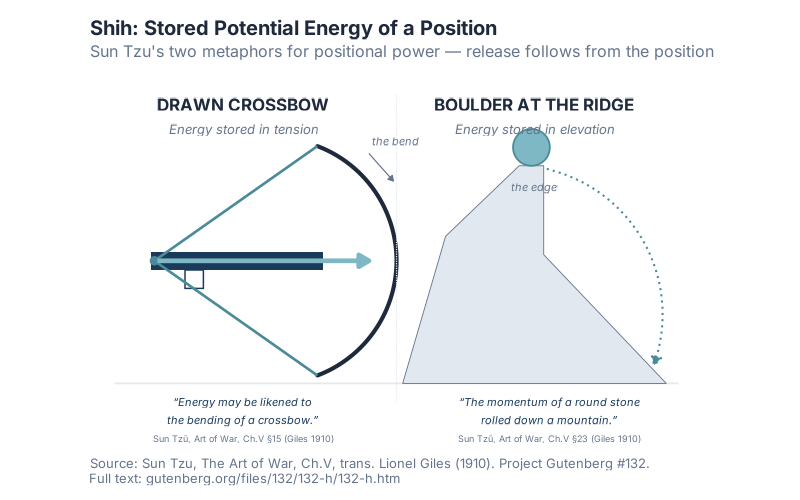
Two of Sun Tzu’s analogies anchor it. Both are mechanical. Both are about a system that has been set up such that the outcome, once released, is no longer in doubt.
"Energy may be likened to the bending of a crossbow; decision, to the releasing of the trigger." (Sun Tzŭ, Ch.V, §15, trans. Giles 1910)
"Thus the energy developed by good fighting men is as the momentum of a round stone rolled down a mountain thousands of feet in height. So much on the subject of energy." (Sun Tzŭ, Ch.V, §23, trans. Giles 1910)
The crossbow does not decide. The boulder does not deliberate. The positioning — the bent bow, the stone perched at the cliff edge — has already determined what happens next. The trigger pull is administrative.
This is what shih means in a strategic sense: the work is in choosing and shaping the position. Once the position is sound, action is cheap. Once the position is wrong, action is expensive — and usually too late.
Invincibility Lies in the Defence
Sun Tzu’s Chapter IV — Tactical Dispositions — is, despite its dry title, the most uncompromising statement of the positioning idea anywhere in the book.
"The good fighters of old first put themselves beyond the possibility of defeat, and then waited for an opportunity of defeating the enemy." (Sun Tzŭ, Ch.IV, §1, trans. Giles 1910)
"To secure ourselves against defeat lies in our own hands, but the opportunity of defeating the enemy is provided by the enemy himself." (Sun Tzŭ, Ch.IV, §2, trans. Giles 1910)
Translated plainly: you cannot be beaten if your position is sound. You can only win if the enemy’s position is not. That is asymmetric in an important way — your defensibility is yours to engineer; victory is partly the gift of someone else’s mistake.
This is the part of strategy that gets confused with passivity. It is not. Building a position "beyond the possibility of defeat" is brutally active work — the modern names for its outputs (platform lock-in, regulatory capture, scale economics, switching costs, network effects, cash-flow defensiveness) describe years of patient construction, not the absence of effort.
A positioned market looks like this:
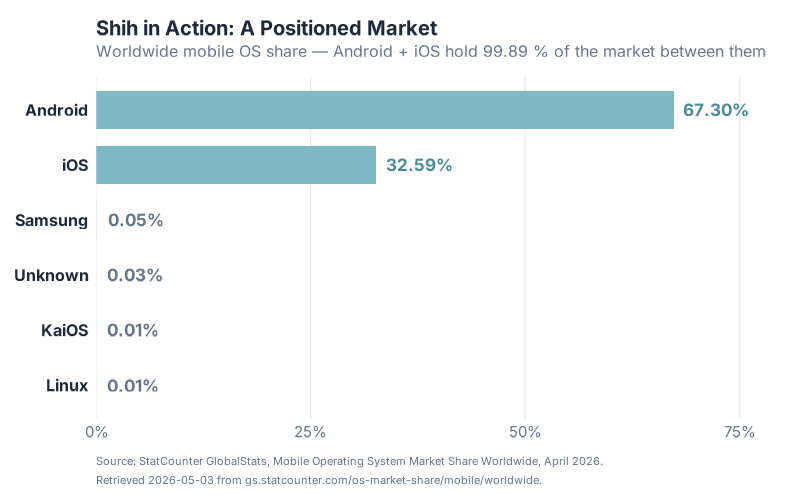
That is the worldwide mobile operating system market in April 2026. Android sits at 67.3%. iOS at 32.59%. Together they account for 99.89% of every smartphone shipped on the planet (StatCounter GlobalStats, Mobile Operating System Market Share Worldwide, April 2026; retrieved 2026-05-03 from gs.statcounter.com/os-market-share/mobile/worldwide).
There is no challenger here. No clever pivot, no funded insurgent, no app-store rebellion that closes the gap. The duopoly is not loved — it is positioned. Apple and Google have, in Sun Tzu’s phrase, put themselves beyond the possibility of defeat. Whatever that means for competition policy, it is a textbook demonstration of shih: the position itself does the work.
Water and the Shapeless Form
A positioned advantage is not a fixed advantage. Sun Tzu was specific about this.
"Military tactics are like unto water; for water in its natural course runs away from high places and hastens downwards." (Sun Tzŭ, Ch.VI, §29, trans. Giles 1910)
"Water shapes its course according to the nature of the ground over which it flows; the soldier works out his victory in relation to the foe whom he is facing." (Sun Tzŭ, Ch.VI, §31, trans. Giles 1910)
"Therefore, just as water retains no constant shape, so in warfare there are no constant conditions." (Sun Tzŭ, Ch.VI, §32, trans. Giles 1910)
The shape of a strong position is dictated by the terrain — the customer, the competitor, the regulator — not by the plan. Five-year strategy decks commit to a shape (a target market, a portfolio mix, a margin profile) and defend it past the point where the terrain has moved.
Shih is not the rigid shape. Shih is the energy of being correctly positioned for whatever shape the ground demands next. Water flowing downhill does not need a five-year plan — it needs to know which way is down.
Positioning vs. Maneuvering: The Sun Tzu Strategic Loop
Put together, the May 2026 series so far gives us a three-stage loop.
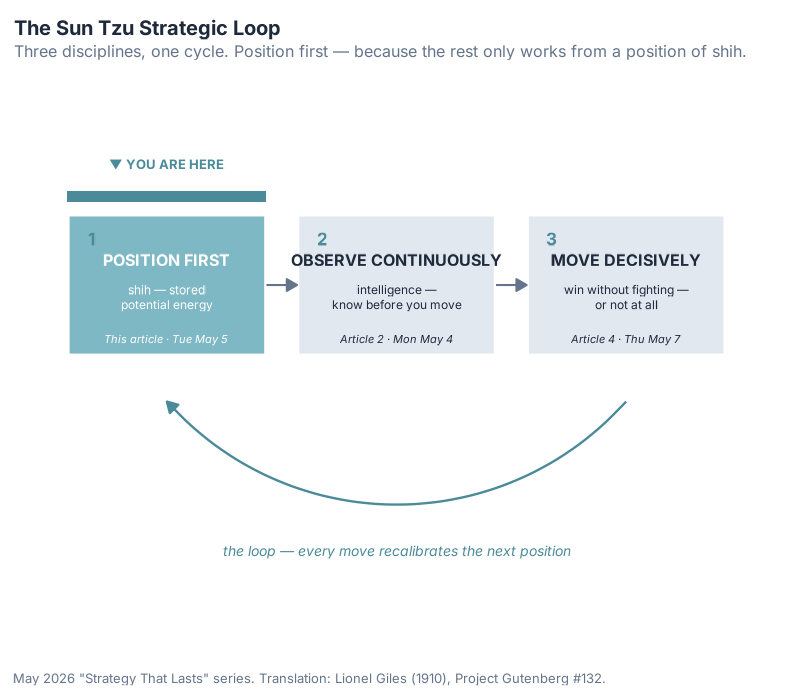
- Position First (shih). Engineer the moats. Choose terrain where victory is the path of least resistance — like water flowing downhill. (This article.)
- Observe Continuously (foreknowledge). Once positioned, you still need contact with the world. Sun Tzu’s intelligence doctrine is the engine that keeps the position aligned with reality. (See Article 2 of this series, Know Before You Move: Sun Tzu’s Intelligence Doctrine, published Monday May 4.)
- Move Decisively. When the moment comes — the trigger pull, the boulder release — there is no hesitation. The fight, when it happens, is brief. (Teaser for Article 4: winning without fighting, Thursday May 7.)
Most companies operate this loop in the wrong order. They move first, observe second, and only ask about positioning during the post-mortem. Sun Tzu’s order is non-negotiable.
What to do this week (head-of-strategy edition):
- Audit your moats — honestly. Write down each defensible position your firm claims (platform, regulatory, scale, switching cost, cash). For each, name the primary evidence it still holds. If you cannot, it is a story, not a moat.
- Name the one advantage you actually have. Most firms have one — sometimes two — genuine sources of shih. The rest are aspirations. The teams that win are usually the teams that know which is which.
- Identify one position you keep defending out of habit. Every strategy has a sunk-cost shape that the terrain has already moved past. Sun Tzu’s water analogy says: stop holding it. The ground has changed.
Tomorrow we leave defensive positioning behind and ask the harder question: when shih is on your side, what does winning without fighting actually look like? (Article 4 — Thursday May 7.)
Interactive Dashboard
Interactive Dashboard
Explore the data yourself — adjust parameters and see the results update in real time.
Show R Code
# =============================================================================
# generate_shih_positioning_images.R
# Charts for "Shaping the Battlefield: Sun Tzu on Positioning Before Competition"
# Article 3 of 15 — Strategy That Lasts series (May 2026)
# =============================================================================
#
# Output files (all 800px wide, dpi=100, bg='white'):
#   https://inphronesys.com/wp-content/uploads/2026/05/shih_potential_energy.png      (CONCEPTUAL — crossbow + boulder)
#   https://inphronesys.com/wp-content/uploads/2026/05/shih_concentrated_market.png   (NUMERIC — StatCounter mobile OS Apr 2026)
#   https://inphronesys.com/wp-content/uploads/2026/05/shih_strategic_loop.png        (CONCEPTUAL — three-stage Sun Tzu loop)
#
# Translation locked: GILES (1910), public-domain. Project Gutenberg #132.
# Sun Tzu accent color: #7EB8C4 (May 2026 series tag); dark variant #4A8A99.
# =============================================================================

suppressPackageStartupMessages({
  library(ggplot2)
  library(dplyr)
  library(tidyr)
  library(scales)
})

source("Scripts/theme_inphronesys.R")

# Sun Tzu accent (May 2026 series tag)
suntzu_teal      <- "#7EB8C4"
suntzu_teal_dark <- "#4A8A99"

# =============================================================================
# CHART 1 — Shih: Stored Potential Energy of a Position (CONCEPTUAL)
# =============================================================================
# Two side-by-side metaphors from Sun Tzu Ch.V "Energy" (Giles 1910):
#   (a) the drawn crossbow      — energy stored in tension (Ch.V §15)
#   (b) the round-stone boulder — energy stored in elevation (Ch.V §22-§23)
# Source: Sun Tzu, The Art of War, Ch.V, trans. Lionel Giles (1910).
# https://www.gutenberg.org/files/132/132-h/132-h.htm#chap13
# =============================================================================

# --- Helpers: parametric shapes ---
arc_path <- function(cx, cy, r, theta_from, theta_to, n = 60) {
  theta <- seq(theta_from, theta_to, length.out = n)
  data.frame(x = cx + r * cos(theta), y = cy + r * sin(theta))
}

circle_path <- function(cx, cy, r, n = 80) {
  arc_path(cx, cy, r, 0, 2 * pi, n)
}

# --- (a) Drawn crossbow geometry ---
stock <- data.frame(xmin = 1.0, xmax = 3.8, ymin = 2.85, ymax = 3.15)

bow_arc <- arc_path(cx = 3.0, cy = 3.0, r = 2.0,
                    theta_from = -pi / 2.6, theta_to = pi / 2.6, n = 80)

string_top    <- data.frame(x = c(bow_arc$x[length(bow_arc$x)], 1.05),
                            y = c(bow_arc$y[length(bow_arc$y)], 3.00))
string_bottom <- data.frame(x = c(bow_arc$x[1], 1.05),
                            y = c(bow_arc$y[1], 3.00))

arrow_shaft <- data.frame(x = c(1.10, 4.55), y = c(3.00, 3.00))

# --- (b) Boulder at the cliff edge geometry ---
mtn <- data.frame(
  x = c(5.10, 5.80, 7.00, 7.40, 7.40, 9.40, 9.40),
  y = c(1.00, 3.40, 4.55, 4.55, 3.10, 1.00, 1.00)
)

boulder <- circle_path(cx = 7.20, cy = 4.85, r = 0.30)

fall_endpoints <- data.frame(x = 7.45, y = 4.50, xend = 9.20, yend = 1.30)

p1 <- ggplot() +
  annotate("segment", x = 0.4, xend = 9.6, y = 1.0, yend = 1.0,
           color = iph_colors$lightgrey, linewidth = 0.6) +
  geom_rect(data = stock,
            aes(xmin = xmin, xmax = xmax, ymin = ymin, ymax = ymax),
            fill = iph_colors$navy, color = NA) +
  annotate("rect", xmin = 1.55, xmax = 1.85, ymin = 2.55, ymax = 2.85,
           fill = NA, color = iph_colors$navy, linewidth = 0.5) +
  geom_path(data = bow_arc, aes(x = x, y = y),
            color = iph_colors$dark, linewidth = 1.4, lineend = "round") +
  geom_path(data = string_top, aes(x = x, y = y),
            color = suntzu_teal_dark, linewidth = 0.9) +
  geom_path(data = string_bottom, aes(x = x, y = y),
            color = suntzu_teal_dark, linewidth = 0.9) +
  annotate("point", x = 1.05, y = 3.0, color = suntzu_teal_dark, size = 2.4) +
  annotate("segment", x = arrow_shaft$x[1], xend = arrow_shaft$x[2],
           y = arrow_shaft$y[1], yend = arrow_shaft$y[2],
           color = suntzu_teal, linewidth = 1.6,
           arrow = arrow(length = unit(0.30, "cm"), type = "closed")) +
  annotate("text", x = 2.5, y = 5.55, label = "DRAWN CROSSBOW",
           fontface = "bold", size = 4.4, color = iph_colors$dark, family = "Inter") +
  annotate("text", x = 2.5, y = 5.15, label = "Energy stored in tension",
           fontface = "italic", size = 3.5, color = iph_colors$grey, family = "Inter") +
  annotate("segment", x = 4.55, xend = 4.95, y = 4.75, yend = 4.30,
           color = iph_colors$grey, linewidth = 0.4,
           arrow = arrow(length = unit(0.15, "cm"), type = "closed")) +
  annotate("text", x = 4.6, y = 4.95, label = "the bend", size = 3.0,
           color = iph_colors$grey, family = "Inter", fontface = "italic", hjust = 0) +
  annotate("text", x = 2.5, y = 0.70, label = "“Energy may be likened to",
           size = 2.9, color = iph_colors$navy, family = "Inter", fontface = "italic") +
  annotate("text", x = 2.5, y = 0.40, label = "the bending of a crossbow.”",
           size = 2.9, color = iph_colors$navy, family = "Inter", fontface = "italic") +
  annotate("text", x = 2.5, y = 0.10,
           label = "Sun Tzŭ, Art of War, Ch.V §15 (Giles 1910)",
           size = 2.4, color = iph_colors$grey, family = "Inter") +
  annotate("segment", x = 5.0, xend = 5.0, y = 0.7, yend = 5.7,
           color = iph_colors$lightgrey, linewidth = 0.4, linetype = "11") +
  geom_polygon(data = mtn, aes(x = x, y = y),
               fill = iph_colors$lightgrey, color = iph_colors$grey, linewidth = 0.3) +
  geom_polygon(data = boulder, aes(x = x, y = y),
               fill = suntzu_teal, color = suntzu_teal_dark, linewidth = 0.6) +
  geom_curve(data = fall_endpoints,
             aes(x = x, y = y, xend = xend, yend = yend),
             color = suntzu_teal_dark, linewidth = 0.7, linetype = "12",
             curvature = -0.45, ncp = 12,
             arrow = arrow(length = unit(0.25, "cm"), type = "closed")) +
  annotate("text", x = 7.25, y = 5.55, label = "BOULDER AT THE RIDGE",
           fontface = "bold", size = 4.4, color = iph_colors$dark, family = "Inter") +
  annotate("text", x = 7.25, y = 5.15, label = "Energy stored in elevation",
           fontface = "italic", size = 3.5, color = iph_colors$grey, family = "Inter") +
  annotate("text", x = 7.25, y = 4.20, label = "the edge",
           size = 3.0, color = iph_colors$grey, family = "Inter", fontface = "italic") +
  annotate("text", x = 7.50, y = 0.70, label = "“The momentum of a round stone",
           size = 2.9, color = iph_colors$navy, family = "Inter", fontface = "italic") +
  annotate("text", x = 7.50, y = 0.40, label = "rolled down a mountain.”",
           size = 2.9, color = iph_colors$navy, family = "Inter", fontface = "italic") +
  annotate("text", x = 7.50, y = 0.10,
           label = "Sun Tzŭ, Art of War, Ch.V §23 (Giles 1910)",
           size = 2.4, color = iph_colors$grey, family = "Inter") +
  scale_x_continuous(limits = c(0.0, 10.0), expand = c(0, 0)) +
  scale_y_continuous(limits = c(0.0, 6.0), expand = c(0, 0)) +
  coord_fixed(clip = "off") +
  labs(
    title = "Shih: Stored Potential Energy of a Position",
    subtitle = "Sun Tzu's two metaphors for positional power — release follows from the position",
    caption = paste(
      "Source: Sun Tzu, The Art of War, Ch.V, trans. Lionel Giles (1910). Project Gutenberg #132.",
      "Full text: gutenberg.org/files/132/132-h/132-h.htm",
      sep = "\n"
    )
  ) +
  theme_inphronesys(grid = "none") +
  theme(axis.title = element_blank(), axis.text = element_blank(),
        panel.grid = element_blank(), plot.margin = margin(15, 15, 10, 10))

ggsave("https://inphronesys.com/wp-content/uploads/2026/05/shih_potential_energy.png", p1,
       width = 8, height = 5, dpi = 100, bg = "white")

# =============================================================================
# CHART 2 — Concentrated Market: Shih in Action (NUMERIC — primary-cited)
# =============================================================================
# Source: StatCounter GlobalStats, Mobile Operating System Market Share
# Worldwide, April 2026. Retrieved 2026-05-03.
# URL: https://gs.statcounter.com/os-market-share/mobile/worldwide
# =============================================================================

mobile_os <- tibble::tribble(
  ~os,        ~pct,    ~kind,
  "Android",  67.30,   "Positioned",
  "iOS",      32.59,   "Positioned",
  "Samsung",   0.05,   "Long tail",
  "Unknown",   0.03,   "Long tail",
  "KaiOS",     0.01,   "Long tail",
  "Linux",     0.01,   "Long tail"
) |>
  mutate(
    os    = factor(os, levels = rev(os)),
    kind  = factor(kind, levels = c("Positioned", "Long tail")),
    label = paste0(format(pct, nsmall = 2, trim = TRUE), "%")
  )

p2 <- ggplot(mobile_os, aes(x = pct, y = os, fill = kind)) +
  geom_col(width = 0.7) +
  geom_text(aes(label = label, color = kind,
                hjust = ifelse(pct < 5, -0.2, -0.15)),
            fontface = "bold", size = 4.4, family = "Inter") +
  scale_fill_manual(values = c("Positioned" = suntzu_teal,
                                "Long tail"  = iph_colors$lightgrey),
                     guide = "none") +
  scale_color_manual(values = c("Positioned" = suntzu_teal_dark,
                                 "Long tail"  = iph_colors$grey),
                      guide = "none") +
  scale_x_continuous(limits = c(0, 78), breaks = seq(0, 75, 25),
                     labels = function(x) paste0(x, "%"), expand = c(0, 0)) +
  labs(
    title = "Shih in Action: A Positioned Market",
    subtitle = "Worldwide mobile OS share — Android + iOS hold 99.89 % of the market between them",
    x = NULL, y = NULL,
    caption = paste(
      "Source: StatCounter GlobalStats, Mobile Operating System Market Share Worldwide, April 2026.",
      "Retrieved 2026-05-03 from gs.statcounter.com/os-market-share/mobile/worldwide.",
      sep = "\n"
    )
  ) +
  theme_inphronesys(grid = "x") +
  theme(
    axis.text.y = element_text(size = 12, color = iph_colors$dark,
                                face = "bold", hjust = 1),
    panel.grid.major.y = element_blank(),
    plot.caption = element_text(size = 8.5, color = iph_colors$grey,
                                 hjust = 0, lineheight = 1.3,
                                 margin = margin(t = 12)),
    plot.margin = margin(15, 25, 10, 10)
  )

ggsave("https://inphronesys.com/wp-content/uploads/2026/05/shih_concentrated_market.png", p2,
       width = 8, height = 5, dpi = 100, bg = "white")

# =============================================================================
# CHART 3 — The Sun Tzu Strategic Loop (CONCEPTUAL)
# =============================================================================

stages <- tibble::tribble(
  ~order, ~x,   ~y,    ~title,                   ~tag,                                       ~ref,                       ~fill,                ~textcol,
  1L,     2.0,  4.5,   "POSITION FIRST",         "shih — stored\npotential energy",       "This article · Tue May 5",  suntzu_teal,          "white",
  2L,     5.0,  4.5,   "OBSERVE CONTINUOUSLY",   "intelligence —\nknow before you move",  "Article 2 · Mon May 4",     iph_colors$lightgrey, iph_colors$dark,
  3L,     8.0,  4.5,   "MOVE DECISIVELY",        "win without fighting —\nor not at all", "Article 4 · Thu May 7",     iph_colors$lightgrey, iph_colors$dark
)

box_w <- 2.6
box_h <- 1.7

fwd_arrows <- tibble::tribble(
  ~x,                        ~xend,                     ~y,   ~yend,
  stages$x[1] + box_w / 2,   stages$x[2] - box_w / 2,   4.5,  4.5,
  stages$x[2] + box_w / 2,   stages$x[3] - box_w / 2,   4.5,  4.5
)

return_curve <- data.frame(
  x    = stages$x[3],
  y    = 4.5 - box_h / 2 - 0.55,
  xend = stages$x[1],
  yend = 4.5 - box_h / 2 - 0.55
)

p3 <- ggplot() +
  geom_rect(data = stages,
            aes(xmin = x - box_w / 2, xmax = x + box_w / 2,
                ymin = y - box_h / 2, ymax = y + box_h / 2,
                fill = fill),
            color = "white", linewidth = 1.5) +
  scale_fill_identity() +
  geom_point(data = stages,
             aes(x = x - box_w / 2 + 0.32, y = y + box_h / 2 - 0.30),
             shape = 21, fill = "white", color = NA, size = 9) +
  geom_text(data = stages,
            aes(x = x - box_w / 2 + 0.32, y = y + box_h / 2 - 0.30,
                label = order),
            fontface = "bold", size = 4.5,
            color = suntzu_teal_dark, family = "Inter") +
  geom_text(data = stages,
            aes(x = x, y = y + 0.30, label = title, color = textcol),
            fontface = "bold", size = 4.2, family = "Inter") +
  geom_text(data = stages,
            aes(x = x, y = y - 0.15, label = tag, color = textcol),
            size = 3.1, family = "Inter", lineheight = 1.0) +
  geom_text(data = stages,
            aes(x = x, y = y - 0.65, label = ref, color = textcol),
            size = 3.0, family = "Inter", fontface = "italic") +
  scale_color_identity() +
  geom_segment(data = fwd_arrows,
               aes(x = x, xend = xend, y = y, yend = yend),
               color = iph_colors$grey, linewidth = 0.7,
               arrow = arrow(length = unit(0.30, "cm"), type = "closed")) +
  geom_curve(data = return_curve,
             aes(x = x, xend = xend, y = y, yend = yend),
             color = suntzu_teal_dark, linewidth = 0.8,
             curvature = -0.45, ncp = 16,
             arrow = arrow(length = unit(0.30, "cm"), type = "closed")) +
  annotate("text", x = 5.0, y = 1.30,
           label = "the loop — every move recalibrates the next position",
           fontface = "italic", size = 3.6,
           color = suntzu_teal_dark, family = "Inter") +
  annotate("rect",
           xmin = stages$x[1] - box_w / 2,
           xmax = stages$x[1] + box_w / 2,
           ymin = 4.5 + box_h / 2 + 0.15,
           ymax = 4.5 + box_h / 2 + 0.28,
           fill = suntzu_teal_dark, color = NA) +
  annotate("text", x = stages$x[1], y = 4.5 + box_h / 2 + 0.60,
           label = "▼ YOU ARE HERE",
           fontface = "bold", size = 3.4,
           color = suntzu_teal_dark, family = "Inter") +
  scale_x_continuous(limits = c(0.0, 10.0), expand = c(0, 0)) +
  scale_y_continuous(limits = c(0.0, 7.0), expand = c(0, 0)) +
  coord_cartesian(clip = "off") +
  labs(
    title    = "The Sun Tzu Strategic Loop",
    subtitle = "Three disciplines, one cycle. Position first — because the rest only works from a position of shih.",
    caption  = "May 2026 \"Strategy That Lasts\" series. Translation: Lionel Giles (1910), Project Gutenberg #132."
  ) +
  theme_inphronesys(grid = "none") +
  theme(axis.title = element_blank(), axis.text = element_blank(),
        panel.grid = element_blank(), plot.margin = margin(15, 15, 10, 10))

ggsave("https://inphronesys.com/wp-content/uploads/2026/05/shih_strategic_loop.png", p3,
       width = 8, height = 7, dpi = 100, bg = "white")

# Confirmation
message("\n=== Shih positioning images generated ===")
message("https://inphronesys.com/wp-content/uploads/2026/05/shih_potential_energy.png       (CONCEPTUAL: crossbow + boulder)")
message("https://inphronesys.com/wp-content/uploads/2026/05/shih_concentrated_market.png    (NUMERIC: StatCounter mobile OS Apr 2026)")
message("https://inphronesys.com/wp-content/uploads/2026/05/shih_strategic_loop.png         (CONCEPTUAL: 3-stage Sun Tzu loop)")
References
- Sun Tzu. The Art of War, Chapters IV ("Tactical Dispositions"), V ("Energy"), and VI ("Weak Points and Strong"). Translated by Lionel Giles (1910). Public domain. Project Gutenberg #132. https://www.gutenberg.org/files/132/132-h/132-h.htm
- StatCounter GlobalStats. Mobile Operating System Market Share Worldwide, April 2026. Retrieved 2026-05-03. https://gs.statcounter.com/os-market-share/mobile/worldwide
- Article 2 in this series — Know Before You Move: Sun Tzu’s Intelligence Doctrine (May 4, 2026).
Leave a Reply