
For four weeks this series read four dead men: a Chinese general, a Prussian staff officer, a masterless samurai, and a Florentine bureaucrat. They never met. They wrote roughly 2,500 years and several civilisations apart, in four languages, for four kinds of war. Stack their books on one shelf and a heretical thought arrives. Most of what sells in the modern strategy aisle is a footnote to these four. Not a rival school. A footnote.
That is the provocative claim I want to defend in this finale, and then put to work. The canon spans 2,511 years, from Sun Tzu around 500 BC to Richard Rumelt in 2011. Twelve books, four core, eight in support. Here is the whole shelf on one line.
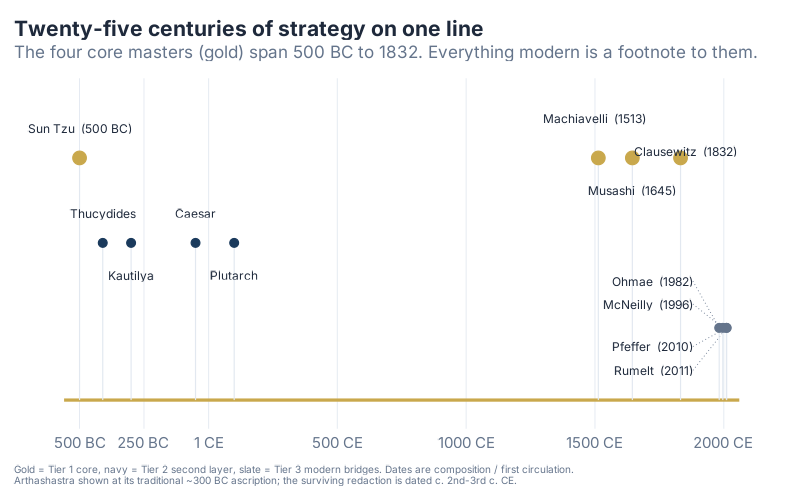
What jumped out when I lined them up is the gap. Sun Tzu, Machiavelli, Musashi, and Clausewitz cover 500 BC to 1832. Then nothing of comparable weight for 150 years, until the business shelf arrives in a tight modern cluster on the far right. I think the reason these four outlast their imitators is unglamorous. They describe the parts of strategy that don’t change. Terrain, friction, mastery, and power behave the same in a Warring States campaign and a 2026 procurement negotiation, because all four run on human judgment under uncertainty. The tools change every decade. The substrate does not.
So the finale does two things. First, it stacks the four masters into a single model you can run on a real decision this week. Then it hands you the reading list to go past the model and into the source.
The Four Layers of Strategic Reality
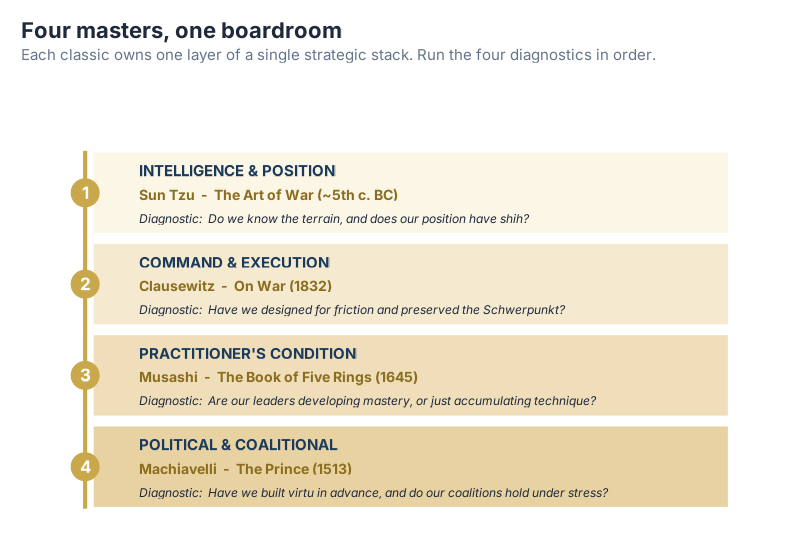
Treat the four masters not as competing theories but as four lenses, each ground for a different stratum of the same problem. Each one owns a layer. Run them top to bottom and you cover the field.
| Layer | Master | The diagnostic question |
|---|---|---|
| 1. Intelligence & Position | Sun Tzu, The Art of War (~5th c. BC) | "Do we know the terrain, and does our position have shih?" |
| 2. Command & Execution | Clausewitz, On War (1832) | "Have we designed for friction and preserved the Schwerpunkt?" |
| 3. Practitioner’s Condition | Musashi, The Book of Five Rings (1645) | "Are our leaders developing mastery, or just accumulating technique?" |
| 4. Political & Coalitional | Machiavelli, The Prince (1513) | "Have we built virtu in advance, and do our coalitions hold under stress?" |
The terms carry weight. A quick gloss. Shih is the advantage you get from position and momentum, the strategic equivalent of fighting downhill. Schwerpunkt is the center of gravity, the one decisive point where you concentrate force instead of spreading it thin. Virtu is prepared capability, the decisive skill you build before fortune arrives to test it.
Notice what the stack refuses to do. It doesn’t rank the layers. A flawless position with no execution loses. Brilliant execution aimed at the wrong point loses faster. A master operator inside a fragile coalition gets removed before the plan matures. The layers are not a priority order. They are a checklist, and you fail at the weakest one.
Where the Four Agree
Four writers, four eras, and yet they converge on four uncomfortable propositions. The overlap is the surprise. That convergence is the load-bearing part of the canon.
Start with uncertainty. None of them treats it as a bug to be engineered away; it’s the medium strategy swims in. Clausewitz built his whole theory on that fact, and though Sun Tzu thought you could buy a lot of it down with good information, even he never believed you could buy all of it. The second agreement follows from the first. Judgment beats formula. Not one of the four offers a procedure that runs without a thinking human at the controls; they give you principles, examples, and warnings, then hand the decision back. That’s the opposite of the optimisation pitch.
The third point is the one modern planners forget most often. The adversary is alive. Not a fixed obstacle, not weather, but an intelligent agent who adapts to whatever you do, so every move you make changes the move they make back. A plan that ignores this is a plan against a statue. Which leads to the conviction the four share most quietly: a deep distrust of the purely analytic approach. Numbers inform. Numbers don’t decide. The spreadsheet that promised certainty is the first casualty of contact with a competitor who read the same spreadsheet.
Where the Four Diverge
The disagreements are sharper than the textbook synthesis admits. They matter. I scored each master on six shared dimensions to make the splits visible.
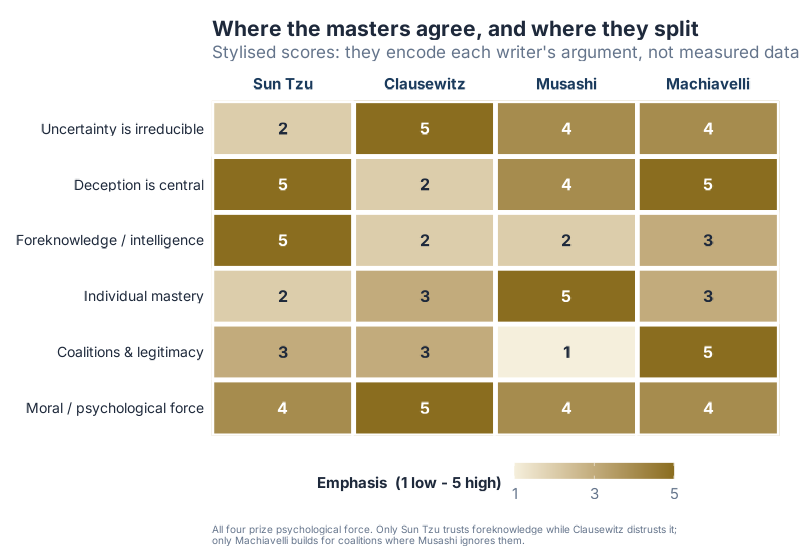
Those scores are stylised. They encode each writer’s argument, not measured data, so read them as a map of emphasis rather than a finding. With that caveat, the pattern is striking.
The hardest split is over intelligence. Sun Tzu trusts foreknowledge above almost everything, scoring a 5: spies, terrain reports, knowing the enemy and yourself. Clausewitz scores a 2 and is openly contemptuous, warning that most intelligence in war is false. That is not a small gap. It is the optimist and the realist looking at the same fog and reaching opposite conclusions about whether you can see through it.
The second split is over uncertainty itself. Clausewitz alone treats it as fully irreducible, a permanent fact of the medium. Sun Tzu believes a well-run intelligence operation shrinks it. If you’ve ever watched a confident forecast survive exactly until the first real shock, you know which of the two ages better.
The third split is structural. Machiavelli is the only one who builds for coalitions and legitimacy, scoring a 5, because a prince who loses the room loses the principality. Musashi scores a 1 and ignores the question entirely. His arena is the duel, a single sword against a single sword, where there is no coalition to hold and no court to manage. That difference reaches straight into the modern org chart. Musashi sharpens the individual operator. Machiavelli keeps the operator in their seat.
The last contrast is one of altitude. Clausewitz writes for the organisation, the army as a system of friction and command. Musashi writes for the person, the practitioner refining a craft until it becomes instinct. Both prize deception, but at different scales: Sun Tzu’s is strategic theater staged across an entire campaign, while Musashi’s is the feint that opens a single cut. One hides an army. The other hides a blade.
A Composite Framework: Four Questions, Asked in Order
Here is the model as a protocol. Before you commit to any meaningful strategic move, run the four diagnostics in sequence. If you can’t answer one of them, that is where your plan is thin.
-
Intelligence & Position (Sun Tzu). "Do we know the terrain, and does our position have shih?" Map the ground and your real source of advantage before you move. Name your edge first. If your edge is just "we will try harder," you have no shih.
-
Command & Execution (Clausewitz). "Have we designed for friction and preserved the Schwerpunkt?" Assume the plan degrades on contact, then ask whether you have concentrated force at the one decisive point or smeared it across ten. Concentrate, do not spread.
-
Practitioner’s Condition (Musashi). "Are our leaders developing mastery, or just accumulating technique?" Tools and frameworks are technique. Mastery is judgment under pressure. A team with twenty certifications and no judgment fails the third diagnostic.
-
Political & Coalitional (Machiavelli). "Have we built virtu in advance, and do our coalitions hold under stress?" The most correct strategy dies if the coalition behind it breaks the first time things get hard. Build it early. Set the capability and the alliances before fortune tests them, not during the test.
Four questions. Asked in order, they will expose the weakest layer of almost any decision faster than a quarter of meetings.
What the Classics Do Not Cover
Honesty means naming the edges. These four books are old, and three large slices of modern strategy sit outside their original scope. That is no failure of the texts. It is a boundary, and pretending otherwise is how people misuse the classics.
They have nothing direct to say about platform economics and network effects. Sun Tzu never faced a market where the product gets more valuable as more rivals’ customers adopt it, where winner-take-most dynamics flip the logic of positioning. The classics assume scarcity and contested ground. A two-sided platform changes the physics.
They are thin on organisational culture as a strategic asset. For them the leader is the unit. The modern view, that a culture can out-execute a smarter competitor for a decade, lives mostly outside their pages. Pfeffer and Rumelt cover more of this ground than any of the four ancients do.
And they predate the modern constraint set on power. Machiavelli wrote before securities law, antitrust, ESG disclosure, and the speed at which a reputation now collapses online. His coalitional realism still holds. The specific guardrails on how you may pursue it don’t appear in the text, and reading him without that update is how you end up quoted in a deposition.
Read the four for the substrate. Read the moderns for the surface that sits on top of it this decade.
The Strategist’s Reading List
A model is a starting point, not a substitute for the source. Summaries flatten the argument and strip the doubt, and the doubt is where the value is. Sun Tzu in a slide deck is a fortune cookie. Sun Tzu on the page is a general arguing with himself about whether you can ever know enough. Read primary sources. Then read the bridges that translate them into the corporation.
Every edition below is real. Each was verified against publisher pages, Project Gutenberg, and WorldCat-class listings. Page counts are approximate and vary by printing. Read-times are estimates for planning, not facts.
The Four Core Texts
| Text | Recommended edition | Approx. pages | Est. read-time | Where to start |
|---|---|---|---|---|
| Sun Tzu, The Art of War (~5th c. BC) | Samuel B. Griffith, Oxford University Press, 1963. Free public-domain alternative: Lionel Giles, 1910 (Project Gutenberg #132) | ~195 | ~5 hrs | The shortest and the best entry point. Read it twice: once straight, once asking "where is my shih?" |
| Clausewitz, On War (1832) | Michael Howard & Peter Paret, Princeton University Press, 1976 (rev. 1984) | ~730 | ~20 hrs | The hardest. Do not read cover to cover. Read Book 1, ch. 1-2 (friction), then Book 8. |
| Musashi, The Book of Five Rings (1645) | Victor Harris, Overlook Press, 1974. Also: William Scott Wilson, Kodansha International, 2002 | ~130 | ~4 hrs | A manual for deliberate practice, not swordfighting. Start with the Earth and Water scrolls. |
| Machiavelli, The Prince (1513) | Quentin Skinner & Russell Price, Cambridge University Press, 1988. Also: Harvey C. Mansfield, University of Chicago Press, 2nd ed. 1998. Free: W. K. Marriott, 1908 (Project Gutenberg #1232) | ~120 | ~4 hrs | Chapters 15 to 19 first (fox and lion, feared versus loved, avoiding hatred). The rest is context. |
The Second Layer
Once the four core texts land, the next four deepen the foundation. Go deeper here. These are where the classics got their own ideas.
| Text | Recommended edition | Approx. pages | Est. read-time | Where to start |
|---|---|---|---|---|
| Thucydides, History of the Peloponnesian War (c. 431-404 BC) | Robert B. Strassler (ed.), The Landmark Thucydides, Free Press, 1996. Also: Rex Warner, Penguin Classics | ~700 | ~20 hrs | The origin of realist strategy. Start with the Melian Dialogue (Book 5) and Pericles’ Funeral Oration (Book 2). |
| Kautilya, Arthashastra (traditionally ~300 BC; surviving redaction c. 2nd-3rd c. CE) | Patrick Olivelle, King, Governance, and Law in Ancient India, Oxford University Press, 2013. Also: L. N. Rangarajan, Penguin Books India, 1992 | ~750 | ~22 hrs | The most systematic ancient on statecraft and intelligence. Use it as a reference, not a cover-to-cover read. |
| Julius Caesar, The Gallic War (c. 58-50 BC) | Carolyn Hammond, Oxford World’s Classics, Oxford University Press, 1996 | ~290 | ~8 hrs | Strategy written by the practitioner himself. A masterclass in logistics, tempo, and managing your own narrative. |
| Plutarch, Parallel Lives (early 2nd c. CE) | Themed selection in Penguin Classics or Oxford World’s Classics. Complete public-domain set: Project Gutenberg (Dryden/Clough) | selection-based | selection-based | Strategy as character. Read paired Lives, such as Alexander and Caesar, to see how temperament shapes decisions. |
One note on dates. The Arthashastra is the single contested entry on this shelf. It is traditionally ascribed to around 300 BC, but the surviving text is a later redaction dated to roughly the 2nd to 3rd century CE. Cite it that way and you stay honest.
The Modern Bridges
These four translate the ancients into the language of the firm. They earn the shelf. Each connects the substrate to the surface without diluting either.
| Text | Edition | Approx. pages | Est. read-time | Why it earns the shelf |
|---|---|---|---|---|
| Kenichi Ohmae, The Mind of the Strategist (1982) | McGraw-Hill, 1982 | ~283 | ~6 hrs | The bridge from the classics to the corporation. The 3C model (customer, competitor, company) is Sun Tzu in a suit. |
| Mark R. McNeilly, Sun Tzu and the Art of Business (1996, rev. 2011) | Oxford University Press, revised edition 2011 | ~208 | ~5 hrs | The most direct Sun-Tzu-to-management translation. It reprints Griffith’s text, so it doubles as a two-in-one. |
| Jeffrey Pfeffer, Power: Why Some People Have It and Others Don’t (2010) | HarperBusiness, 2010 | ~288 | ~6 hrs | Machiavelli for the modern org chart, evidence-based. Uncomfortable and useful on how power actually moves. |
| Richard P. Rumelt, Good Strategy Bad Strategy (2011) | Crown Business, 2011 | ~322 | ~7 hrs | The clearest modern account of what strategy actually is: a diagnosis, a guiding policy, and coherent action. |
How to Read Strategically
Owning is not reading. And reading them once is not the point. Four habits separate the strategist from the collector.
Read slowly, with a pen. These are dense texts. A page of Clausewitz can carry more than a chapter of an airport business book. Mark the lines that sting and write why in the margin.
Argue back. When Sun Tzu claims you can know the enemy completely, write "no" next to it and say what Clausewitz would object. The canon is a conversation. Join it.
Apply immediately. After each session, take one idea to a real decision on your desk this week. An unapplied principle evaporates by morning.
Re-read annually. A book you understood at 30 says something different at 40, because you bring a different self to the page. Re-reading is not repetition. It is a new book wearing the old cover.
Closing the Series
That closes "Strategy That Lasts." Four masters, fifteen articles, one shelf that has already outlived every management fad since the printing press. The bet behind the whole month was simple. The oldest books still win because they teach judgment, not technique, and judgment is the one thing the tools can’t give you.
June turns the lens around. We have spent May on what endures across 2,500 years. Next month looks at something built in the last fifteen, and asks whether any of it will last fifteen more. Consider that a tease, not a spoiler.
Here is your one concrete move for this week. Pick a real decision you’re sitting on right now, then run it through the four diagnostics in order: terrain and shih, friction and Schwerpunkt, mastery versus technique, virtu and coalitions. The question you can’t answer is your weakest layer. Fix that one first. Then open the Canon Explorer below, pick the shortest of the four core texts, and start reading the source instead of the summary.
Interactive Dashboard
Explore the full canon yourself. Filter by layer, era, and difficulty, see the recommended edition for each book, and find the shortest path into the shelf.
Interactive Dashboard
Explore the data yourself — adjust parameters and see the results update in real time.
Show R Code
# =============================================================================
# generate_finale_images.R
# Grand finale of the May "Strategy That Lasts" series.
# Merged capstone: "Four Masters, One Boardroom" + "The Strategist's Reading List"
# Bravo-Zero-R | team strategy-finale-2026-05-29 | DATA-FIRST GATE
#
# Synthesis / close color = GOLD #C9A84C (the series' synthesis color).
# All charts source the shared theme and write finale_*.png to Images/ (<=800px, white bg).
#
# Run from project root:
#   Rscript Scripts/generate_finale_images.R
# =============================================================================

source("Scripts/theme_inphronesys.R")
showtext_opts(dpi = 100)   # match ggsave dpi so showtext sizes are correct

suppressPackageStartupMessages({
  library(ggplot2)
  library(dplyr)
})

set.seed(42)  # no randomness used, set for house-rule reproducibility

# --- Synthesis gold + supporting colors -------------------------------------
gold       <- "#C9A84C"   # series synthesis / focus color
gold_dark  <- "#8a6d1f"   # deep gold for high heatmap cells
gold_cream <- "#f5efdc"   # pale gold for low heatmap cells
navy       <- iph_colors$navy   # #1a3a5c
slate      <- iph_colors$grey   # #64748b
ink        <- iph_colors$dark   # #1e293b

dir.create("Images", showWarnings = FALSE)

# =============================================================================
# DATA: the verified canon (locked in the FINAL DATASET doc)
#   plot_year = year used on the timeline axis (BC negative).
#   tier: 1 = four core masters, 2 = second layer, 3 = modern bridges.
# =============================================================================
canon <- tibble::tribble(
  ~short,         ~plot_year, ~tier,
  "Sun Tzu",          -500,    1L,
  "Thucydides",       -410,    2L,
  "Kautilya",         -300,    2L,
  "Caesar",            -50,    2L,
  "Plutarch",          100,    2L,
  "Machiavelli",      1513,    1L,
  "Musashi",          1645,    1L,
  "Clausewitz",       1832,    1L,
  "Ohmae",            1982,    3L,
  "McNeilly",         1996,    3L,
  "Pfeffer",          2010,    3L,
  "Rumelt",           2011,    3L
) |>
  mutate(
    tier_lab = factor(tier,
                      levels = c(1, 2, 3),
                      labels = c("Tier 1\nCore masters",
                                 "Tier 2\nSecond layer",
                                 "Tier 3\nModern bridges")),
    ybase = c(3, 2, 2, 2, 2, 3, 3, 3, 1, 1, 1, 1),
    tcol  = ifelse(tier == 1, gold, ifelse(tier == 2, navy, slate))
  )

# year axis label helper (BC / AD)
year_lab <- function(y) {
  ifelse(y < 0, paste0(abs(y), " BC"),
         ifelse(y == 0, "1 CE", paste0(y, " CE")))
}

# =============================================================================
# CHART 1 - Canon timeline across ~2,500 years (the longevity thesis)
# =============================================================================
# Manual label placement to avoid collisions, especially the modern cluster
# (1982-2011) whose labels are parked in the empty 1645-1982 gap with leaders.
lab <- canon |>
  mutate(
    lab_x = c(-500, -410, -300, -50, 100, 1500, 1645, 1850,
              1880, 1880, 1880, 1880),
    lab_y = c(3.35, 2.35, 1.62, 2.35, 1.62, 3.46, 2.62, 3.08,
              1.55, 1.28, 0.78, 0.50),
    lab_h = c(0.5, 0.5, 0.5, 0.5, 0.5, 0.5, 0.5, 0.5, 1, 1, 1, 1),
    is_modern = tier == 3,
    label = ifelse(tier == 2, short,
             ifelse(plot_year < 0,
                    paste0(short, "  (", abs(plot_year), " BC)"),
                    paste0(short, "  (", plot_year, ")")))
  )

axis_breaks <- c(-500, -250, 1, 500, 1000, 1500, 2000)

p_timeline <- ggplot() +
  # baseline timeline spine in gold
  annotate("segment", x = -560, xend = 2060, y = 0.15, yend = 0.15,
           color = gold, linewidth = 1.1) +
  # leader lines for the modern cluster
  geom_segment(data = filter(lab, is_modern),
               aes(x = lab_x, xend = plot_year, y = lab_y, yend = ybase),
               color = slate, linewidth = 0.3, linetype = "dotted") +
  # drop lines from each book down to the spine
  geom_segment(data = lab,
               aes(x = plot_year, xend = plot_year, y = ybase, yend = 0.15),
               color = iph_colors$lightgrey, linewidth = 0.4) +
  # points
  geom_point(data = lab,
             aes(x = plot_year, y = ybase, color = tcol, size = tier == 1)) +
  # labels
  geom_text(data = lab,
            aes(x = lab_x, y = lab_y, label = label, hjust = lab_h),
            family = "Inter", size = 3.1, color = ink) +
  scale_color_identity() +
  scale_size_manual(values = c(`TRUE` = 4.2, `FALSE` = 2.6), guide = "none") +
  scale_x_continuous(breaks = axis_breaks, labels = year_lab,
                     limits = c(-620, 2080)) +
  scale_y_continuous(limits = c(0, 3.75)) +
  labs(
    title = "Twenty-five centuries of strategy on one line",
    subtitle = "The four core masters (gold) span 500 BC to 1832. Everything modern is a footnote to them.",
    x = NULL, y = NULL,
    caption = "Gold = Tier 1 core, navy = Tier 2 second layer, slate = Tier 3 modern bridges. Dates are composition / first circulation.\nArthashastra shown at its traditional ~300 BC ascription; the surviving redaction is dated c. 2nd-3rd c. CE."
  ) +
  theme_inphronesys(grid = "x") +
  theme(
    axis.text.y = element_blank(),
    panel.grid.major.x = element_line(color = iph_colors$lightgrey, linewidth = 0.3),
    plot.caption = element_text(size = 7.5, color = slate, hjust = 0)
  )

ggsave("https://inphronesys.com/wp-content/uploads/2026/05/finale_canon_timeline.png", p_timeline,
       width = 8, height = 5, dpi = 100, bg = "white")

# =============================================================================
# CHART 2 - Four-layer synthesis model (Four Masters, One Boardroom)
# Top-to-bottom stack of layers, each with master + diagnostic question.
# =============================================================================
layers <- tibble::tibble(
  ord   = 1:4,
  layer = c("INTELLIGENCE & POSITION",
            "COMMAND & EXECUTION",
            "PRACTITIONER'S CONDITION",
            "POLITICAL & COALITIONAL"),
  master = c("Sun Tzu  -  The Art of War (~5th c. BC)",
             "Clausewitz  -  On War (1832)",
             "Musashi  -  The Book of Five Rings (1645)",
             "Machiavelli  -  The Prince (1513)"),
  question = c("Do we know the terrain, and does our position have shih?",
               "Have we designed for friction and preserved the Schwerpunkt?",
               "Are our leaders developing mastery, or just accumulating technique?",
               "Have we built virtu in advance, and do our coalitions hold under stress?"),
  fill = c("#fbf6e6", "#f5ead0", "#efdeb9", "#e9d2a2")  # gold tints, light -> deep
) |>
  mutate(
    ytop = 4 - (ord - 1),
    ybot = ytop - 0.92,
    ymid = (ytop + ybot) / 2
  )

p_layers <- ggplot(layers) +
  geom_rect(aes(xmin = 0.06, xmax = 1, ymin = ybot, ymax = ytop, fill = fill),
            color = "white", linewidth = 1.2) +
  # gold left spine + numbered nodes
  annotate("segment", x = 0.05, xend = 0.05, y = layers$ybot[4], yend = layers$ytop[1],
           color = gold, linewidth = 1.4) +
  geom_point(aes(x = 0.05, y = ymid), size = 9, color = gold) +
  geom_text(aes(x = 0.05, y = ymid, label = ord),
            family = "Inter", fontface = "bold", color = "white", size = 4.2) +
  # layer name
  geom_text(aes(x = 0.13, y = ymid + 0.24, label = layer),
            hjust = 0, family = "Inter", fontface = "bold",
            size = 3.7, color = navy) +
  # master
  geom_text(aes(x = 0.13, y = ymid - 0.02, label = master),
            hjust = 0, family = "Inter", fontface = "bold",
            size = 3.5, color = gold_dark) +
  # diagnostic question
  geom_text(aes(x = 0.13, y = ymid - 0.28,
                label = paste0("Diagnostic:  ", question)),
            hjust = 0, family = "Inter", fontface = "italic",
            size = 3.1, color = ink) +
  scale_fill_identity() +
  scale_x_continuous(limits = c(0, 1.02)) +
  scale_y_continuous(limits = c(layers$ybot[4] - 0.12, layers$ytop[1] + 0.55)) +
  labs(
    title = "Four masters, one boardroom",
    subtitle = "Each classic owns one layer of a single strategic stack. Run the four diagnostics in order."
  ) +
  theme_void(base_size = 13) +
  theme(
    text = element_text(family = "Inter"),
    plot.title = element_text(face = "bold", size = 16, color = ink,
                              margin = margin(b = 4, l = 4)),
    plot.subtitle = element_text(size = 11, color = slate,
                                 margin = margin(b = 12, l = 4)),
    plot.margin = margin(16, 16, 14, 12)
  )

ggsave("https://inphronesys.com/wp-content/uploads/2026/05/finale_four_layers.png", p_layers,
       width = 8, height = 5.6, dpi = 100, bg = "white")

# =============================================================================
# CHART 3 - Where the masters agree and diverge (STYLISED scores)
# Heatmap: 6 shared dimensions x 4 masters, scores 1-5.
# Scores encode the ARGUMENT, not measured data. Labelled as stylised.
# =============================================================================
dims <- c("Uncertainty is irreducible",
          "Deception is central",
          "Foreknowledge / intelligence",
          "Individual mastery",
          "Coalitions & legitimacy",
          "Moral / psychological force")

masters <- c("Sun Tzu", "Clausewitz", "Musashi", "Machiavelli")

# rows = dimensions (order above), cols = masters (order above)
score_mat <- matrix(
  c(2, 5, 4, 4,   # Uncertainty is irreducible
    5, 2, 4, 5,   # Deception is central
    5, 2, 2, 3,   # Foreknowledge / intelligence
    2, 3, 5, 3,   # Individual mastery
    3, 3, 1, 5,   # Coalitions & legitimacy
    4, 5, 4, 4),  # Moral / psychological force
  nrow = 6, byrow = TRUE,
  dimnames = list(dims, masters)
)

heat <- as.data.frame(as.table(score_mat))
names(heat) <- c("dimension", "master", "score")
heat$dimension <- factor(heat$dimension, levels = rev(dims))
heat$master    <- factor(heat$master, levels = masters)
heat$txtcol    <- ifelse(heat$score >= 4, "white", ink)

p_heat <- ggplot(heat, aes(x = master, y = dimension, fill = score)) +
  geom_tile(color = "white", linewidth = 1.6) +
  geom_text(aes(label = score, color = txtcol),
            family = "Inter", fontface = "bold", size = 4) +
  scale_fill_gradient(low = gold_cream, high = gold_dark,
                      limits = c(1, 5), breaks = c(1, 3, 5),
                      name = "Emphasis  (1 low - 5 high)") +
  scale_color_identity() +
  scale_x_discrete(position = "top", expand = expansion(mult = 0.01)) +
  scale_y_discrete(expand = expansion(mult = 0.01)) +
  labs(
    title = "Where the masters agree, and where they split",
    subtitle = "Stylised scores: they encode each writer's argument, not measured data.",
    x = NULL, y = NULL,
    caption = "All four prize psychological force. Only Sun Tzu trusts foreknowledge while Clausewitz distrusts it;\nonly Machiavelli builds for coalitions where Musashi ignores them."
  ) +
  theme_inphronesys(grid = "none") +
  theme(
    axis.text.x = element_text(face = "bold", color = navy, size = 11),
    axis.text.y = element_text(color = ink, size = 10),
    legend.position = "bottom",
    legend.key.width = unit(1.6, "lines"),
    panel.grid = element_blank(),
    plot.caption = element_text(size = 7.5, color = slate, hjust = 0)
  )

ggsave("https://inphronesys.com/wp-content/uploads/2026/05/finale_agree_diverge.png", p_heat,
       width = 8, height = 5.6, dpi = 100, bg = "white")

# =============================================================================
# VERIFICATION OUTPUT
# =============================================================================
cat("\n=== FINALE IMAGES GENERATED ===\n")
cat("Canon span:", min(canon$plot_year), "to", max(canon$plot_year),
    "=>", max(canon$plot_year) - min(canon$plot_year), "years\n")
cat("Books on timeline:", nrow(canon),
    "(Tier1:", sum(canon$tier == 1),
    " Tier2:", sum(canon$tier == 2),
    " Tier3:", sum(canon$tier == 3), ")\n\n")

cat("Four-layer model (top -> bottom):\n")
for (i in seq_len(nrow(layers))) {
  cat("  ", layers$ord[i], layers$layer[i], "|", layers$master[i], "\n")
}

cat("\nStylised agree/diverge matrix (rows=dimension, cols=master):\n")
print(score_mat)

cat("\nFiles written:\n")
for (f in c("https://inphronesys.com/wp-content/uploads/2026/05/finale_canon_timeline.png",
            "https://inphronesys.com/wp-content/uploads/2026/05/finale_four_layers.png",
            "https://inphronesys.com/wp-content/uploads/2026/05/finale_agree_diverge.png")) {
  cat("  ", f, ifelse(file.exists(f), "[OK]", "[MISSING]"), "\n")
}
cat("\nDone.\n")
Sources
- Sun Tzu, The Art of War. Translated by Samuel B. Griffith, Oxford University Press, 1963. Public-domain alternative: Lionel Giles, 1910, Project Gutenberg #132. Composition c. 500-430 BC (Warring States).
- Carl von Clausewitz, On War (Vom Kriege). Edited and translated by Michael Howard & Peter Paret, Princeton University Press, 1976 (rev. 1984). Written to 1831, published posthumously 1832.
- Miyamoto Musashi, The Book of Five Rings (Go Rin no Sho), 1645. Translated by Victor Harris, Overlook Press, 1974. Also: William Scott Wilson, Kodansha International, 2002.
- Niccolo Machiavelli, The Prince (Il Principe). Edited by Quentin Skinner & Russell Price, Cambridge University Press, 1988. Also: Harvey C. Mansfield, University of Chicago Press, 2nd ed. 1998. Public-domain alternative: W. K. Marriott, 1908, Project Gutenberg #1232. Written 1513, published posthumously 1532.
- Thucydides, History of the Peloponnesian War. Robert B. Strassler (ed.), The Landmark Thucydides, Free Press, 1996. Composition c. 431-404 BC.
- Kautilya, Arthashastra. Patrick Olivelle, King, Governance, and Law in Ancient India, Oxford University Press, 2013. Also: L. N. Rangarajan, Penguin Books India, 1992. Traditionally ascribed to ~300 BC; surviving redaction dated c. 2nd-3rd c. CE.
- Julius Caesar, The Gallic War. Translated by Carolyn Hammond, Oxford World’s Classics, Oxford University Press, 1996. Written c. 58-50 BC.
- Plutarch, Parallel Lives. Themed selections in Penguin Classics or Oxford World’s Classics. Public-domain complete set: Project Gutenberg (Dryden/Clough). Early 2nd c. CE.
- Kenichi Ohmae, The Mind of the Strategist: The Art of Japanese Business, McGraw-Hill, 1982.
- Mark R. McNeilly, Sun Tzu and the Art of Business: Six Strategic Principles for Managers, Oxford University Press, revised edition 2011.
- Jeffrey Pfeffer, Power: Why Some People Have It and Others Don’t, HarperBusiness, 2010.
- Richard P. Rumelt, Good Strategy Bad Strategy: The Difference and Why It Matters, Crown Business, 2011.
Leave a Reply