
Imagine Sales and Operations Planning (S&OP) has agreed on €10 million in ski sales for next winter. Now put yourself in Purchasing. Which model? Which length? How many wood cores? The supplier wants a capacity commitment in February. The plan goes through in May.
I used that fictional example to open my talk, From Broken S&OP to Zero-Shot AI, at KEYNOTION’s Supply Chain & Logistics Transformation Summit in Munich on 12–13 November 2026. It was a way into the summit’s theme, “Connected Planning, Connected Execution.” The connection gets tested when a buyer has to put a quantity and a date on a purchase order.
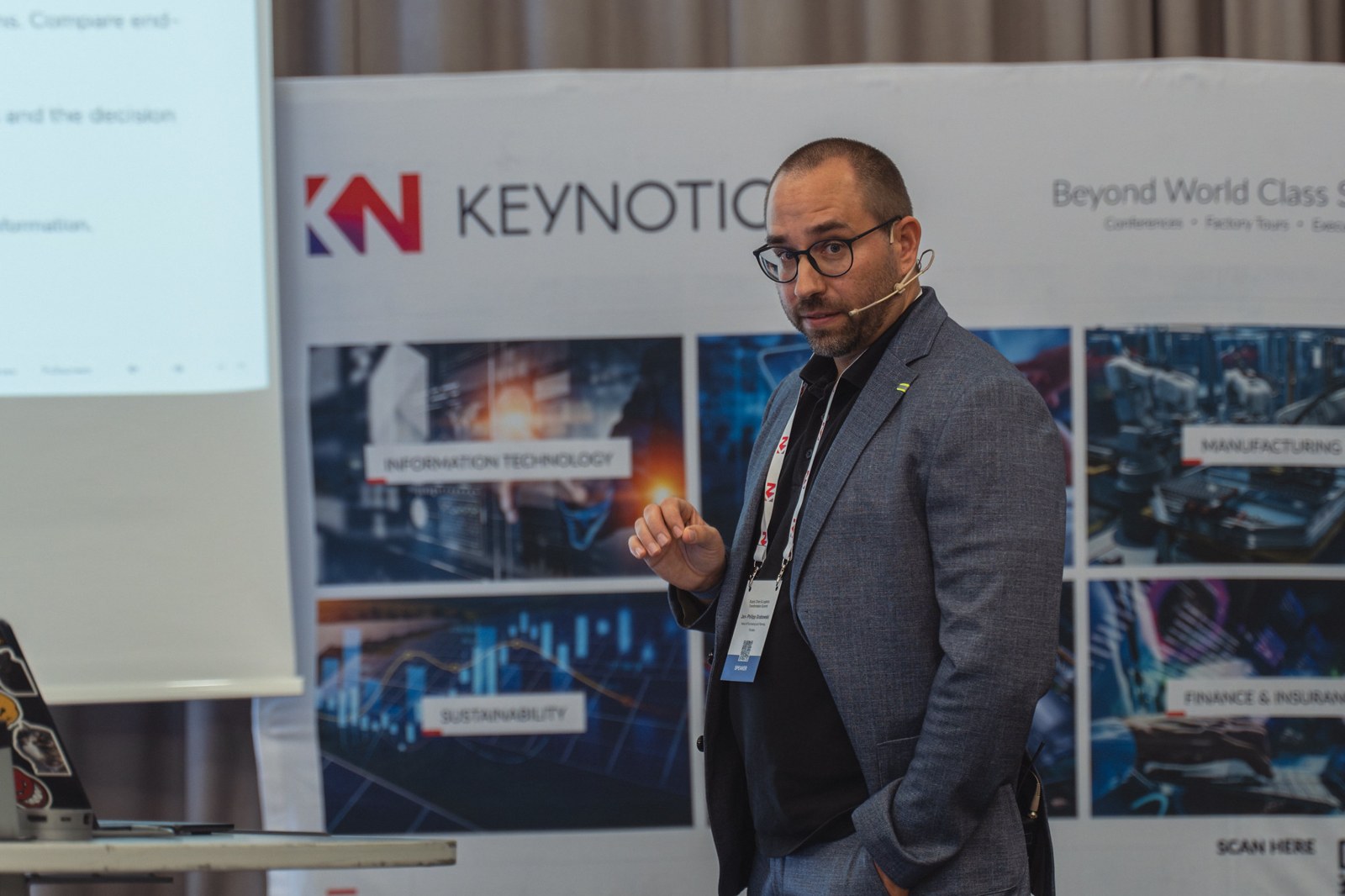
Photo by Grigorii Omes.
The handoff deserves as much attention as the plan
The programme approached that handoff from several directions. Immanuel Söllner’s opening keynote covered how to connect demand, supply, and finance through decision rights and KPIs. Rainer Baumann’s day-two session on probabilistic forecasting put the trade-offs between service, inventory, and cost on the agenda. I spoke about what happens when those choices reach the buyer who has to commit to a supplier.
The ski example gets awkward fast. A revenue target needs a price and a product mix before it becomes units. The mix needs to go down to the size and component level. And somebody has to check whether the supplier can still deliver when the units are needed. If the plan leaves those decisions open, the buyer ends up making the assumptions with a deadline already running.
Put a second number on the table
In another example from the talk, Sales plans for 1,200 units next month and an independent statistical forecast suggests 950. I would ask what explains those extra 250 units. A confirmed order or a new promotion could justify them. A strong recent quarter could also be a seasonal rebound. Once we know the reason, we can record it and check whether it materialises.
That’s why I started with open-source forecasting in R. A seasonal naïve forecast, which repeats demand from the corresponding period last season, gives the team a benchmark everyone can understand. A pretrained time series foundation model can generate a zero-shot forecast from the SKU’s history without training on that SKU. Give both approaches the same historical cutoffs and judge them at the horizon Purchasing actually uses. Then see whether the difference would change an order once lead times, minimum buys, and pack sizes are applied.
Start the 90-day conversation with one decision
I also joined the closing panel on the 90-day transformation roadmap. The question I’d bring to the first week of that roadmap is simple. What’s one order we regularly get wrong, and how early could we still do something about it?
For a first pilot, I’d pick one product group, one recurring buying decision, and one person who can act on the evidence. I’d track forecast bias alongside service, stock, and expediting, and record what happened when somebody overrode the baseline. That gives the team a concrete decision to review when it decides whether to expand the pilot.
Thank you to KEYNOTION, the other speakers and panellists, and everyone who joined the discussion in Munich.
I’ve shared the ski example, the model selection guide, and the steps for a first pilot. Read the presentation takeaways on InPhroNeSys
Created with AI assistance under human editorial control.
Leave a Reply