
The gap closed while nobody was looking
Here’s a number that should stop a busy operations manager mid-scroll. On Artificial Analysis’s independent Intelligence Index, measured 18 July 2026, the best closed model on the planet scores 60. The best open-weight model you can point at scores 57. Three points. That’s the whole lead the most expensive labs in the world have left.
Now the price. That closed leader, Claude Fable 5, costs $7.70 per million tokens on a blended basis. The cheapest capable open model, DeepSeek V4 Pro, costs $0.18. Do the division: 7.70 divided by 0.18 is 42.8. Same ballpark of capability, one forty-second of the bill.
And there’s a twist that would have sounded absurd a year ago. Arena.ai reports a Chinese open model, Kimi K3, at #1 on its public frontend-coding leaderboard, ahead of Anthropic’s flagship. Open weights beating the closed frontier at a real task, on a public leaderboard, today.
If you’re deciding whether to build AI into forecasting, procurement triage, or spec extraction, this is your business case. Let me make the case that for most of that work, paying frontier prices is throwing money away.
What "open weights" actually means
Skip this if you already know. If you don’t, one plain paragraph fixes it.
A model’s "weights" are the billions of numbers it learned during training. They are the model. Open weights means the lab published those numbers so you can download the file, run it on your own hardware, and never send a byte to anyone else’s server. That’s different from open source, which in strict terms also means the training code is public, and different again from fully open, where the training data itself is released (Ai2’s Olmo 3 is the rare model that does all three).
The licenses matter more than the marketing. Apache 2.0 and MIT are permissive: use it commercially, fine-tune it, ship it, no strings. Custom licenses like Meta’s Llama Community terms or Google’s Gemma terms add restrictions and don’t meet the formal open-source definition. So "open" is a spectrum, not a switch.
One catch worth naming up front. A lab can announce a model as "open-weight" before the weights are actually downloadable. Kimi K3 is the headline example: it’s the most capable open model announced so far, but as of today it’s API-only. Moonshot’s own blog says the weights ship "by July 27, 2026." Announced open, not yet open. Read the release date, not the press release.
The scoreboard
Four charts tell the whole story. All benchmark values come from the same Artificial Analysis snapshot, same date, so nothing here mixes scales.
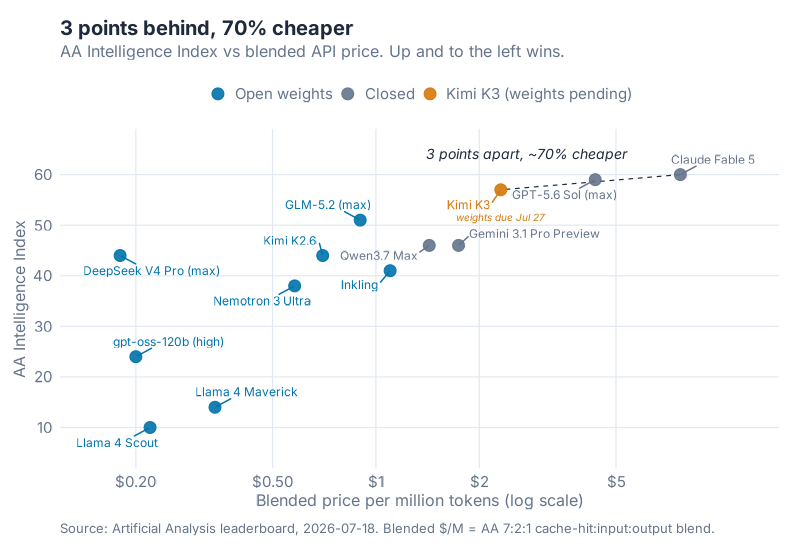
What jumped out at me here isn’t the leader. It’s the shape of the cloud. The closed models sit top-right: high intelligence, high price. The open models form a staircase down the left edge, giving up a few index points at each step for enormous price cuts. GLM-5.2 delivers 85% of Fable 5’s intelligence (51 versus 60) at 11.7% of the blended price ($0.90 versus $7.70). There is no law of nature that says intelligence has to cost $7.70 a million tokens. The open field is proving it.
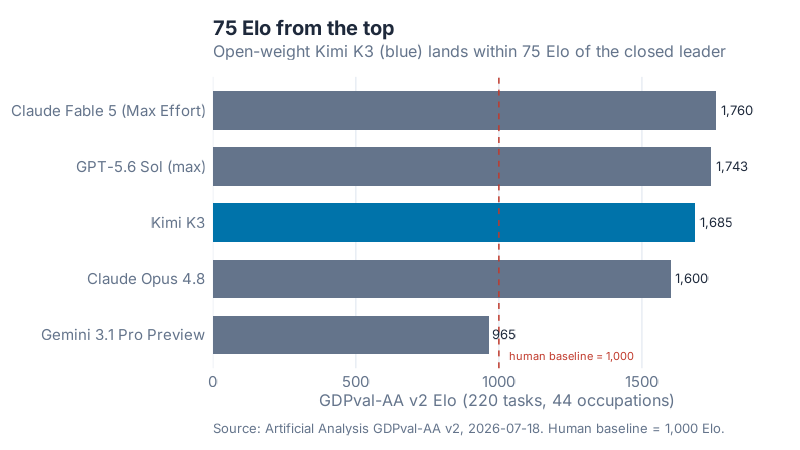
This is the chart I’d put in front of a skeptic. GDPval-AA v2 isn’t a trivia quiz. It’s 220 tasks built by OpenAI across 44 occupations and 9 industries, run in an agentic setup with shell and web access, scored in Elo against a human baseline of 1,000. Fable 5 at Max Effort leads at 1,760. GPT-5.6 Sol lands at 1,743. And Kimi K3, the open model, comes in at 1,685, which is 75 Elo behind the closed leader (1,760 minus 1,685). The surprise is how boring the top of the board has become. The open model isn’t in a different league. It’s in the same three seats.
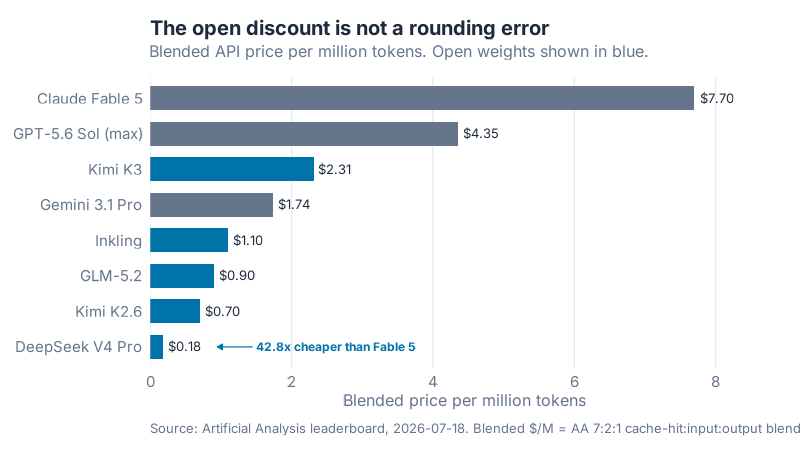
Here’s where the story turns from interesting to actionable. The bars run from Fable 5 at $7.70 down to DeepSeek V4 Pro at $0.18, which is 2.3% of the leader’s price. What struck me is that the cheapest bar isn’t the worst model. DeepSeek V4 Pro scores 44 on the Intelligence Index, higher than several models that cost five times as much. Cheap and dumb used to travel together. They’ve divorced.
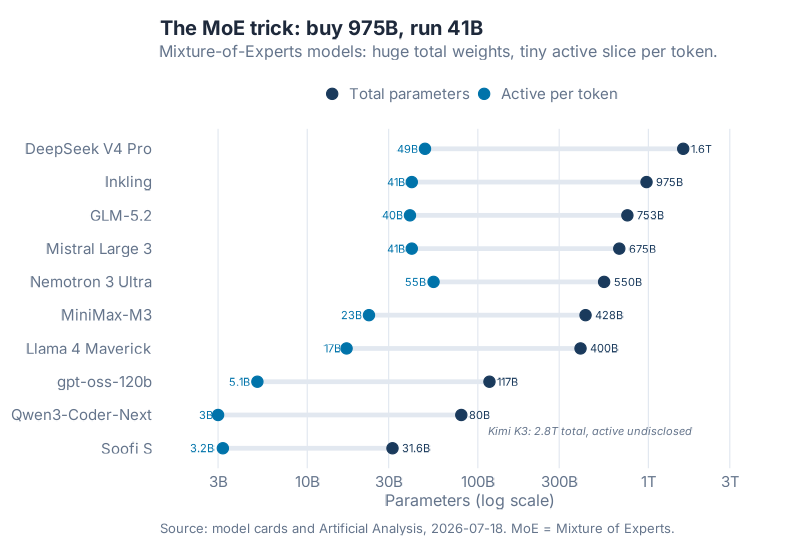
One more chart, because it explains how those cheap bars are possible. Almost every big open model is a Mixture-of-Experts (MoE) design: it stores a huge library of parameters but activates only a small slice per token. Inkling stores 975 billion and runs 41 billion. You pay compute for the slice, not the library. That’s the engine behind the open discount.
The Tier 1 model cards
These are the six names worth knowing. Details are exact; the "as of" dates matter because this field moves weekly.
Kimi K3 (Moonshot AI, China)
The largest open model ever announced, and it isn’t close. 2.8 trillion total parameters in a Mixture-of-Experts design, activating 16 of 896 experts per token (the MoE trick from the chart above, taken to its extreme). Context window: 1,000,000 tokens. Founder Yang Zhilin (Tsinghua, then a PhD at Carnegie Mellon, then Google Brain and Meta) named the lab after Pink Floyd’s The Dark Side of the Moon. Backed by Alibaba and Tencent.
The results: Intelligence Index 57, GDPval-AA 1,685, and a reported #1 on Arena.ai’s Frontend Code Arena at 1,679 points, ahead of Fable 5. API pricing is $3.00 cache-miss input and $15.00 output per million. The asterisk, again: weights aren’t out yet. The blog promises them by 27 July 2026. Until then it’s an API you rent, not a model you own.
Inkling (Thinking Machines Lab, USA)
The leading open-weights model from a US lab, and the one you can actually download today under Apache 2.0. 975B total parameters, 41B active, trained on 45 trillion tokens. Founded by former OpenAI CTO Mira Murati, with OpenAI co-founder John Schulman as chief scientist. Intelligence Index 41, which the lab itself frames honestly: it says Inkling is "not the strongest overall model available today, open or closed." The pitch is calibration and adjustable "thinking effort," served through their Tinker fine-tuning platform at a blended $1.10 per million. Weights live at huggingface.co/thinkingmachines/inkling.
Soofi S (German consortium, Europe)
Europe’s sovereign entry, and the most controversial release of the month. More on that below. 31.6B total parameters, 3.2B active, a hybrid Mamba-2 and MoE design coordinated by the KI Bundesverband with Fraunhofer, DFKI, and TU Darmstadt among the partners. Weights and intermediate checkpoints are on Hugging Face in beta. The headline: highest claimed aggregate scores in both German (79.1) and English (70.1) among fully open models. Every one of those numbers is self-reported. That matters, and it gets its own section below.
DeepSeek V4 (DeepSeek, China)
The value champion. V4-Pro is 1.6T total / 49B active MoE with a 1M context, released open under MIT on 24 April 2026. Weights downloadable today. Intelligence Index 44 at a blended $0.18 per million, the cheapest capable model on the board by a wide margin. Its self-reported SWE-bench Verified score of 80.6% is the top open-weights coding result on the official model card. Founder Liang Wenfeng also runs the quant fund High-Flyer.
GLM-5.2 (Zhipu AI / Z.ai, China)
The current open-weights leader on the Intelligence Index at 51. 753B total / 40B active MoE, 1M context, MIT license, weights on Hugging Face. First-party pricing is $1.40 input / $4.40 output, blended to $0.90 per million. Zhipu was founded by Tsinghua professors and listed in Hong Kong in January 2026. If you want the most capable model you can fully own and run, this is today’s answer.
Qwen (Alibaba, China)
The cautionary tale of the group, because Qwen has forked. Alibaba’s newest overall model, Qwen3.7-Max, is proprietary and API-only (Intelligence Index 46, blended $1.43). The newest open general release, Qwen3.6-27B, is a step behind at Index 37 under Apache 2.0. The team’s long-time lead departed in March 2026, and reporting suggests a strategic tilt toward closed flagships. Open and closed under one brand, and the open line is no longer the front line.
Tier 2, at a glance
Nine more models worth tracking, simplified. "n/a" means the dataset couldn’t confirm a value to a primary source.
| Model | Lab / Country | Version + date | Total / Active | License | Weights? | Cheapest $/M | Headline (independent unless noted) |
|---|---|---|---|---|---|---|---|
| Llama 4 Maverick | Meta / USA | Apr 2025 (stale) | 400B / 17B | Llama 4 Community | Yes | ~$0.34 blended | AA Index 14 |
| gpt-oss-120b | OpenAI / USA | Aug 2025 | 117B / 5.1B | Apache 2.0 | Yes | ~$0.03 / $0.18 | AA Index 24 |
| Kimi K2.6 | Moonshot / China | Apr 2026 | 1T / 32B | Modified MIT | Yes | ~$0.70 blended | AA Index 44 |
| MiniMax-M3 | MiniMax / China | ~Jun 2026 | ~428B / ~23B | MiniMax Community | Yes | n/a | SWE-bench Verified 80.5% (self-rep) |
| Mistral Large 3 | Mistral / France | Dec 2025 | 675B / 41B | Apache 2.0 | Yes | n/a | n/a |
| Gemma 4 | Google / USA | Mar 2026 | 31B dense | Gemma Terms | Yes | n/a | Arena 1452, LiveCodeBench 80.0 (self-rep) |
| Nemotron 3 Ultra | Nvidia / USA | Jun 2026 | 550B / 55B | OpenMDW-1.1 | Yes | ~$0.58 blended | AA Index 38 |
| Olmo 3 32B | Ai2 / USA | Nov 2025 | 32B dense | Apache 2.0 | Yes | n/a | Fully open (data + code) |
| Apertus 70B | EPFL/ETH/CSCS / Switzerland | Sep 2025 | 70B (+8B) | Apache 2.0 | Yes | n/a | 1,811 languages (self-rep) |
Two flags. Llama 4 is 15 months stale, and Meta’s 2026 flagship reportedly went closed, so the open Llama line has gone quiet. And if you want fully open (weights, data, and code, no black boxes), Olmo 3 and Apertus are your two candidates.
The Soofi S problem, and why it’s a good sign
Soofi S launched with strong claimed results, but its credibility case rests on numbers the consortium reported itself. As of mid-July 2026, nobody had independently reproduced them. Jenia Jitsev of the LAION consortium publicly called the project’s self-defined "capability index" overstated. The architecture isn’t new either. Soofi S builds on Nvidia’s openly published Nemotron 3 Nano design, and critics call the training run heavily overtrained versus Chinchilla-optimal ratios; the technical lead says that math doesn’t apply to Mixture-of-Experts models. The authors’ own report also documents a sharp long-context weakness: RULER word-extraction accuracy collapses to roughly 3 percent beyond 32,000 tokens.
I’d read that as the system working, not failing. When a model claims the top of a benchmark, the open ecosystem now checks the claim within days, in public, by name. A closed model that reports its own scores in a launch blog gets none of that scrutiny, because nobody outside the lab can run it under controlled conditions. Self-reported numbers deserve a raised eyebrow whoever publishes them. The difference is that open weights let the eyebrow do something.
What this means if you run supply chain or operations
Strip away the leaderboard sport and you’re left with a sourcing decision. Two questions decide it.
How hard is the task, really? A lot of operational AI work is not frontier-hard. Drafting a plain-language explanation of why a SKU’s forecast moved. Triaging a supplier email into "delay," "price change," or "quality issue." Pulling six fields out of a spec sheet PDF. For work like that, an open model at Index 44 to 51 is not a compromise. It’s the right tool, and it’s up to 42 times cheaper. Kimi K3 gives you roughly 95% of Fable 5’s intelligence at 30% of the price (57 divided by 60 is 0.95; $2.31 divided by $7.70 is 0.30). At the volume of a real SKU catalog, that ratio is the difference between a pilot that dies in finance review and one that ships.
Does the data need to stay inside your walls? This is where open weights stop being about price and start being about control. Because you can download the file, you can run the model on your own infrastructure, and your supplier contracts, pricing, and forecasts never leave your network. For a European manufacturer with GDPR obligations and nervous legal counsel, that’s not a nice-to-have. Sovereignty is the entire pitch behind Soofi S. You can also fine-tune an open model on your own historical data (platforms like Tinker exist precisely for this), which no API-only frontier model lets you truly do.
When does the closed frontier still earn its premium? Two cases. The hardest multi-step reasoning, where three index points compound across a long chain and the gap actually bites. And agentic reliability, where a model runs tools unsupervised for many steps and small error rates snowball. For those, Fable 5 and GPT-5.6 Sol are worth the money. For routing thousands of bounded, well-defined tasks, they’re a luxury tax.
Your next move this week
Don’t take my word or a leaderboard’s. Run the experiment.
- Pick one high-volume, low-stakes task you already do with AI or want to (forecast-note drafting, email triage, spec extraction). Pull 50 real examples.
- Run them through your current model and log the cost. If you’re on a frontier API, note the per-1,000-task bill. This is your baseline.
- Run the same 50 through an open model. GLM-5.2 (Index 51, MIT, weights on Hugging Face) or DeepSeek V4 Pro (Index 44, $0.18 blended) are the two to start with. Use their hosted API first, before touching your own hardware.
- Blind-score both outputs. Have a colleague rate the 100 results without knowing which model produced which. Count how often the cheap one is "good enough."
- Multiply the price gap by your real annual volume. If the open model clears your bar even 90% of the time, route those 90% to it and reserve the frontier for the 10% that need it.
Do that, and by Friday you’ll have your own number instead of mine. That’s the only benchmark that pays your invoices.
Show R Code
The R code that generates the three charts lives in Scripts/generate_ow_images.R.
# =============================================================================
# generate_ow_images.R
# Charts for "The Open-Weight Model Landscape, July 2026"
# All values are hardcoded VERBATIM from:
#   Research/2026-07-18_Open_Weight_Landscape_FINAL_dataset.md (Section 5)
# Do NOT edit numbers here — this consumes an already-FINAL dataset.
# =============================================================================

source("Scripts/theme_inphronesys.R")

library(ggplot2)
library(dplyr)
library(scales)
library(ggrepel)

# Roles:  open models = brand blue (emphasis); closed = muted grey (de-emphasis)
col_open   <- iph_colors$blue
col_closed <- iph_colors$grey
col_flag   <- iph_colors$orange   # Kimi K3: weights not out yet

cap_src <- "Source: Artificial Analysis leaderboard, 2026-07-18. Blended $/M = AA 7:2:1 cache-hit:input:output blend."

# =============================================================================
# CHART 1 — Intelligence vs Price scatter (dataset 5A, 13 models)
# =============================================================================
scatter <- tibble::tribble(
  ~model,                    ~type,     ~intel, ~price,
  "Claude Fable 5",          "Closed",  60,     7.70,
  "GPT-5.6 Sol (max)",       "Closed",  59,     4.35,
  "Kimi K3",                 "Flag",    57,     2.31,
  "GLM-5.2 (max)",           "Open",    51,     0.90,
  "Gemini 3.1 Pro Preview",  "Closed",  46,     1.74,
  "Qwen3.7 Max",             "Closed",  46,     1.43,
  "DeepSeek V4 Pro (max)",   "Open",    44,     0.18,
  "Kimi K2.6",               "Open",    44,     0.70,
  "Inkling",                 "Open",    41,     1.10,
  "Nemotron 3 Ultra",        "Open",    38,     0.58,
  "gpt-oss-120b (high)",     "Open",    24,     0.20,
  "Llama 4 Maverick",        "Open",    14,     0.34,
  "Llama 4 Scout",           "Open",    10,     0.22
)
scatter$type <- factor(scatter$type, levels = c("Open", "Closed", "Flag"))

pal_scatter <- c("Open" = col_open, "Closed" = col_closed, "Flag" = col_flag)

set.seed(42)
p1 <- ggplot(scatter, aes(x = price, y = intel, color = type)) +
  # pressure-zone connector: Fable 5 -> Kimi K3
  annotate("segment", x = 7.70, xend = 2.31, y = 60, yend = 57,
           color = iph_colors$dark, linewidth = 0.4, linetype = "dashed") +
  annotate("text", x = 1.4, y = 64,
           label = "3 points apart, ~70% cheaper",
           family = "Inter", fontface = "italic", size = 3.6,
           color = iph_colors$dark, hjust = 0) +
  geom_point(size = 3.6, alpha = 0.9) +
  geom_text_repel(aes(label = model),
                  family = "Inter", size = 3.1, seed = 42,
                  min.segment.length = 0.1, box.padding = 0.5,
                  max.overlaps = Inf, show.legend = FALSE) +
  annotate("text", x = 2.31, y = 51.5,
           label = "weights due Jul 27",
           family = "Inter", size = 2.7, fontface = "italic",
           color = col_flag) +
  scale_color_manual(values = pal_scatter,
                     breaks = c("Open", "Closed", "Flag"),
                     labels = c("Open weights", "Closed",
                                "Kimi K3 (weights pending)")) +
  scale_x_log10(breaks = c(0.2, 0.5, 1, 2, 5),
                labels = c("$0.20", "$0.50", "$1", "$2", "$5"),
                limits = c(0.15, 12)) +
  scale_y_continuous(limits = c(5, 66), breaks = seq(10, 60, 10)) +
  labs(
    title = "3 points behind, 70% cheaper",
    subtitle = "AA Intelligence Index vs blended API price. Up and to the left wins.",
    x = "Blended price per million tokens (log scale)",
    y = "AA Intelligence Index",
    color = NULL,
    caption = cap_src
  ) +
  theme_inphronesys(grid = "xy") +
  theme(legend.position = "top")

ggsave("Images/ow_intelligence_vs_price.png", p1,
       width = 8, height = 5.5, dpi = 100, bg = "white")

# =============================================================================
# CHART 2 — GDPval-AA v2 real-work Elo bars (dataset 5B, 5 models)
# =============================================================================
gdpval <- tibble::tribble(
  ~model,                          ~elo,  ~type,
  "Claude Fable 5 (Max Effort)",   1760,  "Closed",
  "GPT-5.6 Sol (max)",             1743,  "Closed",
  "Kimi K3",                       1685,  "Open",
  "Claude Opus 4.8",               1600,  "Closed",
  "Gemini 3.1 Pro Preview",         965,  "Closed"
) %>%
  mutate(model = reorder(model, elo),
         is_open = type == "Open")

p2 <- ggplot(gdpval, aes(x = elo, y = model, fill = is_open)) +
  geom_col(width = 0.68) +
  geom_vline(xintercept = 1000, linetype = "dashed",
             color = iph_colors$red, linewidth = 0.5) +
  annotate("text", x = 1035, y = 0.62, label = "human baseline = 1,000",
           family = "Inter", size = 2.9, color = iph_colors$red, hjust = 0) +
  geom_text(aes(label = comma(elo)), hjust = -0.15,
            family = "Inter", size = 3.3, color = iph_colors$dark) +
  scale_fill_manual(values = c("TRUE" = col_open, "FALSE" = col_closed),
                    guide = "none") +
  scale_x_continuous(limits = c(0, 1980), expand = expansion(mult = c(0, 0))) +
  labs(
    title = "75 Elo from the top",
    subtitle = "Open-weight Kimi K3 (blue) lands within 75 Elo of the closed leader",
    x = "GDPval-AA v2 Elo (220 tasks, 44 occupations)",
    y = NULL,
    caption = "Source: Artificial Analysis GDPval-AA v2, 2026-07-18. Human baseline = 1,000 Elo."
  ) +
  theme_inphronesys(grid = "x") +
  theme(panel.grid.major.y = element_blank())

ggsave("Images/ow_gdpval_pressure.png", p2,
       width = 8, height = 4.5, dpi = 100, bg = "white")

# =============================================================================
# CHART 3 — Price gap bars (dataset 5C, 8 models)
# =============================================================================
price <- tibble::tribble(
  ~model,               ~price,  ~type,
  "Claude Fable 5",     7.70,    "Closed",
  "GPT-5.6 Sol (max)",  4.35,    "Closed",
  "Kimi K3",            2.31,    "Open",
  "Gemini 3.1 Pro",     1.74,    "Closed",
  "Inkling",            1.10,    "Open",
  "GLM-5.2",            0.90,    "Open",
  "Kimi K2.6",          0.70,    "Open",
  "DeepSeek V4 Pro",    0.18,    "Open"
) %>%
  mutate(model = reorder(model, price),
         is_open = type == "Open")

p3 <- ggplot(price, aes(x = price, y = model, fill = is_open)) +
  geom_col(width = 0.68) +
  geom_text(aes(label = dollar(price, accuracy = 0.01)), hjust = -0.15,
            family = "Inter", size = 3.3, color = iph_colors$dark) +
  # callout on the DeepSeek bar (bottom row after reorder)
  annotate("text", x = 1.5, y = 1.0, label = "42.8x cheaper than Fable 5",
           family = "Inter", size = 3.2, fontface = "bold",
           color = col_open, hjust = 0) +
  annotate("segment", x = 1.45, xend = 0.95, y = 1.0, yend = 1.0,
           color = col_open, linewidth = 0.4,
           arrow = arrow(length = unit(0.02, "npc"), type = "closed")) +
  scale_fill_manual(values = c("TRUE" = col_open, "FALSE" = col_closed),
                    guide = "none") +
  scale_x_continuous(limits = c(0, 8.9), expand = expansion(mult = c(0, 0))) +
  labs(
    title = "The open discount is not a rounding error",
    subtitle = "Blended API price per million tokens. Open weights shown in blue.",
    x = "Blended price per million tokens",
    y = NULL,
    caption = cap_src
  ) +
  theme_inphronesys(grid = "x") +
  theme(panel.grid.major.y = element_blank())

ggsave("Images/ow_price_gap.png", p3,
       width = 8, height = 4.5, dpi = 100, bg = "white")

# =============================================================================
# CHART 4 — Total vs active params dumbbell (dataset 5D, 10 MoE models)
# Kimi K3 excluded (active undisclosed) — noted in annotation.
# =============================================================================
params <- tibble::tribble(
  ~model,               ~total,  ~active,
  "DeepSeek V4 Pro",    1600,    49,
  "Inkling",            975,     41,
  "GLM-5.2",            753,     40,
  "Mistral Large 3",    675,     41,
  "Nemotron 3 Ultra",   550,     55,
  "MiniMax-M3",         428,     23,
  "Llama 4 Maverick",   400,     17,
  "gpt-oss-120b",       117,     5.1,
  "Qwen3-Coder-Next",   80,      3,
  "Soofi S",            31.6,    3.2
) %>%
  mutate(model = reorder(model, total))

fmt_b <- function(x) ifelse(x >= 1000,
                            paste0(formatC(x / 1000, format = "f", digits = 1), "T"),
                            paste0(formatC(x, format = "fg"), "B"))

p4 <- ggplot(params, aes(y = model)) +
  geom_segment(aes(x = active, xend = total, yend = model),
               color = iph_colors$lightgrey, linewidth = 1.6) +
  geom_point(aes(x = total, color = "Total"), size = 3.4) +
  geom_point(aes(x = active, color = "Active"), size = 3.4) +
  geom_text(aes(x = total, label = fmt_b(total)), hjust = -0.35,
            family = "Inter", size = 2.9, color = iph_colors$navy) +
  geom_text(aes(x = active, label = fmt_b(active)), hjust = 1.35,
            family = "Inter", size = 2.9, color = col_open) +
  annotate("text", x = 115, y = 1.5,
           label = "Kimi K3: 2.8T total, active undisclosed",
           family = "Inter", size = 2.8, fontface = "italic",
           color = iph_colors$grey, hjust = 0) +
  scale_color_manual(values = c("Total" = iph_colors$navy, "Active" = col_open),
                     breaks = c("Total", "Active"),
                     labels = c("Total parameters", "Active per token")) +
  scale_x_log10(breaks = c(3, 10, 30, 100, 300, 1000, 3000),
                labels = c("3B", "10B", "30B", "100B", "300B", "1T", "3T"),
                limits = c(2, 4000)) +
  labs(
    title = "The MoE trick: buy 975B, run 41B",
    subtitle = "Mixture-of-Experts models: huge total weights, tiny active slice per token.",
    x = "Parameters (log scale)",
    y = NULL,
    color = NULL,
    caption = "Source: model cards and Artificial Analysis, 2026-07-18. MoE = Mixture of Experts."
  ) +
  theme_inphronesys(grid = "x") +
  theme(panel.grid.major.y = element_blank(),
        legend.position = "top")

ggsave("Images/ow_params_active.png", p4,
       width = 8, height = 5.5, dpi = 100, bg = "white")

cat("Done. Generated 4 PNGs in Images/\n")
References
Independent benchmarks (Artificial Analysis):
- Intelligence Index leaderboard: https://artificialanalysis.ai/leaderboards/models
- GDPval-AA v2 evaluation: https://artificialanalysis.ai/evaluations/gdpval-aa
- Inkling analysis: https://artificialanalysis.ai/articles/thinking-machines-has-released-inkling-the-new-leading-u-s-open-weights-model
Kimi K3 (Moonshot AI):
- Announcement: https://www.kimi.com/blog/kimi-k3
- Simon Willison notes: https://simonwillison.net/2026/Jul/16/kimi-k3/
- Frontend Code Arena leaderboard: https://arena.ai/leaderboard/code/webdev (announcement: https://x.com/arena/status/2077824029126504525)
Inkling (Thinking Machines Lab):
- Announcement: https://thinkingmachines.ai/news/introducing-inkling/
- Weights: https://huggingface.co/thinkingmachines/inkling
Soofi S (German consortium):
- Coverage: https://the-decoder.com/german-ai-consortium-releases-soofi-s-an-open-30b-model-that-tops-benchmarks-in-both-english-and-german/
- Technical report: https://arxiv.org/abs/2607.09424
- Jitsev critique and consortium background: https://xpert.digital/en/deutschlands-erstes-ernstzunehmendes-ki-modell/
DeepSeek V4:
- Release notes: https://api-docs.deepseek.com/news/news260424/
- Weights: https://huggingface.co/deepseek-ai/DeepSeek-V4-Pro
- Pricing: https://api-docs.deepseek.com/quick_start/pricing/
GLM-5.2 (Zhipu AI / Z.ai):
- Weights: https://huggingface.co/zai-org/GLM-5.2
- Pricing: https://docs.z.ai/guides/overview/pricing
Qwen (Alibaba):
- Qwen3-Coder-Next: https://huggingface.co/Qwen/Qwen3-Coder-Next
- Qwen3.7-Max: https://artificialanalysis.ai/models/qwen3-7-max
Closed-frontier anchors:
- Anthropic Claude Fable 5 / Mythos 5: https://platform.claude.com/docs/en/about-claude/models/introducing-claude-fable-5-and-claude-mythos-5
- OpenAI GPT-5.6: https://openai.com/index/gpt-5-6/
Fully open and Tier 2 references:
- Olmo 3 32B (Ai2): https://huggingface.co/allenai/Olmo-3-1125-32B
- Apertus 70B (EPFL/ETH/CSCS): https://huggingface.co/swiss-ai/Apertus-70B-2509
- Nemotron 3 (Nvidia): https://nvidianews.nvidia.com/news/nvidia-debuts-nemotron-3-family-of-open-models
- gpt-oss (OpenAI): https://openai.com/index/introducing-gpt-oss/
Leave a Reply