
Two playbooks, sixty years apart, almost word for word
America’s first operational jet fighter was built in 143 days. The year was 1943. The small Lockheed team that did it worked next to a reeking plastics factory, which is how the place got its nickname: the Skunk Works. The XP-80 Shooting Star came in seven days early. Over the next forty years the same shop produced the U-2, the SR-71 Blackbird, and the F-117 stealth fighter, often in a fraction of the time and cost the rest of the industry needed.
Now jump ahead. A different company started landing orbital rockets and flying them again, then cut the price of reaching space by roughly twenty times. The man running it has a five-step routine he repeats so often that his biographer turned it into a chapter. He calls it the Algorithm.
Here is the part that got me. Kelly Johnson, who ran the Skunk Works, wrote down his management rules in the 1950s. Elon Musk’s Algorithm took shape around 2018 on a car assembly line. The two men never worked together. Johnson died in 1990. Yet set the two lists side by side and you would swear one was traced from the other.
They weren’t. That turns out to be the more interesting story.
Where the Skunk Works came from
Lockheed founded its secret unit, officially called Advanced Development Programs, in June 1943. The assignment was simple and terrifying: build a jet fighter, fast, to answer Germany’s new jets. Clarence "Kelly" Johnson took the job with a tiny crew and almost no oversight. He delivered. The XP-80 was designed and built in 143 days, seven days ahead of schedule (Lockheed Martin, Skunk Works origin story).
Then he kept doing it. The U-2 reconnaissance plane was delivered about eight months after the contract began. The SR-71 Blackbird first flew in 1964. The F-117 first flew in 1981 and stayed an official secret until 1988. Johnson distilled the method into 14 Rules of Management. They read less like aerospace doctrine and more like a war on paperwork.
Where Musk’s Algorithm came from
Musk founded SpaceX in March 2002 and helped incorporate Tesla in July 2003. By 2017 Tesla was in what he called "production hell" on the Model 3. He had over-automated the Fremont line, building robots for jobs that people did better and faster. In April 2018 he said it out loud: "Humans are underrated." (NBC News; TechCrunch).
Out of that wreckage came the Algorithm. It is not a philosophy. It is a checklist for cutting waste out of any process, run strictly in order. Walter Isaacson made it the centerpiece of his 2023 biography.
Musk’s Algorithm, in his words
Five steps, always in this sequence (Isaacson, Elon Musk, 2023, pp. 285-286):
- Question every requirement. Each requirement should come with the name of the person who made it. Never accept that a requirement came from a department (for example "the legal department" or "the safety department"); know the real person’s name. Then question it, no matter how smart that person is. Requirements from smart people are the most dangerous, because people are less likely to question them. Always do so, even if the requirement came from me. Then make the requirements less dumb.
- Delete any part or process you can. You may have to add them back later. If you do not end up adding back at least 10% of them, you didn’t delete enough.
- Simplify and optimize. This comes after step two. A common mistake is to simplify and optimize a part or process that should not exist.
- Accelerate cycle time. Every process can be speeded up, but only after the first three steps. (At Tesla, Musk wasted time accelerating processes he later realized should have been deleted.)
- Automate. This comes last. The big mistake in Nevada and Fremont was automating every step first; he should have waited until requirements had been questioned, parts and processes deleted, and the bugs shaken out.
The order is the whole point. Automation comes dead last.
Johnson’s 14 Rules, stripped to the spine
Johnson’s list is older and built for a 1950s defense contractor, so it talks about military specifications, funding cycles, and inspection regimes. Strip away the era and the same instinct shows through. Rule 3 is the heart of it: "The number of people having any connection with the project must be restricted in an almost vicious manner. Use a small number of good people (10% to 25% compared to the so-called normal systems)."
The rest reinforce that one idea. Rule 1 hands the manager "practically complete control" of the program. Rule 4 demands "a very simple drawing and drawing release system." Rule 5 caps the paperwork. Rule 12 runs on "mutual trust" and daily contact instead of memos and correspondence. Johnson summed up his whole shop as "a concentration of a few good people" solving problems "by applying the simplest, most straightforward methods possible." The full 14 sit in the interactive explorer below.
The side-by-side
Map the two doctrines against each other and the overlap is hard to miss. The third column names the shared idea each one drew on, or arrived at independently. It is not a claim that anyone copied anyone.
| # | Musk Algorithm step | Closest Kelly Johnson rule | Shared ancestor / principle |
|---|---|---|---|
| 1 | Question every requirement; name the person; make it less dumb | Rule 10: a spec section listing which military specs will NOT be complied with, and why | Toyota Production System: challenge every spec, "5 Whys," eliminate muda (waste) |
| 2 | Delete any part or process (add back under 10% means you under-deleted) | Rule 5 (minimum reports), Rule 8 (don’t duplicate inspection), Rule 3 (restrict headcount viciously) | Lean muda elimination; subtractive design |
| 3 | Simplify and optimize (only what survives deletion) | Rule 4 (very simple drawing and release system); the "simplest, most straightforward methods" credo | Lean; design for simplicity |
| 4 | Accelerate cycle time | Demonstrated: XP-80 in 143 days, U-2 in about 8 months; Rule 4 flexibility plus Rule 11 timely funding remove delay | John Boyd’s OODA loop: win on tempo, not mass |
| 5 | Automate, last | No direct 1950s analogue; closest is Johnson’s caution against complexity before the design is proven. Musk’s own lesson: Fremont over-automation, 2018 | Lean jidoka: automate a stable process, never a broken one |
| C1 | Managers must be hands-on (code 20% of the time) | Rule 1 (near-total program control); Rule 9 (the team flies and tests its own product) | Toyota genchi genbutsu ("go and see"); leaders at the bench |
| C2 | Small teams; "comradery is dangerous" | Rule 3 (a few good people; 10 to 25% of normal headcount) | Fred Brooks, The Mythical Man-Month: adding people to a late project makes it later |
| C3 | Mutual challenge; "OK to be wrong, not confident and wrong" | Rule 12 (mutual trust, day-to-day liaison, minimum correspondence) | High-trust, low-bureaucracy team design |
Did Musk copy Kelly Johnson?
No. The dates alone make copying close to impossible. Johnson died in 1990. The Algorithm was articulated around 2018, nearly three decades later, and there is no documented line of influence from one to the other. So why do they rhyme?
Biologists have a word for this. Convergent evolution. Sharks and dolphins both have torpedo bodies and dorsal fins, but a shark is a fish and a dolphin is a mammal. They never shared that body plan. The ocean handed both of them the same problem, and water has only so many good answers. Streamline or die.
Johnson and Musk swam in the same ocean: bureaucratic latency strangling engineering. They reached for the same three tools because those tools work. Cut the team down to a few excellent people. Subtract everything you can. Iterate fast and test in the real world. Those ideas had names before either man. The Toyota Production System spent decades teaching engineers to attack waste and challenge every requirement. John Boyd, a fighter pilot turned strategist, argued that whoever cycles through observe, orient, decide, and act fastest wins, regardless of size. Fred Brooks warned in 1975 that piling people onto a late software project only makes it later. Johnson and Musk are not the source of these ideas. They are two of its most stubborn practitioners, born forty years apart.
The timeline, 1943 to 2023
The two tracks never touch, and that is the point.
- 1943 (June) Skunk Works founded; XP-80 built in 143 days, 7 days early
- 1955 U-2 first flight; delivered about 8 months after the contract started
- 1964 SR-71 Blackbird first flight
- 1981 F-117 Nighthawk first flight
- 1988 F-117’s existence publicly acknowledged
- 2002 SpaceX founded in El Segundo, California
- 2003 Tesla Motors incorporated
- 2008 Falcon 1 reaches orbit on its fourth attempt
- 2017 First reflight of a used Falcon 9 booster
- 2018 "The Algorithm" takes shape on the Model 3 line
- 2023 Isaacson names and publishes it
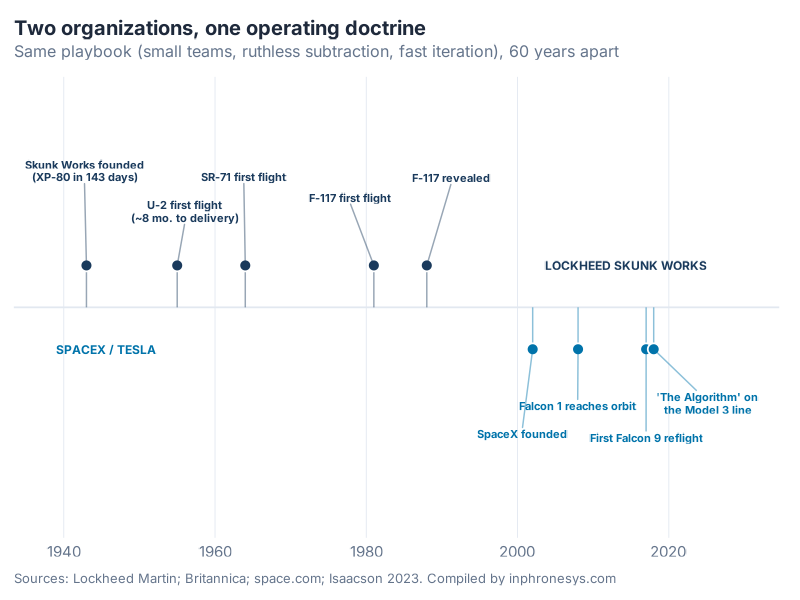
What jumped out to me building this timeline is the gap in the middle. Forty years separate the F-117’s reveal from the founding of SpaceX. No torch was passed. The same answer simply got rediscovered, because the problem never went away.
The thing both were actually fighting
Name the enemy precisely and the whole picture sharpens. It was never company size. It was latency.
By latency I mean two things added together. First, feedback-loop time: how long from "I have an idea" to "I know if it worked." Second, the number of veto-holders standing between an engineer and a change. Every approval box, every sign-off, every "let me check with legal" adds delay and dilutes ownership. A purchase that needs seven signatures is not safer than one that needs two. It is just slower, and nobody in the chain feels responsible.
Johnson’s Rule 3 and Musk’s "delete the process" are the same move against the same enemy. Both shorten the loop. Both rip out veto-holders. Company size has almost nothing to do with whether an organization can still invent. The org chart does.
Isolation versus pervasion
Here the two diverge.
Johnson solved latency by isolation. He walled off a few dozen people behind a fence, gave them their own rules, and kept the parent company’s bureaucracy on the far side of that wall. The Skunk Works worked precisely because it was not the rest of Lockheed. It was a protected island of speed inside a slow giant. That model is reliable, and it is also a quiet admission of defeat. You don’t fix the bureaucracy. You hide from it.
Musk made a more radical bet. Pervasion. Instead of carving out a small protected team, he tried to make an entire company, tens of thousands of people, behave like a skunkworks all the way through. No island. The Algorithm is not a fence around a special unit. It is meant to run on every line, every requirement, every part, everywhere at once. Whether that scales is the real experiment of the last decade. So far, the evidence says it can.
Can only startups innovate?
This is where Clayton Christensen earns a seat at the table. In The Innovator’s Dilemma (Harvard Business School Press, 1997), he argued that great big companies often fail not because they are stupid but because they are well run. They listen to their best customers. They invest in their fattest margins. And they rationally ignore cheap, crummy, low-end products that later grow up to eat them alive. The dilemma is real, and I think it is the single best explanation of why incumbents lose.
But look closely at his diagnosis. It is about incentives and process, not about headcount. Christensen never said "big is bad." He said "optimizing for your current customers is a trap." Those are different claims. A large company that keeps its feedback loops short and its veto-holders few can still take the disruptive bet. A tiny startup buried under its own committees cannot.
The proof is sitting in the data. SpaceX and Tesla are no longer scrappy startups. They are enormous. And they are still fast. Reusability let Falcon 9 cut the cost of reaching low Earth orbit from the Space Shuttle’s $54,500 per kilogram to $2,720 per kilogram, roughly a twentyfold drop, or about 95% (figures from The Conversation, an academic outlet).
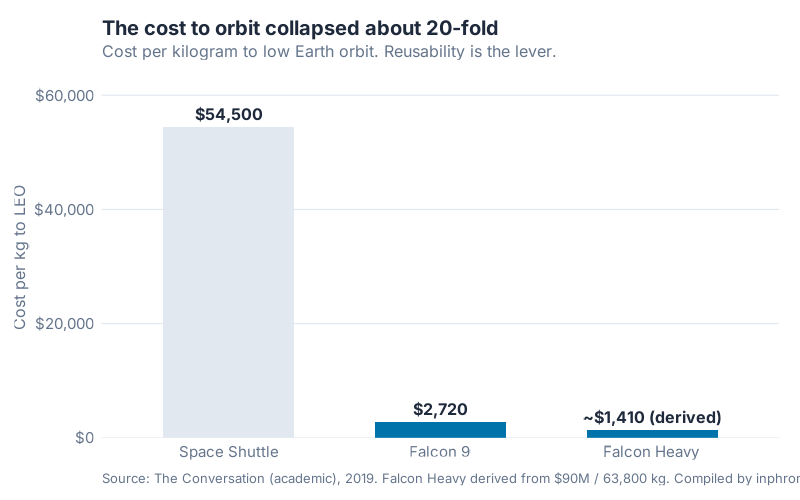
A company that had truly aged into bureaucracy could not have done that. Bigness is not the disease. Bureaucracy is. The two get confused because they so often travel together, but they are not the same thing, and the difference is the whole game.
What to do with this
You don’t need a rocket program to use any of this. You need to measure your own latency and start cutting it.
- Count your veto-holders. Pick one recent decision. Write down every person who could have said no. That number is your latency tax.
- Name the requirement owner. Find one rule nobody can trace to a person. Either find the name or kill the rule.
- Run the deletion test. Take one process and remove a step. If nothing breaks within a month, it was waste. If you never add anything back, you didn’t cut hard enough.
- Protect the loop, not the team. Before you build a special "innovation unit," ask whether you are fixing the bureaucracy or just hiding from it.
Start with the first one this week. The number will surprise you, and that surprise is the point.
Interactive Dashboard
Explore both doctrines yourself: line up Musk’s five steps against Johnson’s 14 Rules, see the shared ancestors, and scrub through the 1943 to 2023 timeline.
Interactive Dashboard
Explore the data yourself — adjust parameters and see the results update in real time.
Show R Code
# =============================================================================
# generate_alg_images.R
# Charts for "The Algorithm vs. The Skunk Works" (2026-06-16)
# All numbers verified in the project FINAL DATASET.
# Run from project root:  Rscript Scripts/generate_alg_images.R
# =============================================================================

source("Scripts/theme_inphronesys.R")

library(ggplot2)
library(dplyr)
library(scales)

dir.create("Images", showWarnings = FALSE)

# -----------------------------------------------------------------------------
# CHART 1 - Cost to orbit collapse (verified $/kg to LEO)
# Source: The Conversation, "How SpaceX lowered costs and reduced barriers
#   to space." Shuttle $54,500/kg; Falcon 9 $2,720/kg;
#   Falcon Heavy derived $90M / 63,800 kg.
# -----------------------------------------------------------------------------

cost <- data.frame(
  vehicle = c("Space Shuttle", "Falcon 9", "Falcon Heavy"),
  cost_kg = c(54500, 2720, 1410),
  label   = c("$54,500", "$2,720", "~$1,410 (derived)"),
  era     = c("Old model", "Reusable", "Reusable")
)
cost$vehicle <- factor(cost$vehicle,
                       levels = c("Space Shuttle", "Falcon 9", "Falcon Heavy"))

p1 <- ggplot(cost, aes(x = vehicle, y = cost_kg, fill = era)) +
  geom_col(width = 0.62) +
  geom_text(aes(label = label), vjust = -0.6, size = 4.1,
            family = "Inter", fontface = "bold", color = iph_colors$dark) +
  scale_fill_manual(values = c("Old model" = iph_colors$lightgrey,
                               "Reusable"  = iph_colors$blue),
                    guide = "none") +
  scale_y_continuous(labels = dollar_format(),
                     expand = expansion(mult = c(0, 0.16))) +
  labs(
    title = "The cost to orbit collapsed about 20-fold",
    subtitle = "Cost per kilogram to low Earth orbit. Reusability is the lever.",
    x = NULL, y = "Cost per kg to LEO",
    caption = "Source: The Conversation (academic). Falcon Heavy derived. inphronesys.com"
  ) +
  theme_inphronesys(grid = "y")

ggsave("https://inphronesys.com/wp-content/uploads/2026/06/alg_launch_cost.png", p1,
       width = 8, height = 5, dpi = 100, bg = "white")

# -----------------------------------------------------------------------------
# CHART 2 - Dual-track innovation timeline 1943-2023
# Every date verified in the FINAL DATASET.
# -----------------------------------------------------------------------------

tl <- data.frame(
  year  = c(1943, 1955, 1964, 1981, 1988,
            2002, 2008, 2017, 2018),
  track = c("Skunk Works", "Skunk Works", "Skunk Works", "Skunk Works", "Skunk Works",
            "SpaceX / Tesla", "SpaceX / Tesla", "SpaceX / Tesla", "SpaceX / Tesla"),
  event = c("Skunk Works founded\n(XP-80 in 143 days)",
            "U-2 first flight\n(~8 mo. to delivery)",
            "SR-71 first flight",
            "F-117 first flight",
            "F-117 revealed",
            "SpaceX founded",
            "Falcon 1 reaches orbit",
            "First Falcon 9 reflight",
            "'The Algorithm' on\nthe Model 3 line")
)
tl$track <- factor(tl$track, levels = c("Skunk Works", "SpaceX / Tesla"))
tl$ypos  <- ifelse(tl$track == "Skunk Works", 1, -1)
tl$lab_y <- tl$ypos * c(2.2, 3.4, 2.2, 3.4, 2.2,
                        2.2, 3.4, 2.2, 3.4)

p2 <- ggplot(tl, aes(x = year, y = ypos, color = track)) +
  geom_hline(yintercept = 0, color = iph_colors$lightgrey, linewidth = 0.6) +
  geom_segment(aes(xend = year, yend = 0), linewidth = 0.5, alpha = 0.5) +
  geom_point(size = 3.4) +
  geom_text(aes(y = lab_y, label = event), size = 2.95,
            family = "Inter", lineheight = 0.92, fontface = "bold") +
  annotate("text", x = 1943, y = 0.7, label = "LOCKHEED SKUNK WORKS",
           hjust = 0, size = 3.2, family = "Inter", fontface = "bold",
           color = iph_colors$navy) +
  annotate("text", x = 1943, y = -0.7, label = "SPACEX / TESLA",
           hjust = 0, size = 3.2, family = "Inter", fontface = "bold",
           color = iph_colors$blue) +
  scale_color_manual(values = c("Skunk Works"    = iph_colors$navy,
                                "SpaceX / Tesla" = iph_colors$blue),
                     guide = "none") +
  scale_x_continuous(breaks = seq(1940, 2020, 20), limits = c(1940, 2026)) +
  scale_y_continuous(limits = c(-4.4, 4.4)) +
  labs(
    title = "Two organizations, one operating doctrine",
    subtitle = "Same playbook (small teams, ruthless subtraction, fast iteration), 60 years apart",
    x = NULL, y = NULL,
    caption = "Sources: Lockheed Martin; Britannica; space.com; Isaacson 2023. inphronesys.com"
  ) +
  theme_inphronesys(grid = "none") +
  theme(axis.text.y = element_blank(),
        panel.grid.major.x = element_line(color = iph_colors$lightgrey,
                                          linewidth = 0.3))

ggsave("https://inphronesys.com/wp-content/uploads/2026/06/alg_innovation_timeline-1.png", p2,
       width = 8, height = 5, dpi = 100, bg = "white")

cat("Done. Wrote https://inphronesys.com/wp-content/uploads/2026/06/alg_launch_cost.png and https://inphronesys.com/wp-content/uploads/2026/06/alg_innovation_timeline-1.png\n")
References
- Isaacson, Walter. Elon Musk. New York: Simon & Schuster, 2023. ISBN 978-1-9821-8128-4. (The Algorithm, pp. 285-286.)
- Rich, Ben R., and Leo Janos. Skunk Works: A Personal Memoir of My Years at Lockheed. Boston: Little, Brown and Company, 1994. ISBN 978-0-316-74330-3 (first edition, hardcover).
- Christensen, Clayton M. The Innovator’s Dilemma: When New Technologies Cause Great Firms to Fail. Boston: Harvard Business School Press, 1997.
- Brooks, Frederick P., Jr. The Mythical Man-Month: Essays on Software Engineering. Reading, MA: Addison-Wesley, 1975.
- Ohno, Taiichi. Toyota Production System: Beyond Large-Scale Production. Cambridge, MA: Productivity Press, 1988.
- Coram, Robert. Boyd: The Fighter Pilot Who Changed the Art of War. Boston: Little, Brown and Company, 2002. (On John Boyd and the OODA loop.)
- Lockheed Martin. "Kelly’s 14 Rules & Practices." https://www.lockheedmartin.com/content/dam/lockheed-martin/aero/photo/skunkworks/kellys-14-rules.pdf
- Lockheed Martin. "Skunk Works Origin Story." https://www.lockheedmartin.com/en-us/who-we-are/business-areas/aeronautics/skunkworks/skunk-works-origin-story.html
- Lockheed Martin. "Fastest Plane in History: The Blackbird." https://www.lockheedmartin.com/en-us/news/features/history/blackbird.html
- The Conversation. "How SpaceX Lowered Costs and Reduced Barriers to Space." https://theconversation.com/how-spacex-lowered-costs-and-reduced-barriers-to-space-112586
- Britannica. "SpaceX." https://www.britannica.com/money/SpaceX
Leave a Reply