
In 1513 Niccolò Machiavelli wrote a sentence that almost nobody quotes correctly. The text is more careful. He did not say it is better to be feared than loved. He said it would be best to be both, and that if the prince has to pick one, fear is the safer bet because love depends on the other party and fear depends on the prince. Five centuries later most management commentary still gets this wrong. Chapter 17 is not a license to terrify people. Chapter 18 is not a license to manipulate them. Read together, the two chapters describe a four-quadrant model of power that explains why some operators stay in their seats through hostile takeovers and regulatory storms, and others get removed at the first turn of pressure.
This is the closing Machiavelli post. Let’s tie the four chapters into one model.
The Fox and the Lion: Why You Need Both
Two sides, one choice. Chapter 18 opens with the cleanest taxonomy of contest in the political canon.
"You must know there are two ways of contesting, the one by the law, the other by force; the first method is proper to men, the second to beasts; but because the first is frequently not sufficient, it is necessary to have recourse to the second." (The Prince, ch. XVIII)
Then he names the beasts. Both are mandatory.
"A prince, therefore, being compelled knowingly to adopt the beast, ought to choose the fox and the lion; because the lion cannot defend himself against snares and the fox cannot defend himself against wolves. Therefore, it is necessary to be a fox to discover the snares and a lion to terrify the wolves. Those who rely simply on the lion do not understand what they are about." (The Prince, ch. XVIII)
That is the model in two animals. Force without intelligence walks into traps. Intelligence without force gets ignored. The fox sees the snare and decides whether the cheese is worth the bite. The lion makes the snare unprofitable to lay. A regulatory affairs team that is only a fox writes excellent memos and loses every enforcement action. An M&A team that is only a lion overpays for the target and underprices the integration risk. The discipline is using both.
The Bond of Love Breaks. The Bond of Fear Holds.
Chapter 17 raises the famous question.
"Upon this a question arises: whether it be better to be loved than feared or feared than loved? It may be answered that one should wish to be both, but, because it is difficult to unite them in one person, it is much safer to be feared than loved, when, of the two, either must be dispensed with." (The Prince, ch. XVII)
The mechanism comes one paragraph later.
"men have less scruple in offending one who is beloved than one who is feared, for love is preserved by the link of obligation which, owing to the baseness of men, is broken at every opportunity for their advantage; but fear preserves you by a dread of punishment which never fails." (The Prince, ch. XVII)
This is principal-agent theory in Florentine prose. Love is a commitment the counterparty controls. Fear, properly built, is a commitment the prince controls. Under low stress the two bonds look identical. Under stress they don’t.
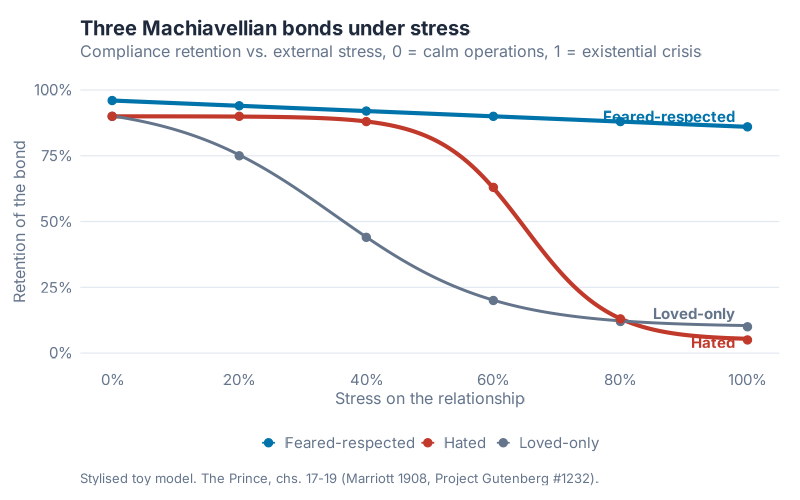
Run a stylised stress test on three relationship types. Stress index 0 is calm operations. Stress index 1 is existential crisis. At s = 0.8, modelled as hostile M&A pressure, the feared-respected bond retains 0.88 of its compliance. The loved-only bond retains 0.12. Feared-respected beats loved-only by 76 percentage points at the same stress level. The feared-respected curve is also the only one of the three that holds a majority of the bond at every point from 0 to 1.
I think the real lesson is not "fear works." That’s the bumper sticker. The lesson is that bonds whose enforcement lives in the other party degrade the instant the other party reprices its interest. If your supplier honours a contract because they like you, you do not have a contract. You have a friendship. The next quarter’s margin pressure will end it.
The Hatred Boundary: Where Feared Tips Into Doomed
Machiavelli then puts an iron fence around the argument. The prince should be feared. The prince must never be hated.
"Nevertheless a prince ought to inspire fear in such a way that, if he does not win love, he avoids hatred; because he can endure very well being feared whilst he is not hated, which will always be as long as he abstains from the property of his citizens and subjects and from their women." (The Prince, ch. XVII)
"above all things he must keep his hands off the property of others, because men more quickly forget the death of their father than the loss of their patrimony." (The Prince, ch. XVII)
The pivot is in chapter 19. Hatred changes the conspiracy math.
"And one of the most efficacious remedies that a prince can have against conspiracies is not to be hated and despised by the people, for he who conspires against a prince always expects to please them by his removal" (The Prince, ch. XIX)
The model encodes this directly.
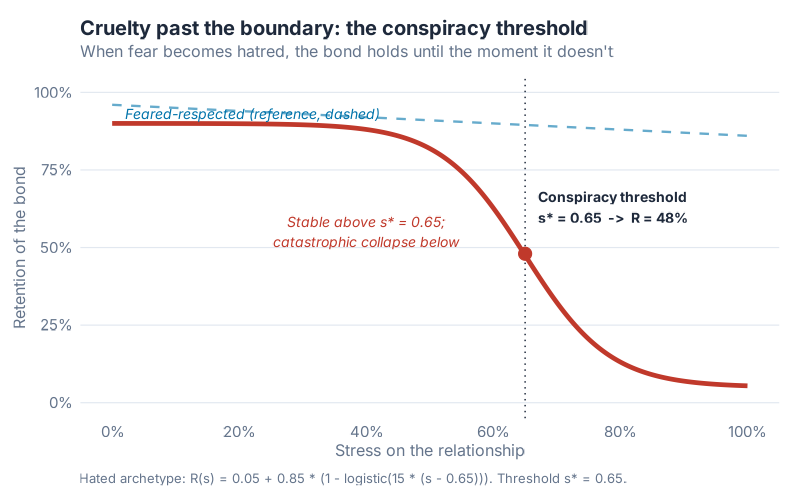
The hated bond looks stable up to a stress index of 0.65. Then it collapses. At the conspiracy threshold s* = 0.65 the retention is 0.48. By s = 0.8 the hated bond holds just 0.13, almost identical to the loved-only line. The feared-respected operator, plotted in dashed blue as reference, is still at 0.88 (a 75 percentage point gap). The collapse is not gradual. It is calm, calm, calm, then everyone the operator offended is in the room at the same time.
The supply-chain version of "the property of others" is direct. Don’t lie about volumes to lock in capacity. Don’t unilaterally rewrite payment terms on suppliers who can’t push back. Don’t claim cost downs you did not earn. Each is rapacity. Each is a deposit in the conspiracy account.
Modern Misapplications: Performance Is Not Credibility
The reading of Chapter 17 that you hear in business books is "be the alpha." That is not what the text says. The text says the prince should establish his authority on what is in his own control.
"men loving according to their own will and fearing according to that of the prince, a wise prince should establish himself on that which is in his own control and not in that of others; he must endeavour only to avoid hatred, as is noted." (The Prince, ch. XVII)
The translation into management terms is not "be intimidating." It is "make your commitments credible." A senior leader who keeps every promise they make, including the unpopular ones, is feared in the Machiavellian sense. A leader who raises their voice in meetings and never follows through is the worst of both worlds. Performative aggression without follow-through is the costume of fear, not the substance. It produces hatred without producing consequence.
Here is the provocative claim. Most "tough" leaders in modern firms are not feared. They are merely unpleasant. The room that goes quiet when they enter is not deferring. It is waiting for them to leave so the real conversation can resume. Credible enforcement of commitment is the harder discipline, and it does not photograph well.
The 2×2: Where Each Archetype Wins
Stack the two chapters together. The result is the four-quadrant model the title points to.
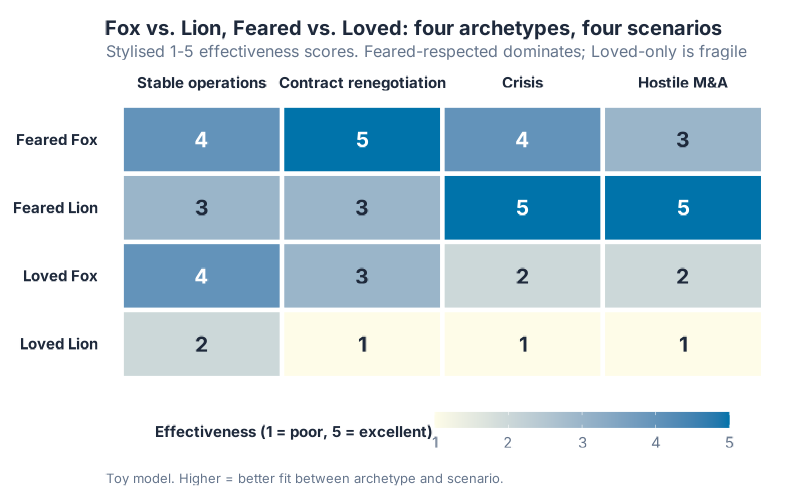
Score each archetype on four operating scenarios from 1 (poor fit) to 5 (excellent fit). The row totals carry the argument.
- Feared Fox: 16. Credible consequence plus adaptability. The renegotiation specialist. Scores 5 on contract renegotiation, where the ability to shift between cooperative and coercive frames without losing credibility is the actual skill.
- Feared Lion: 16. Credible force, low cunning. The crisis operator. Scores 5 on both crisis and hostile M&A. The exemplar Machiavelli reaches for is Septimius Severus, "a most valiant lion and a most cunning fox" (The Prince, ch. XIX).
- Loved Fox: 11. Cunning without enforcement. Adequate in stable operations and routine negotiation. Fragile in crisis because counterparties know there is no claw.
- Loved Lion: 5. Performative force without credibility. The worst of the four. Aggressive enough to attract enemies, without the cunning to see snares or the credibility to terrify wolves.
Both feared archetypes tie at 16. The Loved Lion totals just 5. The takeaway is not that you should pick a quadrant and live there. The takeaway is that the durable leader operates across all four and chooses by context. Routine vendor reviews call for the Loved Fox. The day the regulator opens an inquiry calls for the Feared Fox. The integration of a hostile acquisition calls for the Feared Lion. Almost nothing calls for the Loved Lion.
Machiavelli saw the objection. Durable leadership requires all four, and that combination is rare.
"Therefore it is unnecessary for a prince to have all the good qualities I have enumerated, but it is very necessary to appear to have them." (The Prince, ch. XVIII)
Appearance is not the substance. The substance is being able to switch quadrants when the scenario shifts.
Closing the Machiavelli Pillar
The series spent four posts on Machiavelli on purpose. The Prince is read in business circles for the wrong sentence and skipped for the right ones. Chapters 12 to 14 are the case against outsourcing core capability. Chapter 17 is the case for credible enforcement of commitments. Chapter 18 is the case for combining cunning with force. Chapter 19 is the case for restraint. The package is not cruelty. It is the discipline of staying in your seat.
Tuesday closes the May strategy series with the Four Masters synthesis. Sun Tzu, Clausewitz, Musashi, and Machiavelli in one boardroom. Where do they agree? Where would they argue? Which of their disagreements actually matters in a 2026 supply chain? See you Tuesday.
Tuesday, Article 14: "Four Masters, One Boardroom." The synthesis.
Interactive Dashboard
Set the stress slider. Watch the three retention curves move. Adjust the conspiracy threshold and see when the Hated bond collapses. Compare the 2×2 effectiveness scores side by side.
Interactive Dashboard
Explore the data yourself — adjust parameters and see the results update in real time.
Show R Code
# =============================================================================
# generate_foxlion_images.R
# Charts for: "Of the Fox and the Lion: Coercion, Cunning, and Modern Power"
# (inphronesys.com, May 22, 2026 — Article 13/15 of the May Strategy Series)
# =============================================================================
# Three transparent toy models illustrating Machiavelli's argument in
# The Prince, chs. 17-19 (Marriott 1908 translation, Project Gutenberg #1232,
# https://www.gutenberg.org/files/1232/1232-h/1232-h.htm).
#
# Model design (locked dataset; Alpha + Charlie quote these numbers verbatim):
#
#   Stress index s in [0, 1] from calm operations (0) to existential
#   crisis (1). Bond retention R(s) for three archetypes:
#
#   1. LOVED-ONLY (no credible enforcement):
#        R_loved(s)   = 0.10 + 0.85 * (1 - plogis(8  * (s - 0.35)))
#      Logistic decay; the bond is real at calm stress but the operator
#      ditches it as soon as defecting pays.
#
#   2. FEARED-AND-RESPECTED (credible consequence, restraint from rapacity):
#        R_feared(s)  = 0.96 - 0.10 * s
#      Near-flat. Minor linear cost of legitimate enforcement.
#
#   3. HATED (cruelty past the boundary -> Ch. 19 conspiracy regime):
#        R_hated(s)   = 0.05 + 0.85 * (1 - plogis(15 * (s - 0.65)))
#      Holds above 0.85 until the conspiracy threshold s* = 0.65, then
#      collapses through it. By s = 0.8 the bond is gone.
#
# These are NOT estimated from data. They are stylised pedagogical curves
# whose shape is chosen to encode Machiavelli's three regimes.
# =============================================================================

# --- Setup ---------------------------------------------------------------
source("Scripts/theme_inphronesys.R")

library(ggplot2)
library(dplyr)
library(tidyr)
library(scales)
library(patchwork)

set.seed(42)

if (!dir.exists("Images")) dir.create("Images")

# --- Model ---------------------------------------------------------------

retention <- function(s, archetype) {
  if (archetype == "Loved-only") {
    0.10 + 0.85 * (1 - plogis(8 * (s - 0.35)))
  } else if (archetype == "Feared-respected") {
    0.96 - 0.10 * s
  } else if (archetype == "Hated") {
    0.05 + 0.85 * (1 - plogis(15 * (s - 0.65)))
  } else {
    stop("Unknown archetype")
  }
}

archetypes <- c("Loved-only", "Feared-respected", "Hated")

stress_grid <- seq(0, 1, length.out = 401)

curves <- expand.grid(
  stress = stress_grid,
  archetype = archetypes,
  stringsAsFactors = FALSE
) |>
  mutate(retention = mapply(retention, stress, archetype))

# Anchor table (Alpha + Charlie quote ONLY these values for prose / dashboard)
anchors <- expand.grid(
  stress = c(0, 0.2, 0.4, 0.6, 0.8, 1.0),
  archetype = archetypes,
  stringsAsFactors = FALSE
) |>
  mutate(retention = round(mapply(retention, stress, archetype), 2))

cat("\n--- Anchor table (locked numbers) ---\n")
print(anchors |> pivot_wider(names_from = archetype, values_from = retention))

# Conspiracy threshold (midpoint of the Hated collapse sigmoid)
s_star <- 0.65
R_star <- round(retention(s_star, "Hated"), 2)
cat(sprintf("\nConspiracy threshold for Hated archetype: s* = %.2f, R(s*) = %.2f\n",
            s_star, R_star))

# --- Colour mapping ------------------------------------------------------
arche_colors <- c(
  "Loved-only"       = iph_colors$lightgrey,
  "Feared-respected" = iph_colors$blue,
  "Hated"            = iph_colors$red
)
# Loved-only is hard to read on white at lightgrey; bump it to grey for the line
arche_line_colors <- c(
  "Loved-only"       = iph_colors$grey,
  "Feared-respected" = iph_colors$blue,
  "Hated"            = iph_colors$red
)

# Stress regime labels (for the x-axis context)
regime_breaks <- c(0, 0.25, 0.55, 0.85, 1.0)
regime_labels <- c("Calm", "Renegotiation", "Crisis", "Hostile M&A", "")

# =============================================================================
# CHART 1: Three retention curves vs. stress
# =============================================================================

curves$archetype <- factor(curves$archetype,
                           levels = c("Feared-respected", "Hated", "Loved-only"))
anchors$archetype <- factor(anchors$archetype,
                            levels = c("Feared-respected", "Hated", "Loved-only"))

p1 <- ggplot(curves, aes(x = stress, y = retention,
                          color = archetype, linewidth = archetype)) +
  geom_line() +
  geom_point(data = anchors, size = 2.4) +
  scale_color_manual(values = arche_line_colors, name = NULL) +
  scale_linewidth_manual(values = c("Feared-respected" = 1.4,
                                     "Hated" = 1.4,
                                     "Loved-only" = 1.0),
                          guide = "none") +
  scale_y_continuous(labels = percent_format(accuracy = 1),
                     limits = c(0, 1), breaks = seq(0, 1, 0.25)) +
  scale_x_continuous(labels = percent_format(accuracy = 1),
                     breaks = seq(0, 1, 0.2)) +
  labs(
    title    = "Three Machiavellian bonds under stress",
    subtitle = "Compliance retention vs. external stress, 0 = calm operations, 1 = existential crisis",
    x = "Stress on the relationship",
    y = "Retention of the bond",
    caption = "Stylised toy model. The Prince, chs. 17-19 (Marriott 1908, Project Gutenberg #1232)."
  ) +
  theme_inphronesys(grid = "y") +
  theme(legend.position = "bottom")

# Annotate which curve dominates at high stress
p1 <- p1 +
  annotate("text", x = 0.98, y = 0.88,
           label = "Feared-respected", hjust = 1, vjust = 0,
           color = iph_colors$blue, fontface = "bold", size = 4) +
  annotate("text", x = 0.98, y = 0.02,
           label = "Hated", hjust = 1, vjust = 0,
           color = iph_colors$red, fontface = "bold", size = 4) +
  annotate("text", x = 0.98, y = 0.13,
           label = "Loved-only", hjust = 1, vjust = 0,
           color = iph_colors$grey, fontface = "bold", size = 4)

ggsave("https://inphronesys.com/wp-content/uploads/2026/05/foxlion_durability_curves.png", p1,
       width = 8, height = 5, dpi = 100, bg = "white")

# =============================================================================
# CHART 2: Zoom on the Hated archetype's conspiracy threshold
# =============================================================================

hated_df <- curves |> filter(archetype == "Hated")
feared_df <- curves |> filter(archetype == "Feared-respected")

p2 <- ggplot() +
  # Feared-respected as faint reference
  geom_line(data = feared_df,
            aes(x = stress, y = retention),
            color = iph_colors$blue, linewidth = 0.8, linetype = "dashed",
            alpha = 0.6) +
  # Hated curve
  geom_line(data = hated_df,
            aes(x = stress, y = retention),
            color = iph_colors$red, linewidth = 1.6) +
  # Conspiracy threshold vertical line
  geom_vline(xintercept = s_star, color = iph_colors$dark,
             linetype = "dotted", linewidth = 0.5) +
  # Threshold point
  annotate("point", x = s_star, y = R_star,
           color = iph_colors$red, size = 4) +
  # Threshold annotation
  annotate("text", x = s_star + 0.02, y = R_star + 0.10,
           label = paste0("Conspiracy threshold\ns* = ", s_star,
                          "  ->  R = ", scales::percent(R_star, accuracy = 1)),
           hjust = 0, vjust = 0, color = iph_colors$dark,
           fontface = "bold", size = 3.6) +
  # Reference label
  annotate("text", x = 0.02, y = 0.93,
           label = "Feared-respected (reference, dashed)",
           hjust = 0, color = iph_colors$blue, size = 3.6,
           fontface = "italic") +
  annotate("text", x = 0.40, y = 0.55,
           label = paste0("Stable above s* = ", s_star, ";\n",
                          "catastrophic collapse below"),
           hjust = 0.5, color = iph_colors$red, size = 3.6,
           fontface = "italic") +
  scale_y_continuous(labels = percent_format(accuracy = 1),
                     limits = c(0, 1), breaks = seq(0, 1, 0.25)) +
  scale_x_continuous(labels = percent_format(accuracy = 1),
                     breaks = seq(0, 1, 0.2)) +
  labs(
    title    = "Cruelty past the boundary: the conspiracy threshold",
    subtitle = "When fear becomes hatred, the bond holds until the moment it doesn't",
    x = "Stress on the relationship",
    y = "Retention of the bond",
    caption = "Hated archetype: R(s) = 0.05 + 0.85 * (1 - logistic(15 * (s - 0.65))). Threshold s* = 0.65."
  ) +
  theme_inphronesys(grid = "y")

ggsave("https://inphronesys.com/wp-content/uploads/2026/05/foxlion_hatred_threshold.png", p2,
       width = 8, height = 5, dpi = 100, bg = "white")

# =============================================================================
# CHART 3: 2x2 Fox/Lion x Feared/Loved effectiveness heatmap (4 scenarios)
# =============================================================================

# Locked 4 x 4 scoring table (1 = poor, 5 = excellent)
matrix_df <- tribble(
  ~archetype,    ~scenario,                ~score,
  "Loved Fox",   "Stable operations",      4,
  "Loved Fox",   "Contract renegotiation", 3,
  "Loved Fox",   "Crisis",                 2,
  "Loved Fox",   "Hostile M&A",            2,

  "Loved Lion",  "Stable operations",      2,
  "Loved Lion",  "Contract renegotiation", 1,
  "Loved Lion",  "Crisis",                 1,
  "Loved Lion",  "Hostile M&A",            1,

  "Feared Fox",  "Stable operations",      4,
  "Feared Fox",  "Contract renegotiation", 5,
  "Feared Fox",  "Crisis",                 4,
  "Feared Fox",  "Hostile M&A",            3,

  "Feared Lion", "Stable operations",      3,
  "Feared Lion", "Contract renegotiation", 3,
  "Feared Lion", "Crisis",                 5,
  "Feared Lion", "Hostile M&A",            5
)

matrix_df$archetype <- factor(matrix_df$archetype,
  levels = c("Loved Lion", "Loved Fox", "Feared Lion", "Feared Fox"))
matrix_df$scenario <- factor(matrix_df$scenario,
  levels = c("Stable operations", "Contract renegotiation",
             "Crisis", "Hostile M&A"))

p3 <- ggplot(matrix_df, aes(x = scenario, y = archetype, fill = score)) +
  geom_tile(color = "white", linewidth = 1.5) +
  geom_text(aes(label = score),
            color = ifelse(matrix_df$score >= 4, "white", iph_colors$dark),
            fontface = "bold", size = 5.5) +
  scale_fill_gradient(
    low = "#fefce8",
    high = iph_colors$blue,
    limits = c(1, 5),
    breaks = 1:5,
    name = "Effectiveness (1 = poor, 5 = excellent)"
  ) +
  scale_x_discrete(position = "top") +
  labs(
    title    = "Fox vs. Lion, Feared vs. Loved: four archetypes, four scenarios",
    subtitle = "Stylised 1-5 effectiveness scores. Feared-respected dominates; Loved-only is fragile",
    x = NULL, y = NULL,
    caption = "Toy model. Higher = better fit between archetype and scenario."
  ) +
  theme_inphronesys(grid = "none") +
  theme(
    legend.position = "bottom",
    legend.key.width = unit(1.5, "cm"),
    axis.text.x.top = element_text(face = "bold", color = iph_colors$dark,
                                    size = 11, angle = 0),
    axis.text.y = element_text(face = "bold", color = iph_colors$dark,
                                size = 11)
  )

ggsave("https://inphronesys.com/wp-content/uploads/2026/05/foxlion_2x2_heatmap.png", p3,
       width = 8, height = 5, dpi = 100, bg = "white")

# --- Diagnostics ---------------------------------------------------------
cat("\n--- 4 x 4 matrix totals ---\n")
matrix_df |>
  group_by(archetype) |>
  summarise(total = sum(score), .groups = "drop") |>
  arrange(desc(total)) |>
  print()

cat("\n--- High-stress dominance at s = 0.8 ---\n")
high_stress <- anchors |> filter(stress == 0.8)
print(high_stress)
diff_fl <- anchors$retention[anchors$stress == 0.8 &
                              anchors$archetype == "Feared-respected"] -
           anchors$retention[anchors$stress == 0.8 &
                              anchors$archetype == "Loved-only"]
diff_fh <- anchors$retention[anchors$stress == 0.8 &
                              anchors$archetype == "Feared-respected"] -
           anchors$retention[anchors$stress == 0.8 &
                              anchors$archetype == "Hated"]
cat(sprintf("Feared-respected beats Loved-only by %.0f pts at s = 0.8\n",
            100 * diff_fl))
cat(sprintf("Feared-respected beats Hated by %.0f pts at s = 0.8\n",
            100 * diff_fh))

cat("\nDone. Wrote:\n",
    "  https://inphronesys.com/wp-content/uploads/2026/05/foxlion_durability_curves.png\n",
    "  https://inphronesys.com/wp-content/uploads/2026/05/foxlion_hatred_threshold.png\n",
    "  https://inphronesys.com/wp-content/uploads/2026/05/foxlion_2x2_heatmap.png\n", sep = "")
Sources
- Niccolò Machiavelli, The Prince, Chapters XVII, XVIII, and XIX. Translated by W. K. Marriott, 1908. Public-domain edition: Project Gutenberg eBook 1232. All quotations transcribed verbatim from this edition.
Leave a Reply