
Two labs, $9.03 billion, zero products
Safe Superintelligence has raised $8.00 billion. Yann LeCun’s AMI Labs has raised $1.03 billion. Between them: $9.03 billion, and not one thing you could buy, download, subscribe to, or read. No app. No API. No model weights. No paper.
That is not a scandal. It might be the most rational thing happening in AI right now.
Everyone argued about which chatbot writes better emails. Meanwhile, six labs quietly raised $15.56 billion to bet against the thing the chatbots are built on. 58.0% of that money went to the two labs above, the ones with nothing to show. And the three labs most likely to end up inside your warehouse are the three getting the least attention.
One of these bets lands on your loading dock. The headlines are pointed somewhere else.
Why "stealth" is a strategy, not a stunt
The obvious question first. Why hand $8 billion to a company with no product?
Because a product is a tax. Ship something and you inherit customers, uptime commitments, a support queue, a pricing page, and a roadmap shaped by whoever shouts loudest. Every hour spent on that is an hour not spent on the research problem. If you believe the current approach to AI runs out of road in five years, building a business on top of it wastes your best people.
So you go quiet. You raise enough to not need revenue.
Safe Superintelligence says this out loud on its own website: "We have started the world’s first straight-shot SSI lab, with one goal and one product: a safe superintelligence." One product. Not a first product. Ilya Sutskever, who co-founded OpenAI and now runs SSI as CEO, has argued publicly that the field is leaving the era where you simply added more compute and data, and returning to one that needs new ideas. That’s a paraphrase of his framing, not a quote, but it explains the strategy. If the next win comes from research rather than scale, a product is a distraction.
Here’s my read: most of this $15.56 billion will be lost. That’s just the arithmetic of research bets, and it’s why the cheque-writers spread them across six incompatible theories of what comes next.
Act 1: the quiet money
Six labs. Founded between 2023 and 2026. Here’s who they are and what each one is actually wagering.
| Lab | Founder or face | The bet | Capital raised | Valuation | Released |
|---|---|---|---|---|---|
| Thinking Machines Lab | Mira Murati (ex-OpenAI CTO) | Open weights and customization beat one giant closed model | $2.00B | $12B | 2 |
| Safe Superintelligence | Ilya Sutskever | A "straight shot" to superintelligence, no product on the way | $8.00B | $32B | 0 |
| AMI Labs | Yann LeCun (Chairman) | World models replace next-word prediction | $1.03B | $4.53B | 0 |
| Physical Intelligence | Karol Hausman, Sergey Levine, Chelsea Finn | One foundation model that drives any robot body | $1.10B | $5.6B | 4 |
| Skild AI | Deepak Pathak, Abhinav Gupta | An "omni-bodied" robot brain, sold commercially now | $2.20B | $14B | 1 |
| World Labs | Fei-Fei Li | Spatial intelligence: machines that understand 3D space | $1.23B | $5B (reported) | 1 |
Four notes, because the details matter. "Released" counts generally available products plus models whose weights or technical paper are public, so limited research previews score zero. SSI’s $32B is post-money from early 2025 (sources disagree on the month and SSI never issued a press release, so "early 2025" is as precise as the record allows). AMI Labs’ $4.53B is implied post-money: $3.50 billion pre-money plus the $1.03 billion raised. World Labs’ $5B is reported, and the company declined to confirm it.
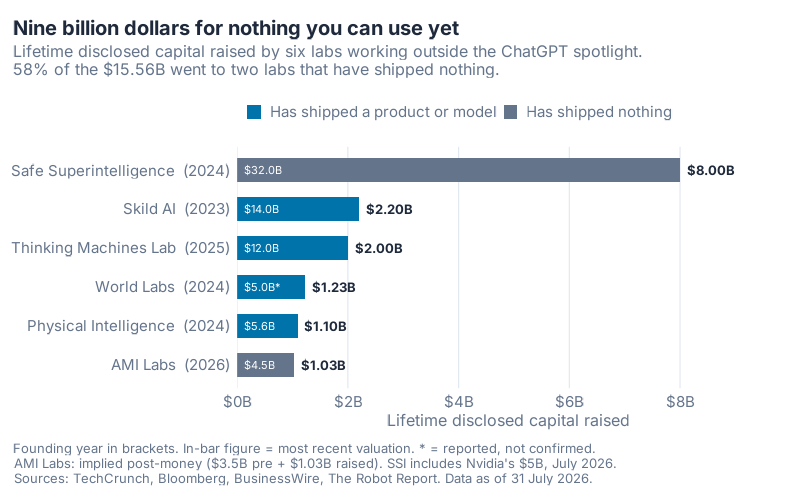
One caveat on the biggest bar. SSI’s $8.00 billion includes $5.0 billion from Nvidia in July 2026, a figure reported by Bloomberg and tied to a compute partnership (neither company disclosed an amount), and SSI never said whether it repriced the company. Third-party tallies of SSI’s lifetime total vary for exactly this reason, some landing well above $8 billion. Count priced equity rounds only and the figure is $3.00 billion, which drops the six-lab total to $10.56 billion. I use the disclosed-capital numbers throughout, but you should know the softer one exists. Sutskever’s explanation for taking the money was plain: "We have research that is worthy of scaling up, and having access to a big NVIDIA computer will let us do so."
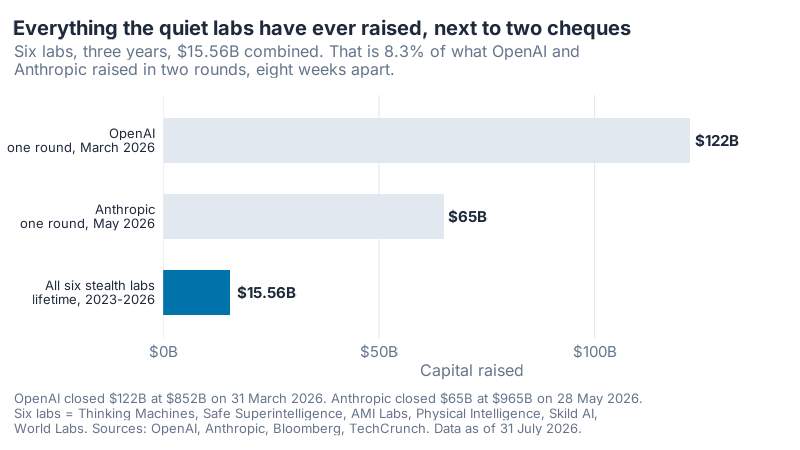
What jumped out at me here isn’t how much these labs raised. It’s how little. All six of them, across their entire lifetimes, add up to 12.8% of what OpenAI raised in a single round in March 2026 ($122 billion, at an $852 billion post-money valuation). Set them against OpenAI plus Anthropic’s 2026 rounds together and the six labs are 8.3% of the total.
So when I call this "the quiet money," I mean it literally. In a year where AI took 65.6% of all US venture deal value (PitchBook-NVCA’s Q4 2025 Venture Monitor puts it at roughly $222 billion of $339 billion), the six strangest bets in the industry are rounding errors next to the two loudest companies. The contrarian ideas are not where the money is. They’re where the money isn’t.
Act 2: the two bets that say the current road ends
Two of these labs think the entire approach behind ChatGPT is a dead end. They disagree about what replaces it.
SSI: refuse to build anything until you’ve solved the hard part
SSI’s position is the simplest to describe and the hardest to evaluate: one goal, one product, no intermediate revenue. "Building safe superintelligence (SSI) is the most important technical problem of our time," the site says, and then it stops. There is nothing else to assess. No benchmark, no demo, no paper.
That makes SSI either the most disciplined lab on this list or the most expensive act of faith in modern technology, and there is genuinely no way to tell from the outside yet.
Here’s the number that does hold up: $8.00 billion raised, zero products, more than half of the $15.56 billion in this article sitting behind one silence. I went looking for a per-employee figure to sharpen the point and threw it away, because the only headcount on the record is single-source and undated. When a company is this quiet, even the unflattering statistics are unverifiable.
AMI Labs and world models: the forklift driver’s intuition
LeCun’s bet is the one I find most interesting, and it’s the one that actually explains Physical AI. So let’s do it properly.
A large language model predicts the next word. That’s it. Everything it does happens in the space of text, and it is extraordinarily good at that. Ask it to describe how to reverse a forklift into a tight dock and it will produce a competent paragraph, because it has read every paragraph ever written on the subject.
Now put it in the forklift.
An experienced driver doesn’t reason in words. They have a running model of what happens next: this pallet is loaded high and slightly off-center, that turn at this speed will tip it, the guy walking behind the rack can’t see me. That model runs constantly, cheaply, and mostly below the level of language. It is not a description of the physical world. It’s a prediction engine for it.
LeCun’s argument, which he laid out in his 2022 position paper "A Path Towards Autonomous Machine Intelligence," is that you cannot get that from predicting words, and you also can’t get it by predicting video frame by frame. Predicting pixels wastes nearly all of a model’s capacity on detail that doesn’t matter: the precise texture of a shadow, the exact grain of the cardboard. His alternative, the Joint Embedding Predictive Architecture (JEPA), predicts an abstract summary of what happens next instead, and deliberately throws the unpredictable detail away.
Think about what you actually predict when you watch a colleague stack a pallet badly. You don’t render the fall in your head pixel by pixel. You think: that’s coming down. You keep the consequence and discard the detail. That’s the whole idea.
This isn’t a slide deck. The JEPA line has been shipping research for years: I-JEPA (arXiv:2301.08243, January 2023, published at CVPR 2023), then V-JEPA in February 2024, then V-JEPA 2 in June 2025. V-JEPA 2 has 1.2 billion parameters and was pretrained on over 1 million hours of video plus 1 million images. Here’s the number that matters for anyone who moves boxes: Meta reports V-JEPA 2 achieving 65% to 80% success on pick-and-place with new objects in environments it had never seen. The robot-control version was post-trained on fewer than 62 hours of unlabeled robot video.
Sixty-two hours. Not sixty-two thousand.
That is the case for world models in one statistic. If a model that understands how physical things behave can be pointed at a new task with two days of video, the economics of automating a non-standard warehouse task change completely.
LeCun is Chairman at AMI Labs, not CEO. The CEO is Alexandre LeBrun, the company is headquartered in Paris, and LeBrun deserves credit for the most self-aware quote in this entire story: "My prediction is that ‘world models’ will be the next buzzword. In six months, every company will call itself a world model to raise funding." He also set expectations honestly: "AMI Labs is a very ambitious project, because it starts with fundamental research. It’s not your typical applied AI startup."
Believe the second quote and budget for the first.
Who’s actually a contender?
Time to be blunt, because "six interesting labs" is not an assessment.
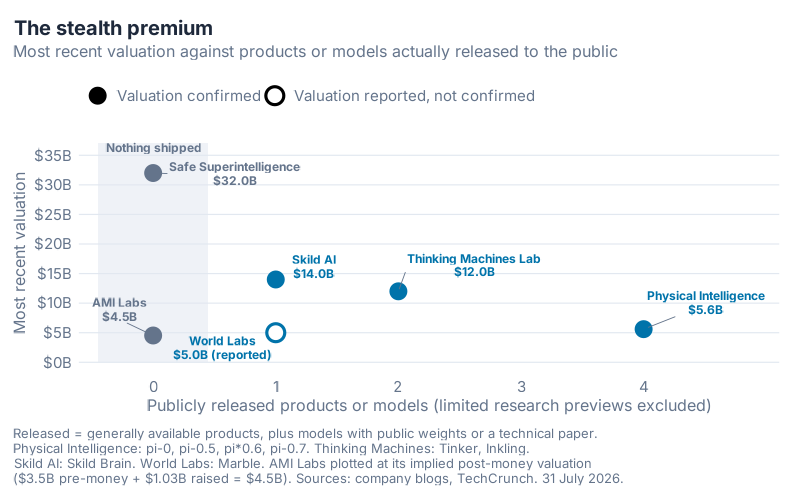
The chart splits the field cleanly. Two labs sit on the left axis with nothing shipped. Four have put something into the world. And the surprise, at least to me, is that the ranking by valuation and the ranking by output are almost unrelated.
Physical Intelligence and Skild are chasing a different prize from LeCun’s: not a better model of the world, but one set of motor skills that transfers between bodies. Today, a gripper trained on your carton line is worth nothing to the arm two stations down, because the training is welded to that specific hardware. A generalist policy is the claim that "pick up an awkward box" can be learned once and reused on any arm that has the reach. That’s what "omni-bodied" means in Skild’s pitch. If it holds, the thing that gets cheaper isn’t the robot. It’s the second robot.
My read, lab by lab:
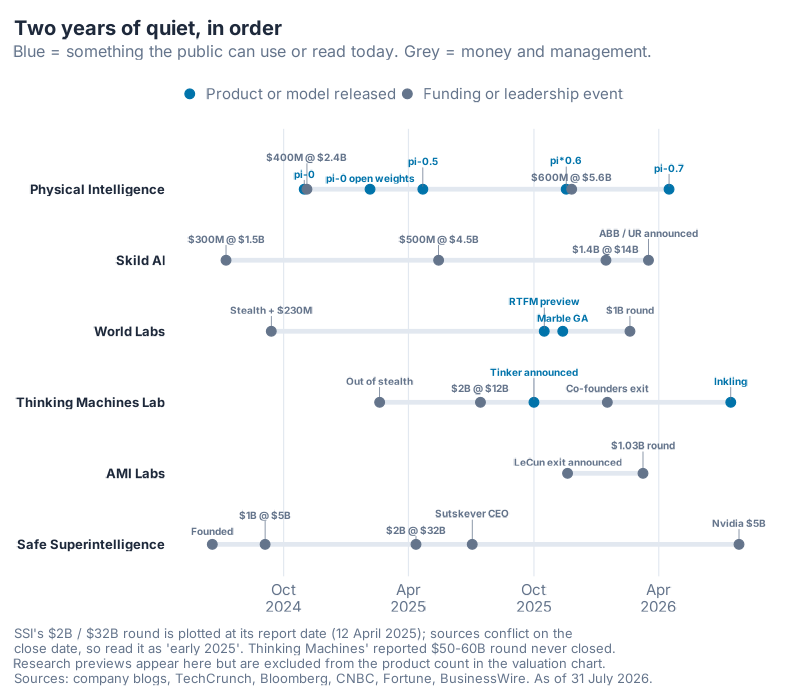
Real contenders inside three years. Physical Intelligence and Skild AI. Both have shipped, and both are attacking a problem where success is measurable in totes per hour rather than vibes. Physical Intelligence has released four generations of its policy models (π0, π0.5, π0.6, π0.7), open-sourced π0 in February 2025 via openpi, and has since opened the π0.5 weights too; only π0.6 and π0.7 stay closed. Skild has one product, Skild Brain. ABB Robotics and Universal Robots have announced they are integrating it into their robot portfolios, and Skild plans to ship it with Foxconn to control dual-arm robots on NVIDIA’s Blackwell GPU production lines. Announced integrations and planned shipments, not completed rollouts, to hold Skild to this article’s own standard. Skild also acquired Zebra Technologies’ robotics division, which is the single clearest signal on this list that someone is aiming at warehouses on purpose.
Contender with a caveat. World Labs. Fei-Fei Li is building the training ground rather than the robot, which is a real and probably necessary layer. Her framing is elegant: "Spatial Intelligence is the scaffolding upon which our cognition is built." Marble went generally available on 12 November 2025, and a $1 billion round followed in February 2026. The caveat is that "generated 3D worlds" has an obvious adjacent market in games and design, and Autodesk money in the last round points that way, so the robotics payoff may arrive late or sideways.
Contender on a longer clock. AMI Labs. I think the architecture argument is right and the timeline is slower than the funding implies. Fundamental research doesn’t respond to capital the way product development does.
Unknowable. SSI. Either the most important company on this list or a $32 billion silence. Anyone claiming to know which is guessing.
The cautionary tale. Thinking Machines Lab, and this one deserves its own section.
Where it breaks
Quiet does not mean safe, and Thinking Machines is the proof.
On paper it’s the strongest story here: Mira Murati, formerly OpenAI’s CTO, raised a $2.0 billion seed round in July 2025 at a $12 billion valuation. It has shipped real things. Tinker reached general availability in December 2025, and the pitch behind it is genuinely useful: "Tinker empowers researchers and hackers to experiment with models by giving them control over the algorithms and data while we handle the complexity of distributed training." In July 2026 the lab released Inkling under Apache 2.0, a mixture-of-experts model with 975 billion total parameters, 41 billion active, up to a 1 million token context window, pretrained on 45 trillion tokens.
Then the other side of the ledger. Bloomberg reported funding talks at around $50 billion in November 2025. Those talks collapsed by January 2026, and the valuation stayed where it was at $12 billion. Four of the six original co-founders have left: Andrew Tulloch to Meta in October 2025, Barret Zoph and Luke Metz in January 2026, and Lilian Weng in July 2026, who then joined OpenAI. Murati and John Schulman remain, and PyTorch co-creator Soumith Chintala came in as CTO in January 2026.
So a lab with an exceptional founder, real products, and open weights still saw a rumoured four-fold valuation jump evaporate, and lost two thirds of its founding team in under a year. Stealth is a bet, not a promise.
Three more ways this whole story could disappoint you:
Valuations are not evidence. Skild AI went from $4.5 billion to over $14 billion in under a year, a 3.1x step, on the strength of one product in deployment. Reflection AI raised $2 billion at an $8 billion valuation in October 2025 and still hasn’t shipped a frontier model. Private valuations in this market measure investor conviction, nothing more.
A pilot is not a rollout, and vendors know the difference even when decks don’t. More on this below, because in robotics the gap between the two is where most of the disappointment lives.
The buzzword risk is real, and an insider called it. LeBrun’s prediction that everyone would relabel themselves a world model within six months is the most useful piece of vendor-filtering advice in this article. When your automation supplier’s deck suddenly features world models, ask what they were calling it last year.
Act 3: what Physical AI means on your loading dock
Now the part you’re here for.
"Physical AI" is a decent name for a simple idea: take the general-purpose learning that worked for text and point it at machines that move things. The prize is a robot you can retask by showing it, instead of reprogramming it.
That distinction is the whole business case. Traditional warehouse automation is brilliant at repetition and brittle at variety. Give it one SKU shape and it’s a bargain. Give it a pallet of mixed cartons, a new supplier’s packaging, or a shrink-wrapped oddity and it becomes an expensive obstacle with an engineer attached. Every exception costs integration hours, which is why these business cases live or die on SKU stability, and why most piece-picking projects quietly narrow their scope after the pilot.
A generalist robot policy attacks exactly that cost. If one model drives different arms and handles objects it has never seen, the integration bill per new task falls, and tasks that were never worth automating come into range.
Forget the six labs for a moment. Look at what’s already running in production.
| Deployment | What is actually happening | Status |
|---|---|---|
| Amazon | Over 1,000,000 robots across 300+ facilities (July 2025); its DeepFleet routing model claims a ~10% travel-time improvement | Operating at scale |
| Agility Robotics and GXO | Industry-first multi-year commercial Robots-as-a-Service humanoid agreement; Digit passed 100,000 totes moved in the live deployment by November 2025 | Commercial |
| Agility Robotics and Schaeffler | Agreement signed November 2024; trade press reports Digit running supervised production shifts at Cheraw, South Carolina, with a stated plan to scale across roughly 100 plants by 2030 | Supervised production, rest is a plan |
| Figure and BMW | A ten-month Figure 02 pilot supported production of over 30,000 BMW X3; a separate Figure 03 logistics-sequencing role started 25 June 2026 | Pilot |
| Skild AI | ABB Robotics and Universal Robots announced they are integrating Skild Brain; planned shipment with Foxconn for NVIDIA Blackwell GPU production lines (March 2026) | Announced integration |
Now put Amazon’s fleet next to the rest of the planet. The International Federation of Robotics counted 542,000 industrial robots installed worldwide in 2024, the second-highest year on record. Amazon alone runs over a million. To be fair about the units: Amazon’s number is a cumulative fleet, mostly mobile drive robots the IFR wouldn’t count as industrial robots, set against a single year of installations. It’s a scale comparison, not like-for-like. Even so: one company’s logistics network holds roughly 1.8 times the robots the entire world installed in factories last year.
That reframes where robotics actually happens. The center of gravity for deployed robots is no longer the automotive assembly line. It’s the fulfillment center. So the next wave of robot intelligence, whoever builds it, gets aimed at material handling first. Not manufacturing. Not cars. Boxes.
Now the honest boundary. Nothing above is a general-purpose warehouse worker. Figure at BMW is a pilot and I won’t dress it up as anything else. Schaeffler’s 100 plants by 2030 is a stated plan, and plans of that shape slip. The Agility and GXO agreement is genuinely commercial, and 100,000 totes is a real number, but it isn’t a headcount replacement. As for V-JEPA 2, a 65% to 80% success rate on unseen objects is impressive for research and nowhere near a production service level. A picker that misses between one attempt in five and one in three isn’t a colleague. It’s an exception generator.
So the useful question isn’t "when do robots take over the warehouse." Try a narrower one: which of my tasks are high-variety, low-volume, and currently un-automatable, and how fast is the cost of automating them falling? That’s the number these six labs are moving. If your answer is "we have 200 such tasks and we’ve never costed them," you have homework that doesn’t depend on any of these companies succeeding.
Real-world impact: what to actually do with this
Three consequences, in rough order of how soon they hit you.
Your automation vendor’s model supplier is now a supply chain risk. Start here. If a robot’s capability comes from a foundation model licensed from someone else, you’ve acquired a dependency you probably haven’t documented. Ask who supplies the intelligence, what happens to your fleet if that supplier pivots or gets acquired, and whether capability updates arrive as a service you pay for. Skild buying Zebra’s robotics division is exactly the kind of event that quietly changes who controls your equipment’s brain.
The automation business case needs a rewrite. Standard piece-picking ROI models assume integration cost scales with task variety. Generalist policies attack that assumption directly. If they work, tasks sitting below your automation threshold move above it, and the ranking of what to automate first changes. Revisit the model before your next capex cycle, not after.
Open weights matter more here than in text. Physical Intelligence open-sourced π0, and Thinking Machines put Inkling out under Apache 2.0. When the model driving your equipment has public weights, you can evaluate it, fine-tune it on your own SKUs, and keep running it if the vendor relationship ends. When it doesn’t, you’re renting capability with no exit. That’s a procurement question, not an IT question. Ask it early.
Interactive Dashboard
Compare all six labs side by side: capital raised, valuation, what each has actually shipped, and where each one sits on the language-world versus physical-world split. Every default value matches the figures in this article. The SSI toggle swaps the disclosed-capital figure ($8.00B) for the priced-equity-only one ($3.00B) and rebuilds every comparison around it, so you can see how much of the story rests on Nvidia’s cheque.
Interactive Dashboard
Explore the data yourself — adjust parameters and see the results update in real time.
Your next steps
Five things you can do this week. None of them require a robot budget.
- Count your unseen-object rate. Pull the SKUs introduced in the last 90 days and work out what share of pick volume comes from items no existing automation was configured for. That single percentage tells you whether generalist robot policies are interesting to you or irrelevant for another five years.
- Cost your top 10 un-automatable tasks. Not to automate them now. To have the numbers ready when the integration cost drops, so you’re comparing against a baseline instead of starting from scratch under time pressure.
- Add a "model supplier" row to your supplier risk register. For every piece of automation on order or in evaluation, record who supplies the underlying model, whether the weights are open, and what your position is if that supplier disappears. Most risk registers stop at the hardware vendor.
- Read the V-JEPA 2 announcement yourself. Meta’s own blog post carries the 65% to 80% pick-and-place figure; the accompanying arXiv paper adds the under-62-hours post-training detail. Half an hour, and you’ll evaluate robotics vendor claims better than most people in the room. Primary source, no interpretation layer.
- Write five questions for your next automation vendor meeting. Suggested starters: What model drives this, and who owns it? What’s your measured success rate on objects the system has never seen? Is this a pilot or a commercial deployment, and what’s the difference in your contract? What happens to capability when we add a new packaging format? Who pays for retraining?
If you only do one, do the first. Everything else on this list gets easier once you know that number.
Show R Code
# =============================================================================
# generate_stealth_labs_images.R
# Charts for the blog post "Stealth AI Labs"
# =============================================================================
# Run from the project root:
#   Rscript Scripts/generate_stealth_labs_images.R
#
# All data is hard-coded from Drafts/2026-07-31_Stealth_AI_Labs_FINAL_DATASET.md
# (contract v1.1). Every number in this script has a verified citation there.
# Do not change a value here without bumping the dataset version.
#
# Outputs (all 800px wide):
#   https://inphronesys.com/wp-content/uploads/2026/07/stealth_capital_raised.png          800x500
#   https://inphronesys.com/wp-content/uploads/2026/07/stealth_valuation_vs_products.png   800x500
#   https://inphronesys.com/wp-content/uploads/2026/07/stealth_timeline.png                800x700
#   https://inphronesys.com/wp-content/uploads/2026/07/stealth_capital_concentration.png   800x450
# =============================================================================

source("Scripts/theme_inphronesys.R")

library(ggplot2)
library(dplyr)
library(scales)
library(ggrepel)

dir.create("Images", showWarnings = FALSE)

# =============================================================================
# DATA - contract v1.1
# =============================================================================

# --- The six labs -----------------------------------------------------------
# capital_bn  : lifetime disclosed capital raised, $B
# valuation_bn: most recent valuation, post-money basis, $B
# products    : publicly released products or models (GA products, or models
#               with released weights/paper). Limited research previews are
#               EXCLUDED and tracked in `previews`.
labs <- tibble::tribble(
  ~lab,                       ~short,        ~founded, ~capital_bn, ~valuation_bn, ~products, ~previews, ~val_confirmed,
  "Thinking Machines Lab",    "Thinking\nMachines",  2025,        2.00,         12.00,         2L,        1L,        TRUE,
  "Safe Superintelligence",   "Safe Super-\nintelligence", 2024,  8.00,         32.00,         0L,        0L,        TRUE,
  "AMI Labs",                 "AMI Labs",            2026,        1.03,          4.53,         0L,        0L,        TRUE,
  "Physical Intelligence",    "Physical\nIntelligence", 2024,     1.10,          5.60,         4L,        0L,        TRUE,
  "Skild AI",                 "Skild AI",            2023,        2.20,         14.00,         1L,        0L,        TRUE,
  "World Labs",               "World Labs",          2024,        1.23,          5.00,         1L,        1L,        FALSE
) |>
  mutate(has_shipped = products > 0)

# --- Verified totals and ratios (see FINAL DATASET section 2.4) --------------
total_capital  <- sum(labs$capital_bn)                                   # 15.56
zero_prod_cap  <- sum(labs$capital_bn[labs$products == 0])               # 9.03
share_zero     <- zero_prod_cap / total_capital                          # 0.5804

openai_round    <- 122.0   # closed 2026-03-31, $852B post-money
anthropic_round <-  65.0   # closed 2026-05-28, $965B post-money

stopifnot(
  abs(total_capital - 15.56) < 1e-9,
  abs(zero_prod_cap -  9.03) < 1e-9,
  abs(share_zero - 0.5804) < 1e-3
)

cat(sprintf("Six-lab lifetime capital: $%.2fB\n", total_capital))
cat(sprintf("Zero-product labs: $%.2fB / $%.2fB = %.1f%%\n",
            zero_prod_cap, total_capital, 100 * share_zero))
cat(sprintf("Six labs vs OpenAI round: %.2f / %.0f = %.1f%%\n",
            total_capital, openai_round, 100 * total_capital / openai_round))
cat(sprintf("Six labs vs both rounds: %.2f / %.0f = %.1f%%\n",
            total_capital, openai_round + anthropic_round,
            100 * total_capital / (openai_round + anthropic_round)))

# --- Milestones for the timeline --------------------------------------------
# kind: "product" = product/model release, "funding" = financing or org event
milestones <- tibble::tribble(
  ~lab,                     ~date,        ~label,                ~kind,
  # Thinking Machines Lab
  "Thinking Machines Lab",  "2025-02-18", "Out of stealth",      "funding",
  "Thinking Machines Lab",  "2025-07-15", "$2B @ $12B",          "funding",
  "Thinking Machines Lab",  "2025-10-01", "Tinker announced",    "product",
  "Thinking Machines Lab",  "2026-01-16", "Co-founders exit",    "funding",
  "Thinking Machines Lab",  "2026-07-15", "Inkling",             "product",
  # Safe Superintelligence
  "Safe Superintelligence", "2024-06-19", "Founded",             "funding",
  "Safe Superintelligence", "2024-09-04", "$1B @ $5B",           "funding",
  "Safe Superintelligence", "2025-04-12", "$2B @ $32B",          "funding",
  "Safe Superintelligence", "2025-07-03", "Sutskever CEO",       "funding",
  "Safe Superintelligence", "2026-07-27", "Nvidia $5B",          "funding",
  # AMI Labs
  "AMI Labs",               "2025-11-19", "LeCun exit announced","funding",
  "AMI Labs",               "2026-03-09", "$1.03B round",        "funding",
  # Physical Intelligence
  "Physical Intelligence",  "2024-10-31", "pi-0",                "product",
  "Physical Intelligence",  "2024-11-04", "$400M @ $2.4B",       "funding",
  "Physical Intelligence",  "2025-02-04", "pi-0 open weights",   "product",
  "Physical Intelligence",  "2025-04-22", "pi-0.5",              "product",
  "Physical Intelligence",  "2025-11-17", "pi*0.6",              "product",
  "Physical Intelligence",  "2025-11-25", "$600M @ $5.6B",       "funding",
  "Physical Intelligence",  "2026-04-16", "pi-0.7",              "product",
  # Skild AI
  "Skild AI",               "2024-07-09", "$300M @ $1.5B",       "funding",
  "Skild AI",               "2025-05-15", "$500M @ $4.5B",       "funding",
  "Skild AI",               "2026-01-14", "$1.4B @ $14B",        "funding",
  "Skild AI",               "2026-03-17", "ABB / UR announced",  "funding",
  # World Labs
  "World Labs",             "2024-09-13", "Stealth + $230M",     "funding",
  "World Labs",             "2025-10-16", "RTFM preview",        "product",
  "World Labs",             "2025-11-12", "Marble GA",           "product",
  "World Labs",             "2026-02-18", "$1B round",           "funding"
) |>
  mutate(date = as.Date(date))

# =============================================================================
# CHART 1 - Capital raised, split by whether the lab has shipped anything
# =============================================================================

d1 <- labs |>
  mutate(
    lab_lab = paste0(lab, "  (", founded, ")"),
    lab_lab = forcats::fct_reorder(lab_lab, capital_bn),
    bar_col = ifelse(has_shipped, "shipped", "nothing"),
    # In-bar text = most recent valuation. Kept short so it cannot collide with
    # the capital label sitting just outside the bar. "*" = reported only.
    val_txt = paste0("$", formatC(valuation_bn, format = "f", digits = 1), "B",
                     ifelse(val_confirmed, "", "*"))
  )

p1 <- ggplot(d1, aes(x = capital_bn, y = lab_lab, fill = bar_col)) +
  geom_col(width = 0.62) +
  geom_text(aes(label = paste0("$", formatC(capital_bn, format = "f", digits = 2), "B")),
            hjust = -0.15, size = 3.5, fontface = "bold",
            colour = iph_colors$dark, family = "Inter") +
  geom_text(aes(x = 0.12, label = val_txt),
            hjust = 0, size = 2.9, colour = "white", family = "Inter") +
  scale_fill_manual(
    values = c(shipped = iph_colors$blue, nothing = iph_colors$grey),
    labels = c(shipped = "Has shipped a product or model",
               nothing = "Has shipped nothing"),
    breaks = c("shipped", "nothing")
  ) +
  scale_x_continuous(
    labels = label_dollar(suffix = "B", accuracy = 1),
    breaks = seq(0, 8, 2),
    limits = c(0, 9.6), expand = expansion(mult = c(0, 0.02))
  ) +
  labs(
    title = "Nine billion dollars for nothing you can use yet",
    subtitle = paste0(
      "Lifetime disclosed capital raised by six labs working outside the ChatGPT spotlight.\n",
      round(100 * share_zero), "% of the $",
      formatC(total_capital, format = "f", digits = 2),
      "B went to two labs that have shipped nothing."
    ),
    x = "Lifetime disclosed capital raised", y = NULL, fill = NULL,
    caption = paste0(
      "Founding year in brackets. In-bar figure = most recent valuation. * = reported, not confirmed.\n",
      "AMI Labs: implied post-money ($3.5B pre + $1.03B raised). SSI includes Nvidia's $5B, July 2026.\n",
      "Sources: TechCrunch, Bloomberg, BusinessWire, The Robot Report. Data as of 31 July 2026."
    )
  ) +
  theme_inphronesys(grid = "x") +
  theme(legend.position = "top", legend.justification = "left",
        plot.title.position = "plot", plot.caption.position = "plot")

ggsave("https://inphronesys.com/wp-content/uploads/2026/07/stealth_capital_raised.png", p1,
       width = 8, height = 5, dpi = 100, bg = "white")

# =============================================================================
# CHART 2 - Valuation against products actually shipped
# =============================================================================

d2 <- labs |>
  mutate(
    lbl = paste0(lab, "\n$", formatC(valuation_bn, format = "f", digits = 1), "B"),
    lbl = ifelse(val_confirmed, lbl, paste0(lbl, " (reported)"))
  )

p2 <- ggplot(d2, aes(x = products, y = valuation_bn)) +
  annotate("rect", xmin = -0.45, xmax = 0.45, ymin = 0, ymax = 37,
           fill = iph_colors$lightgrey, alpha = 0.55) +
  annotate("text", x = 0, y = 36.3, label = "Nothing shipped",
           size = 3.1, fontface = "bold", colour = iph_colors$grey,
           family = "Inter") +
  geom_point(aes(colour = has_shipped, shape = val_confirmed),
             size = 5, stroke = 1.6, fill = "white") +
  geom_text_repel(aes(label = lbl, colour = has_shipped),
                  size = 3.1, lineheight = 0.95, family = "Inter",
                  fontface = "bold", box.padding = 0.7, point.padding = 0.5,
                  min.segment.length = 0.3, seed = 42,
                  segment.colour = iph_colors$grey, segment.size = 0.3,
                  show.legend = FALSE) +
  scale_colour_manual(values = c(`TRUE` = iph_colors$blue,
                                 `FALSE` = iph_colors$grey),
                      guide = "none") +
  scale_shape_manual(values = c(`TRUE` = 16, `FALSE` = 21),
                     labels = c(`TRUE` = "Valuation confirmed",
                                `FALSE` = "Valuation reported, not confirmed"),
                     breaks = c(TRUE, FALSE)) +
  scale_x_continuous(breaks = 0:4, limits = c(-0.55, 5.05),
                     expand = expansion(mult = 0.01)) +
  scale_y_continuous(labels = label_dollar(suffix = "B", accuracy = 1),
                     limits = c(0, 37), breaks = seq(0, 35, 5)) +
  labs(
    title = "The stealth premium",
    subtitle = "Most recent valuation against products or models actually released to the public",
    x = "Publicly released products or models (limited research previews excluded)",
    y = "Most recent valuation", shape = NULL,
    caption = paste0(
      "Released = generally available products, plus models with public weights or a technical paper.\n",
      "Physical Intelligence: pi-0, pi-0.5, pi*0.6, pi-0.7. Thinking Machines: Tinker, Inkling.\n",
      "Skild AI: Skild Brain. World Labs: Marble. AMI Labs plotted at its implied post-money valuation\n",
      "($3.5B pre-money + $1.03B raised = $4.5B). Sources: company blogs, TechCrunch. 31 July 2026."
    )
  ) +
  theme_inphronesys(grid = "y") +
  theme(legend.position = "top", legend.justification = "left",
        plot.title.position = "plot", plot.caption.position = "plot")

ggsave("https://inphronesys.com/wp-content/uploads/2026/07/stealth_valuation_vs_products.png", p2,
       width = 8, height = 5, dpi = 100, bg = "white")

# =============================================================================
# CHART 3 - Milestone timeline
# =============================================================================

lab_order <- c("Safe Superintelligence", "AMI Labs", "Thinking Machines Lab",
               "World Labs", "Skild AI", "Physical Intelligence")

d3 <- milestones |>
  mutate(lab = factor(lab, levels = lab_order))

p3 <- ggplot(d3, aes(x = date, y = lab)) +
  geom_line(aes(group = lab), colour = iph_colors$lightgrey, linewidth = 1.6) +
  geom_point(aes(colour = kind), size = 2.9) +
  geom_text_repel(aes(label = label, colour = kind),
                  size = 2.75, family = "Inter", fontface = "bold",
                  direction = "y", nudge_y = 0.30,
                  box.padding = 0.22, point.padding = 0.18,
                  min.segment.length = 0.25, seed = 42,
                  segment.colour = iph_colors$grey, segment.size = 0.25,
                  max.overlaps = 40, show.legend = FALSE) +
  scale_colour_manual(
    values = c(product = iph_colors$blue, funding = iph_colors$grey),
    labels = c(product = "Product or model released",
               funding = "Funding or leadership event"),
    breaks = c("product", "funding")
  ) +
  scale_x_date(date_breaks = "6 months", date_labels = "%b\n%Y",
               limits = as.Date(c("2024-05-01", "2026-09-15")),
               expand = expansion(mult = 0.01)) +
  scale_y_discrete(expand = expansion(add = c(0.45, 0.85))) +
  labs(
    title = "Two years of quiet, in order",
    subtitle = "Blue = something the public can use or read today. Grey = money and management.",
    x = NULL, y = NULL, colour = NULL,
    caption = paste0(
      "SSI's $2B / $32B round is plotted at its report date (12 April 2025); sources conflict on the\n",
      "close date, so read it as 'early 2025'. Thinking Machines' reported $50-60B round never closed.\n",
      "Research previews appear here but are excluded from the product count in the valuation chart.\n",
      "Sources: company blogs, TechCrunch, Bloomberg, CNBC, Fortune, BusinessWire. As of 31 July 2026."
    )
  ) +
  theme_inphronesys(grid = "x") +
  theme(legend.position = "top", legend.justification = "left",
        plot.title.position = "plot", plot.caption.position = "plot",
        axis.text.y = element_text(face = "bold", size = 10,
                                   colour = iph_colors$dark))

ggsave("https://inphronesys.com/wp-content/uploads/2026/07/stealth_timeline.png", p3,
       width = 8, height = 7, dpi = 100, bg = "white")

# =============================================================================
# CHART 4 - Capital concentration: six labs vs. two rounds
# =============================================================================

d4 <- tibble::tibble(
  what = c(
    "OpenAI\none round, March 2026",
    "Anthropic\none round, May 2026",
    "All six stealth labs\nlifetime, 2023-2026"
  ),
  amount = c(openai_round, anthropic_round, total_capital),
  focus  = c("loud", "loud", "quiet")
) |>
  mutate(
    what = forcats::fct_reorder(what, amount),
    # formatC() is not vectorised over `digits`, so build the label row by row
    amount_lbl = paste0("$", vapply(amount, function(a) {
      formatC(a, format = "f", digits = if (a < 20) 2L else 0L)
    }, character(1)), "B")
  )

pct_both <- 100 * total_capital / (openai_round + anthropic_round)

p4 <- ggplot(d4, aes(x = amount, y = what, fill = focus)) +
  geom_col(width = 0.6, show.legend = FALSE) +
  geom_text(aes(label = amount_lbl),
            hjust = -0.12, size = 4, fontface = "bold",
            colour = iph_colors$dark, family = "Inter") +
  scale_fill_manual(values = c(loud = iph_colors$lightgrey,
                               quiet = iph_colors$blue)) +
  scale_x_continuous(labels = label_dollar(suffix = "B", accuracy = 1),
                     limits = c(0, 140),
                     expand = expansion(mult = c(0, 0.02))) +
  labs(
    title = "Everything the quiet labs have ever raised, next to two cheques",
    subtitle = paste0(
      "Six labs, three years, $", formatC(total_capital, format = "f", digits = 2),
      "B combined. That is ", round(pct_both, 1), "% of what OpenAI and\n",
      "Anthropic raised in two rounds, eight weeks apart."
    ),
    x = "Capital raised", y = NULL,
    caption = paste0(
      "OpenAI closed $122B at $852B on 31 March 2026. Anthropic closed $65B at $965B on 28 May 2026.\n",
      "Six labs = Thinking Machines, Safe Superintelligence, AMI Labs, Physical Intelligence, Skild AI,\n",
      "World Labs. Sources: OpenAI, Anthropic, Bloomberg, TechCrunch. Data as of 31 July 2026."
    )
  ) +
  theme_inphronesys(grid = "x") +
  theme(plot.title.position = "plot", plot.caption.position = "plot",
        axis.text.y = element_text(size = 9.5, colour = iph_colors$dark))

ggsave("https://inphronesys.com/wp-content/uploads/2026/07/stealth_capital_concentration.png", p4,
       width = 8, height = 4.5, dpi = 100, bg = "white")

# =============================================================================
# APPLY TO YOUR OWN DATA
# =============================================================================
# The "valuation vs. shipped output" chart is the reusable one. It works for any
# portfolio where you are paying for a promise instead of a delivery: supplier
# development projects, digital transformation programmes, innovation budgets.
#
# Replace the block below with your own rows and re-run. Keep the rule that
# makes the chart honest: the x-axis must count things that already exist and
# can be inspected, not things that are planned, piloted, or "in progress".
#
# my_bets <- tibble::tribble(
#   ~name,             ~spend_k, ~delivered, ~confirmed,
#   "Supplier A ramp",     420,          3L,       TRUE,
#   "MES rollout",        1850,          0L,       TRUE,
#   "Vision QC pilot",     130,          1L,       TRUE,
#   "Digital twin",         960,         0L,       FALSE
# ) |> mutate(has_delivered = delivered > 0)
#
# ggplot(my_bets, aes(x = delivered, y = spend_k)) +
#   geom_point(aes(colour = has_delivered, shape = confirmed),
#              size = 5, stroke = 1.6, fill = "white") +
#   ggrepel::geom_text_repel(aes(label = name, colour = has_delivered),
#                            size = 3.1, family = "Inter", fontface = "bold",
#                            box.padding = 0.7, seed = 42, show.legend = FALSE) +
#   scale_colour_manual(values = c(`TRUE` = iph_colors$blue,
#                                  `FALSE` = iph_colors$grey), guide = "none") +
#   scale_shape_manual(values = c(`TRUE` = 16, `FALSE` = 21), guide = "none") +
#   scale_x_continuous(breaks = scales::breaks_width(1)) +
#   scale_y_continuous(labels = scales::label_comma(prefix = "EUR ", suffix = "k")) +
#   labs(title = "What have we actually received?",
#        subtitle = "Committed spend against deliverables you can inspect today",
#        x = "Deliverables in production", y = "Committed spend") +
#   theme_inphronesys(grid = "y")
#
# ggsave("Images/my_bets.png", width = 8, height = 5, dpi = 100, bg = "white")

cat("\nDone. Four charts written to Images/.\n")
References
- Safe Superintelligence Inc. https://ssi.inc
- TechCrunch (15 Jul 2025). Mira Murati’s Thinking Machines Lab is worth $12B in seed round. https://techcrunch.com/2025/07/15/mira-muratis-thinking-machines-lab-is-worth-12b-in-seed-round/
- TechCrunch (4 Sep 2024). Ilya Sutskever’s startup Safe Superintelligence raises $1B. https://techcrunch.com/2024/09/04/ilya-sutskevers-startup-safe-super-intelligence-raises-1b
- TechCrunch (12 Apr 2025). OpenAI co-founder Ilya Sutskever’s Safe Superintelligence reportedly valued at $32B. https://techcrunch.com/2025/04/12/openai-co-founder-ilya-sutskevers-safe-superintelligence-reportedly-valued-at-32b
- TechCrunch (27 Jul 2026). Ilya Sutskever’s Safe Superintelligence partners with Nvidia to scale its AI research. https://techcrunch.com/2026/07/27/ilya-sutskevers-safe-superintelligence-partners-with-nvidia-to-scale-its-ai-research/
- Bloomberg (27 Jul 2026). Nvidia to Invest $5B in Ilya Sutskever’s AI Startup Safe Superintelligence. https://www.bloomberg.com/news/articles/2026-07-27/nvidia-makes-substantial-investment-in-sutskever-s-ai-startup
- TechCrunch (9 Mar 2026). Yann LeCun’s AMI Labs raises $1.03 billion to build world models. https://techcrunch.com/2026/03/09/yann-lecuns-ami-labs-raises-1-03-billion-to-build-world-models/
- The Robot Report. Physical Intelligence raises $600M to advance robot foundation models. https://www.therobotreport.com/physical-intelligence-raises-600m-advance-robot-foundation-models/
- BusinessWire (14 Jan 2026). Skild AI Raises $1.4B, Now Valued Over $14B. https://www.businesswire.com/news/home/20260114335623/en/Skild-AI-Raises-$1.4B-Now-Valued-Over-$14B
- TechCrunch (18 Feb 2026). World Labs lands $1B, with $200M from Autodesk to bring world models into 3D workflows. https://techcrunch.com/2026/02/18/world-labs-lands-200m-from-autodesk-to-bring-world-models-into-3d-workflows/
- LeCun, Y. (2022). A Path Towards Autonomous Machine Intelligence. https://openreview.net/forum?id=BZ5a1r-kVsf
- Assran, M. et al. (2023). Self-Supervised Learning From Images With a Joint-Embedding Predictive Architecture (I-JEPA). CVPR 2023, arXiv:2301.08243. https://openaccess.thecvf.com/content/CVPR2023/html/Assran_Self-Supervised_Learning_From_Images_With_a_Joint-Embedding_Predictive_Architecture_CVPR_2023_paper.html
- Meta AI (15 Feb 2024). V-JEPA: The next step toward advanced machine intelligence. https://ai.meta.com/blog/v-jepa-yann-lecun-ai-model-video-joint-embedding-predictive-architecture/
- Meta AI (11 Jun 2025). Introducing the V-JEPA 2 world model and new benchmarks for physical reasoning. https://ai.meta.com/blog/v-jepa-2-world-model-benchmarks/
- Meta AI (2025). V-JEPA 2. arXiv:2506.09985. https://arxiv.org/abs/2506.09985
- Thinking Machines Lab (1 Oct 2025). Announcing Tinker. https://thinkingmachines.ai/news/announcing-tinker/
- Thinking Machines Lab (12 Dec 2025). Tinker: General Availability and Vision Input. https://thinkingmachines.ai/news/tinker-general-availability/
- Thinking Machines Lab. Introducing Inkling. https://thinkingmachines.ai/news/introducing-inkling/
- Physical Intelligence. openpi. https://www.pi.website/blog/openpi
- Physical Intelligence. π0.7. https://www.pi.website/blog/pi07
- Skild AI. Series C. https://www.skild.ai/blogs/series-c
- Skild AI. Skild and Zebra. https://www.skild.ai/blogs/skild-zebra
- GlobeNewswire (17 Mar 2026). Skild AI Expands Generalized Robot Intelligence Across Industries With ABB Robotics, Universal Robots and NVIDIA. https://www.globenewswire.com/news-release/2026/03/17/3256839/0/en/Skild-AI-Expands-Generalized-Robot-Intelligence-Across-Industries-With-ABB-Robotics-Universal-Robots-and-NVIDIA.html
- World Labs. RTFM. https://www.worldlabs.ai/blog/rtfm
- Li, F. (10 Nov 2025). From Words to Worlds: Spatial Intelligence is AI’s Next Frontier. https://drfeifei.substack.com/p/from-words-to-worlds-spatial-intelligence
- Amazon (1 Jul 2025). Amazon deploys its one millionth robot and releases a new AI foundation model. https://www.aboutamazon.com/news/operations/amazon-million-robots-ai-foundation-model
- International Federation of Robotics (25 Sep 2025). Global robot demand in factories doubles over 10 years. https://ifr.org/ifr-press-releases/news/global-robot-demand-in-factories-doubles-over-10-years
- BMW Group (27 Feb 2026). BMW Group to deploy humanoid robots in production in Germany for the first time. https://www.press.bmwgroup.com/global/article/detail/T0455864EN/
- GXO. GXO signs industry-first multi-year agreement with Agility Robotics. https://gxo.com/news_article/gxo-signs-industry-first-multi-year-agreement-with-agility-robotics/
- Agility Robotics (20 Nov 2025). Digit Moves Over 100,000 Totes in Commercial Deployment. https://www.agilityrobotics.com/content/digit-moves-over-100k-totes
- Agility Robotics. Strategic investment and agreement with Schaeffler Group. https://www.agilityrobotics.com/content/agility-robotics-announces-strategic-investment-and-agreement-with-motion-technology-company-schaeffler-group
- Bloomberg (13 Nov 2025). Murati’s Thinking Machines in funding talks at $50 billion value. https://www.bloomberg.com/news/articles/2025-11-13/murati-s-thinking-machines-in-funding-talks-at-50-billion-value
- Fortune (16 Jan 2026). Mira Murati’s Thinking Machines staff defections. https://fortune.com/2026/01/16/mira-murati-thinking-machines-staff-defections-openai-zoph-metz-schoenholz/
- TechCrunch (29 Jul 2026). Thinking Machines co-founder Lilian Weng left the company, then joined OpenAI. https://techcrunch.com/2026/07/29/thinking-machines-co-founder-lilian-weng-left-the-company-citing-health-reasons-then-joined-openai/
- CNBC (19 Nov 2025). Meta chief AI scientist Yann LeCun is leaving the company. https://www.cnbc.com/2025/11/19/meta-chief-ai-scientist-yann-lecun-is-leaving-the-company-.html
- CNBC (3 Jul 2025). Ilya Sutskever is CEO of Safe Superintelligence after Meta hired Gross. https://www.cnbc.com/2025/07/03/ilya-sutskever-is-ceo-of-safe-superintelligence-after-meta-hired-gross.html
- OpenAI (31 Mar 2026). Accelerating the next phase of AI. https://openai.com/index/accelerating-the-next-phase-ai/
- Bloomberg (31 Mar 2026). OpenAI valued at $852 billion after completing $122 billion round. https://www.bloomberg.com/news/articles/2026-03-31/openai-valued-at-852-billion-after-completing-122-billion-round
- Anthropic (28 May 2026). Series H. https://www.anthropic.com/news/series-h
- PitchBook-NVCA (Jan 2026). Q4 2025 Venture Monitor. https://nvca.org/wp-content/uploads/2026/01/q4-2025-pitchbook-nvca-venture-monitor.pdf
- Dwarkesh Patel (25 Nov 2025). Ilya Sutskever interview. https://www.dwarkesh.com/p/ilya-sutskever-2
Leave a Reply