
The AI race has a favorite scoreboard: who built the chatbot that writes the best code, passes the hardest exam, or produces a Shakespearean sonnet about a refrigerator.
On that scoreboard, the United States and China attract much of the attention. Europe is often discussed as the place that writes the rules while everyone else builds the machines.
But walk away from the chatbot arena for a moment. Head past the keynote stage, turn left at the warehouse, and follow the spreadsheet with 50,000 product lines.
There is another race happening there.
It involves forecasting electricity demand, factory output, spare-parts consumption, sales, and the thousand other things that arrive one observation at a time. And in this race, European teams have built some remarkably strong contenders.
Meet Timestral, from French AI company Mistral; TiRex-2, from Austrian AI company NXAI; and t0-gamma, from The Forecasting Company, whose research lab is in Paris. They belong to a fast-moving class of systems called time series foundation models, or TSFMs.
The exciting claim is not that Europe has conquered forecasting. It is that, in an area with enormous industrial relevance, European AI is producing technology that deserves a serious place at the table.
First, what is a time series foundation model?
A time series is a sequence of observations arranged in time. Daily orders. Weekly demand. Hourly electricity consumption. Monthly supplier lead times.
Traditional forecasting often involves selecting and fitting a model for a particular series or collection of series. A TSFM takes a different starting point: it is pre-trained across many time series so it can learn general patterns and apply them to new forecasting tasks.
Think of an experienced mechanic. She has never seen your machine before, but she has seen enough machines to recognize a familiar vibration. A TSFM brings something like that prior experience to a new series.
That analogy has limits. The model does not understand your business the way an experienced planner does, and a familiar-looking pattern can still be misleading.
Many TSFMs offer zero-shot forecasting: give the pre-trained model a history and ask for a forecast without fitting its weights to that particular task. Zero-shot does not mean the model works without historical input, and it does not prove that every evaluation dataset was absent from pre-training. Those are separate questions.
Some models can also be fine-tuned on company data. Whether that improves results enough to justify the work is an empirical question, not a feature-list guarantee.
The French contender: Timestral
In October 2026, Mistral introduced Timestral, a family of four forecasting models ranging from 5 million to 209 million parameters. The larger model can consider up to 32,768 time steps and produces probabilistic forecasts: a set of quantiles rather than just one lonely number.
Timestral supports multiple related target series and additional inputs, including historical variables and variables known in advance. For a demand planner, that could mean providing a holiday calendar or a planned promotion alongside demand history. A weather forecast can be an input too, provided you use the forecast that was actually available at the time, not the weather that later happened.
Mistral reports that Timestral-209M ranked first among pretrained zero-shot models on GIFT-Eval, TIME, and fev-bench at launch. That is a striking result and a company-reported benchmark claim, not proof that it will be the best model for every factory, retailer, or planning horizon. The exact comparison depends on the benchmark, the models included, and the evaluation setup. Mistral’s repository provides the model details and inference code.
There is also a practical detail hiding behind the exciting charts: Mistral says the models can run on CPUs. That could make experimentation more accessible, although actual speed and hardware needs still depend on the workload.
The Austrian contender: TiRex-2
A dinosaur named TiRex entering a forecasting contest feels like a questionable risk-management decision. The last dinosaur forecast did not go brilliantly. This one is here to stay and it may be the next Forecasting Apex Predator roaming in the Alps.
The model, however, is worth a look. NXAI’s TiRex-2 extends its earlier TiRex model to forecast multiple related series and use past and known-future covariates. Its recurrent architecture is designed with efficient streaming settings in mind. The public release supports zero-shot forecasts; NXAI lists incremental streaming and fine-tuning among the features of its separate PRO offering.
In plain language: the model can look at several related signals, rather than treating every product, sensor, or market as if it lives on a separate planet. Whether those additional signals actually help depends on their quality and on the problem.
The public TiRex-2 release uses the Apache 2.0 license. Timestral’s repository code is Apache 2.0, while its model weights use a separate Modified MIT license. If you intend to deploy either, read the relevant terms and intended-use documentation for your application. Model weights, code, and hosted services do not automatically come with identical conditions.
Another Paris contender: t0-gamma
The Forecasting Company describes itself as a research lab in Paris. Its t0-gamma is another time series foundation model that can forecast using historical targets, related series, and known-future inputs. It is designed to work without task-specific retraining.
The team reported that t0-gamma led the eligible single-model comparisons on GIFT-Eval, TIME, and fev-bench when it was released on 13 October 2026. Two days later, Mistral introduced Timestral. In Mistral’s published comparison, Timestral-209M and 123M placed ahead of t0-gamma on the six aggregate metrics shown. On GIFT-Eval, their reported MASE scores were 0.6575 and 0.6589, compared with 0.6608 for t0-gamma. Lower is better.
That is a close race between European research teams, not a reason to promise that one model will always win. These are reported benchmark results, not tests on your own inventory or customer demand. A model’s place can change with the benchmark, the metric, the competitors, and the date of the comparison.
This is a global race, and that makes the European story more interesting
Europe is not running alone. Amazon’s Chronos-2, for example, also supports multivariate and covariate-informed zero-shot forecasting. Google’s TimesFM and other research teams add to a competitive field.
That competition matters. A promising European result means more because it is being tested against serious international work. It does not establish that Europe leads every forecasting task, nor does it settle the much broader question of who is winning the overall AI race.
Benchmarks are useful maps, not border treaties. Their rankings depend on the chosen datasets, forecast horizons, metrics, data access, and model versions. A leaderboard average can hide a model that performs beautifully on electricity demand and poorly on intermittent spare parts. Pre-training overlap with evaluation data can complicate comparisons too. Ask what was tested and what evidence supports the result.
The sensible European celebration is therefore: we have strong teams competing at the frontier of an important field. That is already a story worth telling.
Why supply-chain people should care
Most of us do not wake up desperate for a new neural architecture. We wake up wondering whether the right products will be in the right place when customers want them.
TSFMs could help in several ways:
- Faster starting points. A pre-trained model can produce candidate forecasts without a separate model-building exercise for every series.
- More context. Multivariate models and covariates can bring related signals and known events into the forecast.
- A better conversation about uncertainty. Quantiles can show a range of possible outcomes rather than one suspiciously precise number.
- More deployment options. Available weights and local inference can be attractive where data control or connectivity matters, subject to licensing and infrastructure.
Each benefit comes with an asterisk. A promotion plan can change. A sales history can reflect stockouts rather than true demand. A model can produce beautifully formatted intervals that are poorly calibrated. And a forecast for a product family does not automatically add up consistently with forecasts for its individual products.
For example, imagine a company selling 10,000 spare parts. The model forecasts low demand for a slow-moving item. But the historical zeros include weeks when the item was unavailable. The AI has observed low sales, not necessarily low demand. A more sophisticated model cannot recover information the business failed to record without additional evidence or assumptions.
A forecast is a range, not a promise
Suppose a model says next week’s demand has a 10th-percentile forecast of 80 units, a median of 100, and a 90th percentile of 135. Interpreted as forecast quantiles, it assigns 10% probability below 80 and 10% above 135. These are illustrative numbers, not results from either model.
That range is useful only if it holds up over time. Across comparable forecasts, an 80% prediction interval should contain the actual outcome roughly 80% of the time. Check coverage as well as interval width: an absurdly wide interval can achieve high coverage while offering little help.
And do not automatically order 135 units because it is the upper end. Inventory decisions also depend on lead time, existing stock, replenishment constraints, and the relative costs of shortages and excess. Forecasting and deciding are close relatives, but they are not twins.
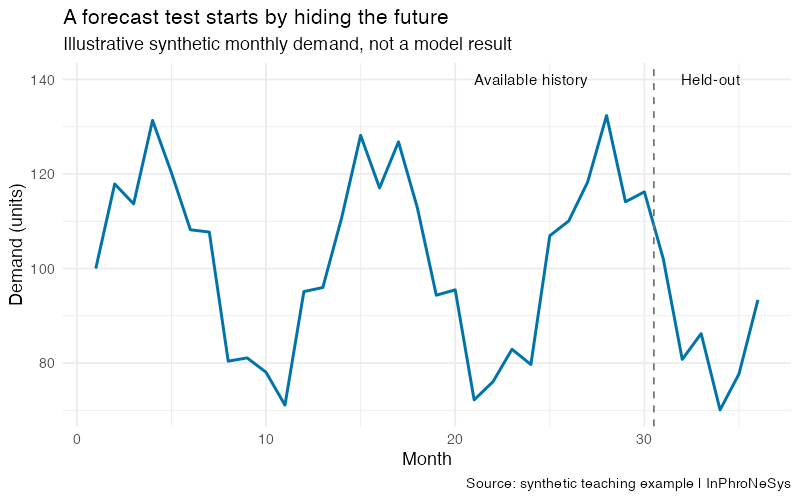
How to test the promise without buying the hype
Before declaring a winner in your business, run a fair race:
- Define the decision. Choose the products, locations, forecast frequency, and horizon that matter operationally. A one-week replenishment forecast and a twelve-month capacity forecast are different assignments.
- Choose serious baselines. Include seasonal naive where appropriate, a suitable statistical method, and the current production forecast. For intermittent demand, include a relevant intermittent-demand benchmark. Simple models deserve a seat at the table.
- Backtest across multiple historical cutoffs. At each cutoff, give every model only the history and future inputs that would have been available then. Preserve old promotion plans and weather forecasts if you want a realistic test.
- Compare like with like. Use the same series, horizons, data treatment, and evaluation periods. Report accuracy by product segment and horizon, not just one grand average. Check bias and interval calibration as well as point error.
- Measure the business consequences. Simulate or pilot decisions using realistic lead times and constraints; examine service, inventory, planner workload, and cost. A lower forecast error does not automatically mean a better operating outcome.
- Examine the exceptions. Stockouts, product launches, discontinuations, data revisions, promotions, and structural breaks deserve their own review. Keep a final untouched test period for the models and settings you select.
And document model version, license, inference cost, data handling, and any known pre-training overlap. The winner should survive both the scoreboard and the meeting with the people who have to operate it.
I have seen why that discipline matters. In my earlier forecasting horse race, an ETS and ARIMA combination beat the tested Chronos-Bolt models on mean MASE across 148 Australian retail series. That was one dataset, one setup, and an earlier model generation. It says nothing conclusive about Timestral or TiRex-2. It does say that an AI model should earn its place against the alternatives.
Europe’s opportunity
Europe has deep industrial experience in manufacturing, logistics, energy, and engineering. Those sectors generate the kind of sequential data that forecasting models are designed to use. That is an opportunity, not an automatic competitive advantage: data quality, deployment, talent, investment, and real operational adoption still have to follow.
Still, it is refreshing to see European teams competing on a problem that matters far beyond the next chatbot demo. A better forecast will not solve a broken supplier relationship or make uncertainty disappear. It can give a planner a better starting point, make a capacity conversation more honest, and help a business prepare for more than one possible future.
The world can keep watching the contest to write better refrigerator sonnets. Meanwhile, Europe has some interesting contenders working on how many refrigerators we might actually need.
Model information and benchmark claims checked 1 November 2026. Forecasting performance is task-dependent; no new model test was conducted for this article.
Interactive time-series AI leaderboard
Compare the top 10 foundation-model entries across three benchmark metrics in Mistral’s published comparison, and see how European contenders compare with international models.
Interactive Dashboard
Explore the data yourself. Adjust the parameters and watch the results update in real time.
Show R code for the illustrative chart
tryCatch(source("Scripts/theme_inphronesys.R"), error=function(e) {
  message("Shared theme font unavailable; using local sans font and brand blue.")
  iph_colors <<- list(blue="#0073aa")
  theme_inphronesys <<- function(...) ggplot2::theme_minimal(base_size=13)
})
library(ggplot2)
d <- data.frame(month=1:36, demand=100+25*sin(2*pi*(0:35)/12)+8*sin((0:35)*2.4))
p <- ggplot(d,aes(month,demand))+geom_line(color=iph_colors$blue,linewidth=1)+geom_vline(xintercept=30.5,linetype="dashed",color="grey45")+annotate("text",x=24,y=140,label="Available history",size=4)+annotate("text",x=33.5,y=140,label="Held-out",size=4)+labs(title="A forecast test starts by hiding the future",subtitle="Illustrative synthetic monthly demand, not a model result",x="Month",y="Demand (units)",caption="Source: synthetic teaching example | InPhroNeSys")+theme_inphronesys()
ggsave("https://inphronesys.com/wp-content/uploads/2026/11/tsfm_forecast_test.png",p,width=8,height=5,dpi=100,bg="white")
Created with AI assistance under human editorial control.
Leave a Reply